
Origins & Development

The Lykoi is one of the youngest recognized cat breeds in the world, with a documented history that begins only in the early 2010s. The breed traces its roots to two unrelated litters of domestic shorthair kittens that displayed an unusual, partially haired coat. The first pair was discovered in Virginia in 2010 and adopted from a rescue by Patti Thomas, who would go on to co-found the breed and give it its name. A second, genetically unrelated pair surfaced in Tennessee in 2011 and came to the attention of Dr. Johnny Gobble, a veterinarian based in Vonore.

Recognizing that the cats might represent something genuinely new rather than simply being sickly or poorly bred animals, the founders committed to rigorous study. Because Patti Thomas did not have the time or resources to carry out the extensive genetic and health testing required to establish a breed, she entrusted her cats to Dr. Johnny Gobble and his wife, Brittney Gobble, who had both the veterinary background and the dedication to pursue formal recognition.

The pivotal moment came when Johnny Gobble bred two of the unrelated cats together. The resulting litter — the first intentionally bred Lykoi, born in September 2011 — confirmed that the distinctive coat was heritable rather than accidental. This proved the trait was a stable gene that could be passed to offspring, the essential foundation on which any new breed must be built.

From there, the Gobbles began a careful outcrossing program using solid black domestic shorthair cats. Because one of the founding mothers was a black domestic, that color became central to early breeding. The outcrossing served two purposes: it expanded the gene pool to avoid the dangers of inbreeding, and it helped establish consistent type while keeping the breed genetically healthy.

A Natural Mutation

Unlike many modern cat breeds that arise from deliberate crosses between existing pedigrees, the Lykoi is the product of a spontaneous, naturally occurring mutation. The gene appears at random in the feral cat population and has been documented independently in several parts of the United States and Canada, as well as elsewhere in the world. This means the Lykoi was not engineered — it was discovered.

When the first cats appeared, their patchy coats and bare faces led many to assume they were sick, suffering from mange, or the result of crossing with hairless breeds such as the Sphynx or the Devon Rex. To settle the question, the founders sought scientific confirmation. Feline geneticist Dr. Leslie Lyons tested the cats and confirmed that they did not carry Sphynx or Devon Rex genetics, and veterinary examination ruled out disease and infection as the cause of their appearance.

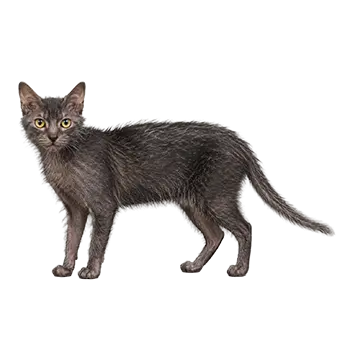
The mutation affects the hair follicles, leaving the cats without a true undercoat and unable to grow a full coat of hair. The result is a roan pattern — a mix of colored and unpigmented hairs scattered throughout the coat — combined with hairless areas around the eyes, nose, muzzle, and chin, and on the legs and paws. The Lykoi is the only known cat breed to display this roaning pattern.

Because the gene is recessive, both parents must carry it for kittens to express the full Lykoi look. This genetic reality shaped the entire breeding strategy, requiring patience and careful pairing. To this day, naturally mutated Lykoi continue to appear in feral colonies, and breeders sometimes incorporate these cats to keep the gene pool diverse and robust.

Cultural Symbolism — The Werewolf Cat

The name Lykoi comes from the Greek word for wolf, and the breed is widely known by its evocative nickname: the werewolf cat. The comparison is not merely marketing. The hairless mask around the eyes and muzzle, the grizzled roan coat, and the way bare skin shows through sparse fur all combine to give the Lykoi a distinctly lupine, almost mythical appearance.

This wolfish look taps into a deep well of folklore. Across many cultures, the werewolf has long symbolized the boundary between the wild and the domestic, the tame and the untamed. A small house cat that resembles a tiny werewolf carries an irresistible novelty — it is at once a familiar companion animal and a creature that looks plucked from a gothic tale.

The breed's admirers have leaned into this imagery, and it has played a significant role in the Lykoi's rapid fame. Where many new breeds struggle for years to attract attention, the Lykoi's striking, story-ready appearance gave it instant cultural traction, particularly in the visual world of the internet.

It is worth noting that the resemblance is purely cosmetic. The Lykoi is fully domestic, descended entirely from ordinary house cats, and has no wild ancestry whatsoever. The werewolf association is a charming coincidence of appearance rather than any reflection of temperament or lineage.

Breed Clubs & Standards

Establishing a new breed within the cat fancy is a long, deliberate process, and the Lykoi's progress through the registries reflects that. After the breed name was settled, Dr. Gobble submitted documentation to The International Cat Association (TICA) in 2012, where the Lykoi was first accepted for experimental, registration-only status by unanimous consent.

The breed then advanced step by step through TICA's structured ladder. It was passed to Preliminary New Breed status in 2014, promoted to Advanced New Breed in 2015, and finally elevated to full Championship status, allowing Lykoi to compete against established breeds beginning in May 2017. Within TICA's championship competition, the black roan coloration is the recognized show standard, though Lykoi occur in a range of colors and patterns.

Recognition has continued to broaden beyond TICA. The Cat Fanciers' Association (CFA), one of the world's largest registries, accepted the Lykoi under miscellaneous status in 2018 and has since advanced the breed within its competitive classes. In the United Kingdom, the Governing Council of the Cat Fancy (GCCF) granted the Lykoi preliminary recognition in 2020.

Breed clubs and dedicated breeders around the world now coordinate to maintain health, genetic diversity, and consistent type. Their standards emphasize the breed's signature roan coat, the hairless mask, a wedge-shaped head, and a lithe, athletic body free of excessive bulk. Ongoing collaboration among breeders remains essential to a breed still early in its development.

The Breed Today

More than a decade after its founding, the Lykoi has moved from curiosity to established breed, though it remains relatively rare. Kittens are in demand, waiting lists at reputable catteries are common, and the breed's distinctive look continues to draw new admirers. Its scarcity is partly a function of the recessive gene and the careful breeding required to produce healthy, well-typed cats.

Health-wise, the Lykoi is generally regarded as a robust breed with few breed-specific concerns, a reflection of the conscientious outcrossing program that underpinned its development. Because the breed is still young, breeders continue to monitor for any emerging issues and to prioritize genetic diversity over rapid expansion.

In temperament, today's Lykoi has earned a reputation as an affectionate, intelligent, and energetic companion. Owners often describe them as dog-like in their loyalty and playfulness, with a strong prey drive and a problem-solving curiosity. They tend to bond closely with their families, which has helped the breed find a devoted following.

The Lykoi also occupies an interesting place in the broader cat community as a living example of natural genetic novelty being shepherded responsibly into the pedigree world. For many enthusiasts, part of the appeal is knowing that this remarkable cat began not in a breeding plan but as a quiet surprise in the feral population.

Notable Individuals & Founding Cats

The story of the Lykoi is inseparable from the people and the original cats who shaped it. Patti Thomas holds the distinction of co-founding and naming the breed after recognizing that the unusual kittens she adopted were something worth preserving. Her decision to entrust the project to others who could see it through was itself a pivotal act in the breed's history.

Dr. Johnny Gobble and Brittney Gobble are credited as the breed's principal architects. As a practicing veterinarian, Johnny Gobble brought the medical rigor needed to rule out disease and document the mutation, while the couple's sustained breeding program turned a chance discovery into a recognized breed. Their first intentionally bred litter stands as the foundational moment from which all pedigreed Lykoi descend.

Scientific validation came through the work of geneticist Dr. Leslie Lyons, whose DNA testing confirmed that the Lykoi represented a genuinely new mutation rather than a known hairless gene. This independent confirmation gave the breed the credibility it needed to be taken seriously by the registries.

Beyond these key figures, the modern Lykoi gene pool owes much to the anonymous feral cats from across the United States, Canada, and beyond whose natural mutations were carefully incorporated into breeding programs. Every pedigreed Lykoi alive today can ultimately trace its lineage back to these feral foundation cats — a reminder that the breed's most notable individuals include the ordinary street cats who carried an extraordinary gene.

Always consult a qualified professional before making any health-related decisions. This content is provided for informational reference only and should not replace professional guidance specific to your animal.