
Origins & Early History

The Dragon Li, known in its homeland as Li Hua Mao or Li Hua, is widely considered to be the oldest naturally occurring domestic cat breed native to China. Its ancestry is believed to trace directly to the Chinese mountain cat, Felis silvestris bieti, a subspecies of wildcat found across the arid steppes and mountainous terrain of northwestern China. Unlike many Western cat breeds that were developed through deliberate selective breeding programs, the Dragon Li is thought to have undergone a process of natural self-domestication over thousands of years as wild cats gravitated toward early Chinese agricultural settlements.

Archaeological evidence from sites across China suggests that cats began associating with human communities as early as 5,300 years ago in the farming villages of Shaanxi and Henan provinces. Grain storage attracted rodents, and wildcats followed, forming a mutually beneficial relationship with human settlers. While the precise genetic relationship between these ancient settlement cats and the modern Dragon Li is still being studied, the breed's physical resemblance to Felis bieti and its retention of strong hunting instincts suggest a closer link to its wild ancestor than most other domestic breeds maintain.

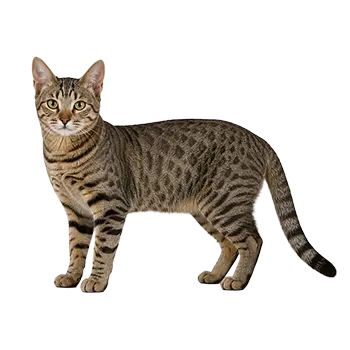
The breed's common name in Chinese, Li Hua Mao, translates roughly to fox flower cat, a reference to the distinctive mackerel tabby pattern that marks its coat. This pattern, characterized by narrow, unbroken stripes running vertically down the body with a characteristic dark dorsal stripe and an M-shaped forehead marking, is one of the oldest known coat patterns in domestic cats. The name Dragon Li, used primarily in English-speaking countries, was adopted when the breed was presented to international audiences and reflects the cultural prestige associated with the dragon in Chinese tradition.

For centuries, the Dragon Li existed as a common village and farm cat throughout much of eastern and central China. It was not regarded as a pedigree breed but rather as an essential working animal valued for its exceptional mousing ability and hardy constitution. This long period of unmanaged natural selection, shaped by the demands of rural Chinese life rather than by show ring aesthetics, produced a robust and self-sufficient cat whose physical characteristics have remained remarkably stable across many generations.

Historical Roles

Throughout Chinese history, the Dragon Li and its ancestors fulfilled a role that was both practical and deeply embedded in the rhythms of agricultural life. In a civilization built on rice cultivation and grain storage, the cat's ability to control rodent populations was not merely convenient but economically vital. Rats and mice posed an existential threat to stored harvests, and a capable mousing cat could mean the difference between a household surviving the winter and facing starvation. The Dragon Li, with its powerful build, keen senses, and tireless hunting drive, was ideally suited to this role.

Beyond the farmstead, cats resembling the modern Dragon Li served in silk production facilities, where they protected silkworm cocoons from rodent damage. The silk trade was one of imperial China's most important industries, and the economic value of cats in these settings was substantial. Historical texts from the Tang dynasty period reference the keeping of cats in silk workshops, and while breed-specific identification at that distance is impossible, the brown mackerel tabby pattern described in some accounts is consistent with the Dragon Li's appearance.

In traditional Chinese medicine and folk belief, cats were sometimes credited with protective spiritual qualities. The presence of a cat in a household was thought by some to ward off evil spirits, and the cat's nocturnal habits and reflective eyes contributed to an aura of supernatural guardianship. While these beliefs were not unique to the Dragon Li specifically, the breed's prevalence in Chinese homes meant that it was most commonly the cat occupying this symbolic role in everyday life.

The Dragon Li also played an informal role in the social fabric of village communities. Cats moved freely between households, and a particularly skilled mouser might be shared among neighbors or gifted to a family struggling with a rodent infestation. This communal relationship between people and their cats differed markedly from the Western model of individual pet ownership and reflected a broader Chinese cultural attitude toward domestic animals as shared community assets rather than strictly personal property.

Cultural Symbolism

The cat occupies a complex and sometimes contradictory place in Chinese cultural symbolism, and the Dragon Li, as the country's most representative native breed, is closely associated with these traditions. In Chinese folklore, cats are frequently depicted as clever, independent creatures whose loyalty must be earned rather than assumed. This characterization aligns closely with the Dragon Li's actual temperament, which tends toward self-reliance and a reserved but affectionate bond with familiar humans.

One of the most enduring pieces of Chinese cat mythology involves the original role of cats in the celestial bureaucracy. According to a popular folk tale, cats were originally appointed to govern the world but proved too fond of sleeping and playing to fulfill their duties, whereupon the responsibility was transferred to humans. This story, while humorous, reflects a genuine cultural ambivalence toward the cat as a creature that exists alongside human society but refuses to be fully subordinated to it. The Dragon Li's independent streak makes it a particularly apt living embodiment of this mythological tradition.

The breed also carries associations with prosperity and good fortune in certain regional traditions. The beckoning cat figurine, or maneki-neko, though Japanese in its most familiar form, has roots in broader East Asian cat symbolism that includes Chinese antecedents. Some Chinese folk art traditions depict tabby cats in association with abundance, fertility, and the protection of household wealth. The Dragon Li's golden-brown coloring and alert, watchful expression lend themselves naturally to these positive associations.

In contemporary Chinese culture, the Dragon Li has taken on additional symbolic weight as a marker of national heritage. As interest in preserving indigenous Chinese animal breeds has grown, the Dragon Li has been embraced by cultural commentators and breed advocates as a living link to China's agrarian past. The breed's recognition by the Cat Aficionado Association in 2010 was celebrated in Chinese media as an acknowledgment of the country's contribution to the global catalog of pedigree cat breeds, elevating the Dragon Li from a common village cat to a point of national pride.

Breed Clubs & Standards

The formal standardization of the Dragon Li is a relatively recent development in the breed's long history. For most of its existence, the breed was defined not by written standards but by the natural selection pressures of rural Chinese life. The movement to establish the Dragon Li as a recognized pedigree breed began in earnest in the early 2000s, when Chinese cat fanciers and breeders organized efforts to document the breed's characteristics and present it to domestic and international registries.

The Cat Aficionado Association, which is the primary cat registry operating in China, played the central role in developing the Dragon Li breed standard. The standard emphasizes the breed's natural, unexaggerated proportions: a muscular body with a broad chest, strong legs, and a rounded head with wide-set ears. The coat must display a clear brown mackerel tabby pattern with distinct striping, and the breed standard specifically notes that the tabby markings should be well-defined and symmetrical. Eye color in the standard ranges from yellow to green, with golden-yellow being the most prized shade.

The Cat Fanciers' Association in the United States accepted the Dragon Li into its miscellaneous class in 2010, allowing the breed to be shown at CFA events though not yet eligible for championship competition. This recognition brought the breed to the attention of Western cat fanciers for the first time in a formal context. However, the Dragon Li remains extremely rare outside of China, and the number of breeders working with the breed in North America and Europe has remained very small.

Breed preservation efforts in China have focused on maintaining the Dragon Li's natural characteristics rather than refining it toward an exaggerated show type. Advocates for the breed emphasize that its value lies precisely in its authenticity as a naturally evolved landrace rather than a human-engineered designer breed. This philosophy has sometimes put Dragon Li proponents at odds with the competitive show culture that tends to reward extreme physical features, but it has also attracted admirers who value the breed's unpretentious working heritage and genetic health.

The Breed Today

The Dragon Li occupies an unusual position in the contemporary cat world. Within China, it is one of the most commonly encountered cat types, as its brown mackerel tabby phenotype is widespread among the general population of free-roaming and domestic cats. However, the number of cats specifically bred and registered as pedigree Dragon Li remains relatively modest, even in its homeland. The distinction between a pedigree Dragon Li and a common Chinese tabby street cat is primarily one of documented lineage and adherence to the breed standard, since the physical type is broadly shared.

Internationally, the Dragon Li is among the rarest recognized cat breeds. Very few breeders outside of China maintain Dragon Li breeding programs, and acquiring a pedigree Dragon Li in North America or Europe typically requires importing directly from Chinese catteries. This scarcity has limited the breed's visibility at international cat shows and has meant that most Western cat enthusiasts are aware of the breed only through online resources and breed databases rather than through firsthand experience.

The breed's natural hardiness and lack of known breed-specific genetic diseases have made it attractive to those interested in robust, low-maintenance companion cats. Dragon Li enthusiasts frequently note that the breed's centuries of natural selection have produced a cat with exceptional physical resilience, strong immune function, and a sound skeletal structure free from the conformational problems that plague some heavily selected breeds. This health profile has drawn attention from veterinary researchers interested in studying the genetic basis of breed-related disease resistance.

Efforts to increase the Dragon Li's international profile continue, driven primarily by Chinese breed clubs and a small but dedicated community of international supporters. Social media has played an important role in introducing the breed to global audiences, with Dragon Li owners in China sharing photographs and information that highlight the breed's distinctive appearance and engaging personality. Whether the Dragon Li will achieve widespread popularity outside its homeland remains uncertain, but its cultural significance within China and its status as the country's preeminent native cat breed appear secure.

Notable Individuals

The Dragon Li's history as a working village cat rather than a pedigreed show breed means that individually documented cats from the breed's early history are essentially nonexistent. Unlike Western breeds, where foundation cats were often named and their pedigrees meticulously recorded from the outset, the Dragon Li's transition from landrace to recognized breed occurred so recently that the breed lacks the deep roster of named historical individuals found in breeds like the Siamese or Persian.

The cats that played the most significant individual roles in the breed's modern history are the foundation animals selected by Chinese breeders during the formal standardization process in the early 2000s. These cats were chosen from among the general population of Chinese tabbies based on their adherence to the emerging breed standard, and their documented pedigrees form the root of all registered Dragon Li lines. While their individual names are primarily known within the Chinese breeding community, their selection represented a pivotal moment in the breed's transformation from an unmanaged population to a standardized breed.

In the show ring, the Dragon Li cats that were exhibited at CFA international shows following the breed's 2010 acceptance attracted considerable attention as ambassadors for a breed that most Western judges and spectators had never encountered. These early show representatives helped establish the breed's profile in the international cat fancy and demonstrated that the Dragon Li could compete in a formal show environment despite its origins as a natural, unrefined breed.

More recently, individual Dragon Li cats have gained followings on Chinese social media platforms such as Weibo and Douyin. These internet-famous cats have helped humanize the breed for a domestic audience that might otherwise view the common Chinese tabby as unremarkable. By showcasing the Dragon Li's intelligence, playfulness, and distinctive expressions, these social media personalities have contributed to growing domestic appreciation for China's native cat breed and have encouraged interest in formal breeding and registration programs.

Always consult a qualified professional before making any health-related decisions. This content is provided for informational reference only and should not replace professional guidance specific to your animal.