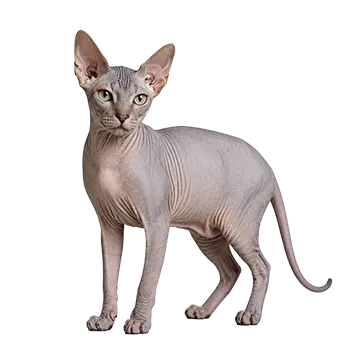

Origins & Development

The Donskoy traces its beginnings to the southern Russian city of Rostov-on-Don, where in 1987 a local resident named Elena Kovaleva rescued a kitten she found being mistreated. The kitten, a female later named Varvara, gradually lost her coat as she matured. At first the hair loss was assumed to be the result of illness, and a series of treatments were attempted without success before it became clear that the baldness was simply part of who she was.

Varvara eventually produced litters in which some kittens were also hairless. Because the trait reappeared in her offspring, breeders concluded it was hereditary rather than a symptom of disease. A professional breeder named Irina Nemikina recognized the potential of these unusual cats and, in the early 1990s, began a deliberate program to establish a consistent and healthy type.

The breed was first known as the Don Sphynx, a name still used in several registries today. The modern name Donskoy references the Don River region from which the founding cats came. Over the following decade, careful outcrossing and selection produced a recognizable breed with a stable temperament, sound conformation, and the wrinkled, warm-to-the-touch skin that defines it.

A Different Kind of Hairlessness

One of the most important facts in the Donskoy's history is genetic, and it sets the breed apart from the better-known Sphynx. The Donskoy's hairlessness is caused by a dominant gene, whereas the Sphynx carries a recessive one. Although the two breeds can look superficially similar, they are genetically distinct and arose independently. Crossing the two is discouraged by most registries precisely because their hairless traits are not the same.

The dominant nature of the Donskoy gene means kittens can be born displaying several different coat states. Breeders commonly describe four: rubber bald cats that are born hairless and stay that way; flocked cats that appear bald but feel like soft suede; velour cats that have a bald patch on the head at birth and may lose more coat over time; and brush cats that carry a wiry, partial coat that may persist into adulthood.

This genetic foundation has shaped the breed's entire development. Understanding that the Donskoy is not simply a Russian Sphynx is essential to appreciating its place in feline history, and it remains a point that breed clubs and educators emphasize to newcomers.

Establishing the Breed

Formal recognition followed the breeding work of the 1990s. The World Cat Federation accepted the Don Sphynx in 1997, giving the breed an internationally acknowledged standard for the first time. The Cat Fanciers' world gradually took notice, and in 2005 The International Cat Association granted the Donskoy championship recognition under that name.

Writing a standard for a breed defined by a dominant, variable gene was a meaningful challenge. Standards had to describe a cat that might be entirely bald or partly coated, while still calling for the breed's signature features: a muscular medium body, large ears, almond-shaped eyes, prominent cheekbones, wrinkled skin, and long, webbed-looking toes that the cats use with notable dexterity.

Recognition by major registries helped distinguish the Donskoy from the Sphynx in the public mind and gave breeders a shared blueprint. It also opened the breed to a wider international community of enthusiasts who continue to refine type and prioritize health and sociability.

Cultural Symbolism

Hairless cats have always carried a certain symbolic weight, and the Donskoy is no exception. Their exposed skin, expressive faces, and warm bodies draw comparisons to ancient sculpture and give them an almost otherworldly presence that admirers find striking and skeptics sometimes find unsettling. For many owners, that very polarization is part of the appeal.

In Russia, the breed carries a quiet sense of national pride as a homegrown creation that achieved international recognition. The Donskoy is sometimes held up as evidence that distinctive, world-class breeds can emerge from chance discoveries rather than long pedigreed lineages.

The breed also feeds a broader cultural fascination with hairless animals as symbols of intimacy and vulnerability. Because a Donskoy seeks out warmth and physical closeness, owners frequently describe the relationship in unusually affectionate terms, and that reputation has become part of the breed's identity in cat-loving communities.

Legacy and the Peterbald

The Donskoy's most significant contribution to feline history may be a breed it helped create. In the mid-1990s, a Russian breeder crossed a Donskoy with an Oriental Shorthair, producing the elegant, hairless-to-coated Peterbald. The Peterbald inherited its hairlessness trait from the Donskoy side of the cross, making the Donskoy a foundational breed in its own right.

This legacy underscores how influential a single chance discovery can become. Within a generation of Varvara, the Donskoy line had not only achieved international recognition but had also seeded an entirely new breed that went on to develop its own following.

For enthusiasts, this connection adds depth to the Donskoy story. A cat once mistaken for a sick stray became the genetic origin point of a recognized lineage, a reminder of how much modern breed history can hinge on careful observation and a willingness to look past appearances.

The Breed Today

Today the Donskoy remains relatively uncommon outside of Russia and Eastern Europe, though dedicated breeders maintain it in many countries. It is still frequently confused with the Sphynx by the general public, and a recurring task for breed clubs is simply explaining the difference between the two.

Modern Donskoy breeding tends to emphasize health, temperament, and responsible management of the dominant hairless gene. Because the cats lack a protective coat, contemporary care guidance focuses on regular bathing, sun protection, and keeping them comfortably warm, and reputable breeders prepare new owners for these practical realities.

Within the cat fancy, the Donskoy occupies a respected niche as a friendly, people-oriented breed with a remarkable origin story. Its community is small but enthusiastic, and the breed continues to win over newcomers who are drawn to its warmth, sociability, and unmistakable appearance.

Always consult a qualified professional before making any health-related decisions. This content is provided for informational reference only and should not replace professional guidance specific to your animal.