
Origins & Development

The Bombay cat is an entirely American creation, born from the vision of breeder Nikki Horner of Louisville, Kentucky, who set out in the late 1950s to produce a domestic cat that resembled a miniature black panther. Horner began crossing sable Burmese cats with black American Shorthairs, carefully selecting for a sleek, jet-black coat, copper eyes, and the muscular yet compact body she envisioned. The breeding program required patience and persistence, as achieving the desired combination of traits across multiple generations proved challenging.

Horner's early crosses did not immediately produce the look she was after. It took several years of selective breeding and refinement before kittens consistently displayed the deep black coat, rounded head, and striking eye color that would come to define the breed. By the mid-1960s, the program was yielding cats that closely matched her original blueprint, and interest from other breeders began to grow.

The Cat Fanciers' Association granted the Bombay provisional status in 1970, and the breed achieved full championship recognition in 1976. The International Cat Association followed with its own recognition shortly thereafter. Throughout the 1970s and 1980s, a small but dedicated group of breeders worked to expand the gene pool while maintaining the Bombay's distinctive appearance. Today the breed remains relatively uncommon compared to its parent breeds, but it has earned a devoted following among cat enthusiasts who prize its unique combination of exotic appearance and affectionate personality.

Historical Roles

Unlike many cat breeds whose histories stretch back centuries and involve practical roles such as pest control or shipboard mousing, the Bombay was developed purely as a companion animal. From its inception, the breed was intended to be a living room panther — a cat whose purpose was to enchant and delight its owners with its striking appearance and warm disposition. This companion-oriented origin has shaped the breed's temperament profoundly, producing cats that are deeply bonded to their human families.

The Bombay's creation coincided with a broader mid-twentieth-century trend in cat breeding that moved away from utilitarian roles and toward aesthetic and temperamental refinement. During this era, breeders across the United States and Europe were developing new breeds designed specifically for the show ring and the home. The Bombay fit neatly into this movement, representing the idea that a domestic cat could embody the beauty and mystique of a wild feline while remaining gentle and sociable.

While the Bombay never served in a traditional working capacity, its role as a bred companion has proven remarkably successful. The breed's reputation for seeking out human contact, following owners from room to room, and adapting well to household life has made it a valued therapy and emotional support animal in more recent decades. Bombays have found their way into programs that pair cats with individuals dealing with anxiety, depression, and loneliness, capitalizing on the breed's innate desire for closeness.

Cultural Symbolism

Black cats have occupied a complex and contradictory place in human culture for millennia, and the Bombay — with its uniformly jet-black coat — inevitably inherits some of that symbolic weight. In many Western traditions, black cats were long associated with superstition, witchcraft, and bad luck, a prejudice that has historically made black cats harder to adopt from shelters. The Bombay breed, however, has played a quiet role in challenging these stereotypes by presenting the black cat as elegant, refined, and desirable.

In other cultural contexts, black cats carry strongly positive associations. In Japanese folklore, black cats are considered good luck and protectors against evil. In British and Scottish traditions, a black cat crossing one's path is often viewed as a sign of good fortune. The Bombay's panther-like beauty has helped reinforce these more favorable cultural readings, and breed enthusiasts have long positioned the Bombay as evidence that black cats are among the most beautiful felines in the world.

The breed's name itself carries cultural resonance. Nikki Horner chose the name "Bombay" as an evocation of the black leopard of India, linking the breed to the exotic wildlife of the subcontinent. This naming choice gave the breed an air of mystery and sophistication that has persisted throughout its history. The association with the Indian black leopard, while purely aesthetic rather than genetic, has helped the Bombay carve out a distinctive identity in the crowded world of pedigreed cats.

Within the cat fancy community, the Bombay has become something of an ambassador for black cats broadly. Breed clubs and rescue organizations have used the Bombay's popularity to advocate for the adoption of black cats of all breeds, particularly around Halloween when black cats are sometimes at heightened risk. This advocacy role has added a layer of cultural significance to the breed that extends well beyond the show ring.

Breed Clubs & Standards

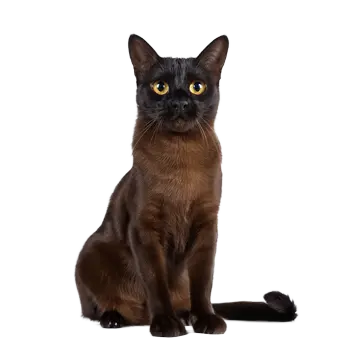
The Bombay breed standard emphasizes the cat's resemblance to a miniature panther. The Cat Fanciers' Association standard calls for a medium-sized, muscular cat with a rounded head, full face, and wide-set ears. The coat must be jet black to the root, with a close-lying, satin-like texture that produces a patent-leather sheen. Eyes should be deep copper to gold, set wide apart and perfectly round. The overall impression should be one of sleek, compact power combined with surprising weight for the cat's size.

The International Cat Association maintains a similar standard but allows for slightly broader interpretation of head shape and body type. Both organizations penalize any deviation from the solid black coat, including rust-tinted fur, white locket markings, or tabby ghost striping. The Bombay's standard is notably strict compared to many breeds, reflecting the very specific aesthetic vision that drove its creation.

Breed clubs dedicated to the Bombay exist within the larger cat fancy organizations rather than as independent entities. Within the CFA and TICA, Bombay breed councils and committees advocate for the breed, mentor new breeders, and help judges understand the finer points of evaluating Bombays in competition. These groups also play an important role in monitoring the breed's genetic health, encouraging outcrossing to Burmese and American Shorthairs when necessary to maintain vigor.

The Bombay's relatively small breeder community has fostered a close-knit culture in which knowledge and mentorship are shared freely. New breeders are typically guided through their first litters by experienced mentors, and breed-specific social media groups and online forums provide ongoing support and education. This collaborative spirit has helped maintain the breed's quality even as its overall numbers remain modest.

The Breed Today

The Bombay remains a relatively rare breed in the twenty-first century, consistently ranking in the lower half of CFA registration statistics. This scarcity is partly by design — the breed's exacting standard and small gene pool mean that responsible breeders produce limited numbers of kittens each year. Waitlists for Bombay kittens from reputable catteries can stretch to a year or more, and prospective owners are often screened carefully to ensure good matches.

Despite its rarity in terms of registered pedigree cats, the Bombay's influence extends beyond the breed itself. The striking appearance of jet-black cats in shelters is frequently compared to the Bombay, and the breed's popularity has helped raise the profile of black cats in general. Some rescue organizations have noted that awareness of the Bombay breed has contributed to increased adoption interest in black domestic cats, helping to counteract the longstanding "black cat bias" documented in shelter statistics.

In the show ring, Bombays continue to compete successfully in both CFA and TICA events. The breed's dramatic appearance — a gleaming black coat against luminous copper eyes — makes it a natural standout in the judging ring, and Bombays have earned top honors at national and international shows. The breed's friendly, unflappable temperament also serves it well in the show environment, as Bombays tend to handle the noise and handling of competition with characteristic calm.

Looking ahead, the Bombay breed community faces the ongoing challenge of maintaining genetic diversity within a small population. Breeders continue to use carefully planned outcrosses to Burmese and, less frequently, black American Shorthairs to introduce fresh genetic material. Health testing for conditions common to the breed's parent lines, including hypertrophic cardiomyopathy and craniofacial defects, has become standard practice among conscientious breeders.

Notable Individuals

While the Bombay breed has not produced the same number of individually famous cats as some more common breeds, several Bombays have left their mark on the breed's history. Among the most significant is Shawnee Road of Fame, one of the early Bombays bred by Nikki Horner that helped establish the breed's type and gain recognition from cat registries. Road of Fame's show career in the 1970s demonstrated that the breed could compete at the highest levels and helped generate the interest necessary for CFA championship acceptance.

In the decades since, individual Bombays have periodically risen to prominence within the cat fancy. Grand champions and regional winners have helped keep the breed visible in competition, and their show records serve as benchmarks for breeders working to maintain and improve the breed standard. Each generation of successful show cats represents the culmination of years of careful breeding decisions.

Beyond the show ring, Bombays have gained attention through their roles as therapy cats and social media personalities. The breed's photogenic black coat and expressive copper eyes translate well to photography and video, and several Bombays have developed significant online followings. These internet-famous Bombays have introduced the breed to audiences who might never encounter one at a cat show, broadening awareness and appreciation.

Nikki Horner herself remains the most notable individual associated with the breed. Her decades-long dedication to creating and refining the Bombay earned her lasting recognition within the cat fancy community. Horner's vision of a domestic cat that captured the essence of a wild black panther in a gentle, companionable package has proven remarkably durable, and the breed she created continues to embody that vision more than sixty years after its inception.

Always consult a qualified professional before making any health-related decisions. This content is provided for informational reference only and should not replace professional guidance specific to your animal.