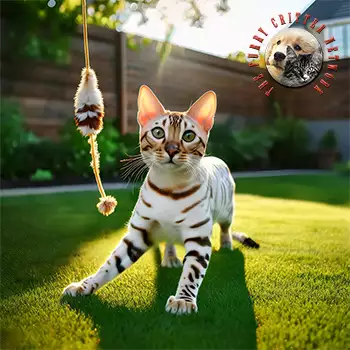

The Bengal cat owes its existence to deliberate crosses between domestic cats and the Asian leopard cat (Prionailurus bengalensis), a small wild feline native to South and Southeast Asia. The earliest documented hybridizations took place in the 1960s, but it was Jean Sudgen Mill of California who pursued the project with the greatest determination. Mill acquired her first hybrid female in 1963 and, after a hiatus of several years, resumed her breeding program in the late 1970s with fresh wild-domestic crosses obtained through a genetics research project at the University of California, Davis.
Mill's goal was to create a domestic cat that carried the vivid rosettes and glitter of its wild ancestor while possessing the temperament suitable for life in a family home. She selected domestic partners carefully — Egyptian Maus, Burmese, Abyssinians, and various street cats from India — to introduce desired coat patterns, muscular builds, and sociable dispositions. Each successive generation moved the breed further from its wild roots: first-generation (F1) hybrids were essentially half wild, while fourth-generation (F4) cats and beyond were considered fully domestic in behavior.
By the mid-1980s, a small but passionate network of breeders across the United States had joined Mill's effort. They exchanged breeding stock, compared notes on temperament screening, and began petitioning cat registries for recognition. The pace of the breed's genetic stabilization was remarkable; within roughly two decades, Bengals had moved from experimental crosses to a recognizable breed with consistent type.
The name "Bengal" was derived from the taxonomic name of the Asian leopard cat rather than from the Bengal tiger, a point that breeders have long clarified. The choice underscored the breed's scientific lineage and set it apart from any association with large, dangerous felids.