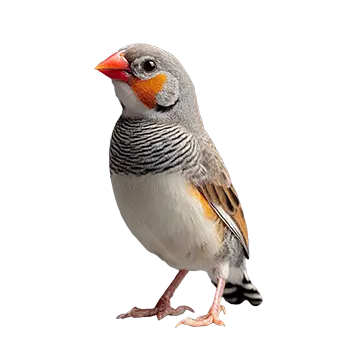

The Zebra Finch has earned a distinctive place in the world of nature documentary filmmaking, though its appearances tend to be driven by its scientific importance rather than the visual spectacle associated with larger or more colorful species. Major natural-history series produced by the BBC, National Geographic, and PBS have featured the Zebra Finch in segments focused on vocal learning, brain science, and the parallels between birdsong and human speech. These programs have introduced millions of viewers to the idea that a small, seemingly unremarkable finch can offer profound insights into the biology of language.
David Attenborough's landmark series have referenced the Zebra Finch and its relatives in episodes exploring the mechanics of bird communication. The species typically appears in the context of laboratory footage or aviary sequences, illustrating how young males learn songs from adult tutors in a process that mirrors the way human infants acquire speech. This narrative framing — the Zebra Finch as a window into our own neurobiology — has proven consistently compelling to documentary audiences and has helped elevate the bird's public profile well beyond the avicultural community.
Television science programs aimed at general audiences have also drawn on Zebra Finch research. Shows covering topics in neuroscience, genetics, and animal behavior frequently use the species as a case study, presenting footage of song spectrograms, brain-imaging studies, and behavioral experiments. The visual simplicity of the Zebra Finch — a small bird perched on a dowel, singing into a microphone — has become almost iconic in science television, a shorthand for the concept of animal cognition research.
The species' documentary presence extends to shorter-format educational content as well. University-produced lecture series, science-communication channels, and museum exhibit films have all employed Zebra Finch footage to illustrate principles of genetics, developmental biology, and evolution. In these contexts the bird serves primarily as a pedagogical tool, its familiarity and accessibility making complex scientific concepts more approachable for non-specialist audiences.