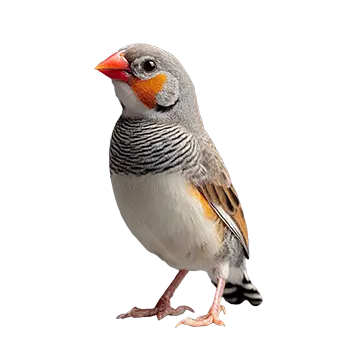

The Zebra Finch (Taeniopygia guttata) is a small passerine bird native to the arid and semi-arid grasslands, open woodlands, and scrublands of Australia. Its range covers the vast majority of the Australian continent, from the interior deserts and spinifex plains of the outback to coastal margins and agricultural clearings. A separate subspecies, Taeniopygia guttata guttata, inhabits the Lesser Sunda Islands of Indonesia, particularly Timor, Flores, and surrounding islets, where it occupies similarly dry and open habitats. The nominate Australian subspecies, Taeniopygia guttata castanotis, is by far the more numerous and widespread of the two.
In the wild the Zebra Finch has adapted to some of the harshest environments inhabited by any passerine. Inland Australia can experience months without rainfall, temperatures that regularly exceed 40 degrees Celsius, and vast distances between reliable water sources. The Zebra Finch meets these challenges through a suite of physiological and behavioral adaptations. It can survive on metabolic water extracted from dry seeds when free-standing water is scarce, and it tends to remain nomadic, tracking unpredictable rainfall events across enormous distances rather than maintaining fixed territories. When conditions are favorable, pairs can breed repeatedly within a single season, rapidly capitalizing on temporary abundance.
The species' preferred habitats typically feature scattered trees or shrubs that provide nesting sites and shade, coupled with open ground where grass seeds — the staple of the Zebra Finch diet — can be foraged efficiently. In agricultural landscapes the birds have proven remarkably adaptable, readily exploiting grain crops, stock-watering troughs, and the shade of farm buildings. This tolerance of modified habitats has helped the species maintain robust populations even as much of Australia's interior has been reshaped by pastoral agriculture.
Fossil and genetic evidence places the estrildid finches, the family to which the Zebra Finch belongs, as having diversified across Australasia and Southeast Asia over millions of years. While the precise timeline of Taeniopygia's divergence from related genera remains an area of active study, it is clear that the Zebra Finch lineage has occupied the Australian continent for a considerable evolutionary span, long enough to develop the drought-adapted physiology and opportunistic breeding strategy that distinguish it from its tropical forest-dwelling relatives.