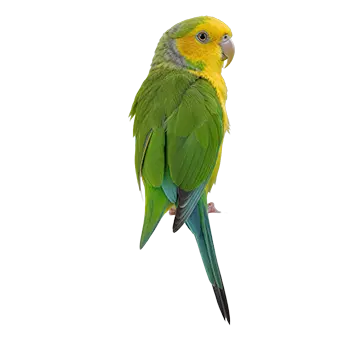

Origins & Natural Habitat

The Yellow-Faced Parrotlet (Forpus xanthops) is endemic to a remarkably narrow geographic range in northern Peru, concentrated along the upper Maranon River valley and its tributaries in the departments of Cajamarca and Amazonas. This arid intermontane valley, carved between the eastern and western cordilleras of the Andes, presents a landscape of dry scrub, cactus-studded hillsides, and scattered patches of riparian woodland that stands in stark contrast to the lush cloud forests found at higher elevations on either side. It is within this semi-arid corridor, typically between 600 and 2,745 meters in elevation, that the Yellow-Faced Parrotlet has carved out its ecological niche.

The species favors habitat where dry thorn scrub transitions into areas of scattered trees, particularly in zones where seasonal watercourses support pockets of denser vegetation. Forpus xanthops feeds primarily on seeds, berries, and blossoms gleaned from native shrubs and small trees, and its diet appears closely tied to the seasonal availability of food resources in this water-limited environment. Small flocks of six to forty or more individuals move through the landscape in tight, fast-flying groups, their high-pitched calls carrying across the rocky terrain as they travel between feeding and roosting sites.

The Maranon Valley itself is one of the most biogeographically distinctive corridors in South America. Its deep, rain-shadowed floor creates conditions more reminiscent of coastal deserts than the surrounding Andean slopes, and the valley harbors a disproportionate number of endemic species across multiple taxa. The Yellow-Faced Parrotlet shares this isolated habitat with other range-restricted birds, reptiles, and plants, making the valley a recognized center of endemism and a priority area for conservation biologists studying the Andes.

Despite the relative aridity of its core habitat, the species is not entirely confined to the driest zones. Observations have recorded Yellow-Faced Parrotlets utilizing edges of cultivated areas, gardens, and semi-open agricultural land adjacent to villages, suggesting a degree of adaptability to human-modified landscapes. Nevertheless, the overall extent of suitable habitat remains limited, and the species' restricted range has been a defining feature of its biology and its vulnerability since it first came to scientific attention.

Scientific Discovery & Classification

The Yellow-Faced Parrotlet was formally described by Philip Lutley Sclater in 1858, based on specimens collected from the Maranon Valley region. Sclater, one of the most prolific ornithological taxonomists of the Victorian era and a longtime secretary of the Zoological Society of London, placed the bird within the genus Forpus, recognizing its affinities with other small Neotropical parrotlets. The specific epithet xanthops derives from the Greek words xanthos, meaning yellow, and ops, meaning face, a direct reference to the species' most conspicuous plumage feature.

At the time of its description, the Yellow-Faced Parrotlet was known from only a handful of specimens, and relatively little was understood about its range or natural history. The remoteness of the Maranon Valley and the difficulty of travel through the Andean interior during the 19th century meant that ornithological expeditions to the region were infrequent and often brief. As a result, the species remained poorly documented for decades after its initial description, with much of what was known about it drawn from museum skins rather than field observations.

Taxonomic understanding of the genus Forpus has been refined considerably since Sclater's time. Modern molecular phylogenetic studies have clarified relationships among the seven recognized Forpus species, placing the Yellow-Faced Parrotlet as a distinct lineage within the genus. Its vivid yellow facial plumage and comparatively large size relative to other parrotlets are considered derived traits, and genetic analyses suggest that Forpus xanthops diverged from its closest relatives during a period of geographic isolation driven by the geological uplift and deepening of Andean valleys.

The species' taxonomic history reflects broader patterns in Neotropical ornithology, where many range-restricted species were described from limited material during the great age of specimen collecting, then remained obscure for long periods before modern fieldwork and molecular tools brought renewed attention. For the Yellow-Faced Parrotlet, the past several decades have seen a significant increase in observational data from researchers and birding expeditions, filling gaps in knowledge about its ecology, population size, and conservation status that persisted for over a century after Sclater's original publication.

Cultural Significance in the Andean Region

Within the communities of northern Peru's Maranon Valley, the Yellow-Faced Parrotlet has long been a familiar presence. Local residents in towns and villages along the river corridor have coexisted with the species for generations, and the birds' noisy, gregarious flocks are a recognizable element of the daily soundscape. While the Yellow-Faced Parrotlet does not occupy the same prominent place in Andean mythology as larger, more widespread parrots and macaws, it is nonetheless woven into the fabric of local rural life in ways that are culturally meaningful.

In some communities, small parrots including parrotlets have historically been kept as informal household companions, captured from wild flocks and maintained in simple enclosures or allowed to perch freely within homes. This practice, while raising modern conservation concerns, reflects a longstanding cultural tradition of close interaction with local wildlife that predates formal aviculture. The Yellow-Faced Parrotlet's relatively calm temperament and attractive coloration made it a favored choice for this type of casual keeping, and older residents of Maranon Valley villages have recounted childhood memories of hand-tamed birds that became familiar fixtures in family homes.

The broader cultural landscape of Peru places parrots among the most symbolically resonant birds in the national imagination. Pre-Columbian civilizations including the Moche, Chimu, and Inca incorporated parrot imagery into ceramics, textiles, and metalwork, and the brightly colored feathers of various parrot species were traded across vast distances as items of prestige and ritual significance. While the Yellow-Faced Parrotlet's small size and restricted range likely limited its role in these ancient trade networks compared to larger macaw species, the deep cultural association between parrots and notions of color, voice, and vitality in Andean societies provides a broader context for understanding the species' place in regional culture.

In recent decades, growing awareness of the Yellow-Faced Parrotlet's vulnerable conservation status has introduced a new dimension to its cultural significance. Local and international conservation organizations working in the Maranon Valley have engaged communities in education and stewardship programs that frame the parrotlet as a source of regional pride and ecological identity. This shift has begun to transform the species from a familiar but overlooked neighbor into a recognized symbol of the valley's unique natural heritage.

Rise in International Aviculture

The Yellow-Faced Parrotlet first entered the international avicultural scene in significant numbers during the latter half of the 20th century, as the broader hobby of parrot keeping expanded and collectors sought out unusual and visually striking species. The bird's vivid yellow facial plumage, which extends from the forehead and lores across the cheeks and throat, sets it apart from the more uniformly green appearance of many other Forpus species and immediately attracted the attention of breeders and enthusiasts looking beyond the more commonly available Pacific and Green-Rumped Parrotlets.

Early importations of Yellow-Faced Parrotlets into Europe and North America were relatively small in scale, and the species developed a reputation as somewhat more delicate and challenging to establish in captivity than its more widely bred congeners. Breeding pairs required careful management of diet, temperature, and nesting conditions, and initial reproductive success rates were inconsistent. These difficulties contributed to the species' status as a specialist bird, sought after by experienced aviculturists rather than casual pet owners, and kept its price and prestige within the hobby at a premium level.

By the 1990s and early 2000s, dedicated breeders in Europe, particularly in the Netherlands, Germany, and Belgium, had achieved more consistent captive breeding results with the Yellow-Faced Parrotlet. Refinements in husbandry practices, including improved understanding of the species' nutritional requirements and the provision of appropriate nesting substrates, led to greater reproductive output and the gradual establishment of self-sustaining captive populations. North American aviculturists followed a similar trajectory, with small but committed breeding communities developing in the United States and Canada.

The species' rise in aviculture has had complex implications for its conservation. On one hand, successful captive breeding has reduced demand for wild-caught individuals and created a genetic reservoir outside the bird's native range. On the other hand, the high market value of Yellow-Faced Parrotlets has at times incentivized illegal trapping, particularly during periods when captive-bred birds were in short supply. The interplay between avicultural interest and conservation pressure remains an ongoing theme in the species' modern history, and responsible breeders have increasingly aligned their practices with broader conservation goals.

Conservation History & Milestones

The conservation history of the Yellow-Faced Parrotlet is closely linked to the broader story of habitat loss and wildlife trade regulation in Peru and across the Neotropics. As early as the 1980s, field researchers began noting that the species' limited range and small population size made it inherently vulnerable to environmental pressures. Habitat degradation from overgrazing by livestock, expansion of small-scale agriculture, and the cutting of native vegetation for firewood and fencing were identified as ongoing threats within the Maranon Valley, reducing the availability of feeding and nesting habitat for the parrotlets.

The species was listed on Appendix II of CITES (the Convention on International Trade in Endangered Species) as part of the broader listing of Psittaciformes, which regulates international commercial trade in parrots. This listing provided a framework for monitoring and controlling exports, though enforcement in remote Andean valleys proved challenging. Peru subsequently enacted national legislation restricting the capture and sale of native wildlife, adding a domestic legal layer to the species' protection. Despite these measures, illegal trapping for the pet trade continued to pose a threat, particularly during the 1990s when demand from international collectors was high.

BirdLife International and the IUCN have classified the Yellow-Faced Parrotlet as Vulnerable on the Red List, reflecting concerns about its restricted range, small and potentially declining population, and the cumulative impact of habitat loss and trapping. Population estimates have varied, but most assessments suggest a total population in the low thousands, distributed across a fragmented landscape where suitable habitat patches are not always connected by corridors that allow movement between subpopulations.

Conservation initiatives targeting the species have included habitat protection efforts in key areas of the Maranon Valley, community-based education programs aimed at reducing local capture of wild birds, and survey work to refine population estimates and map critical habitat. International partnerships between Peruvian conservation organizations and foreign avicultural societies have also contributed funding and technical support. These efforts have achieved meaningful but incremental progress, and the long-term security of the Yellow-Faced Parrotlet depends on sustained commitment to protecting the unique dry-valley ecosystem it inhabits.

The Species Today

Today the Yellow-Faced Parrotlet occupies an unusual position in the world of companion birds, simultaneously celebrated by aviculturists for its beauty and personality and recognized by conservationists as a species that requires ongoing vigilance. Captive populations in Europe and North America are well established, and the species is regularly bred by specialist breeders who participate in studbook programs and coordinate pairings to maintain genetic diversity. In avicultural circles, the Yellow-Faced Parrotlet is considered one of the most attractive and rewarding members of the genus Forpus, valued for its bold coloration, inquisitive temperament, and capacity to form strong bonds with human caregivers.

In its native range, the species continues to face the pressures that have defined its conservation story for decades. The Maranon Valley is not a pristine wilderness but a lived-in landscape where human communities, agriculture, and wildlife coexist in close quarters. Development projects, including road construction and the expansion of irrigation infrastructure, have the potential to alter habitat conditions in ways that could affect the parrotlet and other endemic species. Climate variability, particularly shifts in the timing and intensity of seasonal rainfall, adds an additional layer of uncertainty to the species' long-term prospects in the wild.

The birdwatching community has contributed positively to the Yellow-Faced Parrotlet's profile and conservation. The species is a sought-after target for birders visiting northern Peru, and ecotourism revenue generated by visiting naturalists provides an economic argument for habitat preservation in the Maranon Valley. Local guides who specialize in finding the parrotlet and other endemic birds have become informal ambassadors for conservation, connecting international visitors with the ecological realities of the region and fostering appreciation for its unique biodiversity.

Looking ahead, the Yellow-Faced Parrotlet's future will be shaped by the intersection of local land-use decisions, national conservation policy, international trade regulation, and the commitment of the avicultural community to responsible breeding and transparency. The species' story is far from complete, and its trajectory will depend on whether the coalitions of researchers, breeders, conservationists, and local communities that have formed around it can sustain the momentum needed to protect both the bird and the extraordinary valley it calls home.

Always consult a qualified professional before making any health-related decisions. This content is provided for informational reference only and should not replace professional guidance specific to your animal.