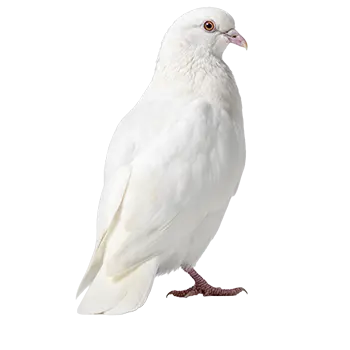

The White Dove kept in homes, ceremonies, and aviaries around the world is a domesticated variety of the Rock Dove (Columba livia), a species that has inhabited cliff faces, rocky gorges, and coastal escarpments across a vast natural range spanning southern Europe, North Africa, the Middle East, and western Asia for hundreds of thousands of years. Unlike many companion birds whose domestication is measured in centuries, the relationship between Columba livia and human civilization stretches back at least five thousand years and arguably much longer. The white plumage that distinguishes these doves from their blue-grey wild ancestors is the result of selective breeding over many generations, favoring a naturally occurring leucistic or albino mutation until it bred true across entire flocks.
Archaeological evidence from Mesopotamia and the eastern Mediterranean indicates that Rock Doves were among the first avian species to be deliberately kept and bred by humans. Clay tablets from ancient Sumer, dating to roughly 3000 BCE, contain references to pigeon keeping, and the remains of purpose-built dovecotes have been found at sites across the Fertile Crescent. While these early domesticated flocks were likely maintained for food, fertilizer, and message carrying, the selective emergence of white-feathered individuals would have been noted and preserved almost immediately, given the human tendency to ascribe spiritual meaning to unusual coloration in animals.
The wild Rock Dove's natural affinity for human structures played a central role in the domestication process. Cliff-nesting instincts translated effortlessly to ledges, rooftops, and the interior niches of temples and granaries, meaning that semi-wild flocks lived in close proximity to human settlements long before any deliberate breeding programs began. This commensal relationship created a natural laboratory for observation and selection, and the appearance of pure white birds within these flocks would have been impossible to overlook.
Genetic studies conducted in the 21st century have confirmed that all domestic pigeon and dove breeds, including the White Dove, descend from Columba livia. The genetic architecture underlying white plumage involves multiple loci, and breeders over the millennia have fixed these alleles through careful pairing. The result is a bird that, while visually striking and culturally distinct, remains genetically close to the common feral pigeon seen in cities worldwide, a fact that underscores the remarkable plasticity of the Rock Dove genome and the depth of the human hand in shaping its expression.