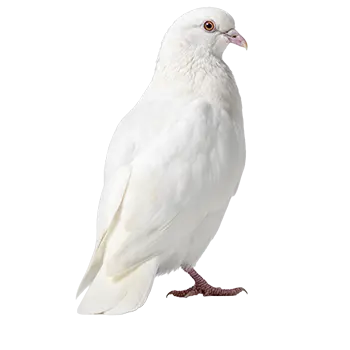

The White Dove in Classical & Fine Art

Few animals have been depicted in Western fine art with the frequency and consistency of the White Dove. Its presence in painting can be traced from the earliest Christian mosaics and Byzantine icons through the full sweep of European art history. In early Christian and medieval art, the dove appeared almost exclusively as a representation of the Holy Spirit, rendered in gold-leafed mosaics at Ravenna, carved into Romanesque church tympanums, and painted into countless Annunciation scenes where a luminous white bird descends toward the Virgin Mary. These depictions established a visual vocabulary that persisted for centuries, making the White Dove one of the most immediately recognizable symbols in religious iconography.

The Renaissance brought new naturalism to dove imagery. Artists such as Giovanni Bellini, Raphael, and Titian rendered doves with increasing anatomical precision while retaining their theological significance. The Baptism of Christ became one of the most frequently painted subjects of the period, and virtually every version included a dove descending from heaven, its white feathers contrasting against dramatic skies. Beyond religious subjects, doves appeared in allegorical compositions representing peace, innocence, and conjugal love, often paired with figures from classical mythology such as Venus and Cupid.

The Baroque and Rococo periods continued to employ dove imagery, though often with greater decorative flair. Gian Lorenzo Bernini's spectacular sculptural interpretation of the Holy Spirit as a radiant dove, set in the apse window of St. Peter's Basilica in Rome, remains one of the most dramatic depictions of the bird in any medium. In secular art, Francois Boucher and Jean-Honore Fragonard included white doves in pastoral and romantic scenes that traded religious gravitas for sensual charm, associating the bird with courtship and aristocratic leisure.

The modern era saw the White Dove undergo a significant artistic transformation. Pablo Picasso's series of dove lithographs, beginning with the image created for the 1949 World Peace Congress poster, stripped the bird of its religious context and repositioned it as a secular symbol of anti-war sentiment and human solidarity. Picasso's spare, fluid renderings proved enormously influential, spawning countless adaptations and establishing a new visual shorthand that linked the White Dove to progressive politics and international cooperation. Contemporary artists continue to engage with dove imagery, sometimes reverently and sometimes subversively, ensuring the bird's place in the fine art tradition remains dynamic and contested.

Literature & Poetry

The White Dove's literary pedigree is as old as written language itself. The Epic of Gilgamesh, among the earliest surviving works of literature, includes a flood narrative in which a dove is released to search for dry land, a story that predates and clearly influenced the biblical account of Noah. From this ancient starting point, the dove wove itself into the literary traditions of virtually every culture it touched, becoming one of the most frequently invoked animals in poetry, allegory, and narrative fiction across the globe.

In the Western poetic tradition, the dove has served as a versatile and enduring metaphor. Shakespeare employed dove imagery in multiple plays and sonnets, often using the bird to represent gentle beauty in contrast to more aggressive or predatory creatures. The Romantic poets, particularly Keats and Shelley, drew on the dove as an emblem of tenderness and transcendence. Emily Dickinson used dove references to explore themes of hope, faith, and the fragile boundary between the earthly and the spiritual. In each case, the white coloring of the dove, whether stated or implied, carried connotations of purity and innocence that deepened the emotional resonance of the verse.

Prose literature has also made extensive use of the White Dove, both as a literal presence and as a symbolic device. In novels ranging from Leo Tolstoy's sweeping historical narratives to Gabriel Garcia Marquez's magical realism, doves appear at moments of transition, reconciliation, or spiritual awakening. The bird's association with peace makes it a natural choice for authors writing about war and its aftermath, and the image of white doves released over battlefields or ruined cities has become a recurring motif in 20th and 21st century fiction.

Children's literature and religious publishing have further extended the White Dove's literary reach. Picture books, devotional texts, and educational materials frequently feature white doves as gentle, accessible characters that introduce young readers to themes of kindness, hope, and environmental stewardship. The cumulative effect of thousands of years of literary attention is a bird whose symbolic weight in the written word is virtually unmatched among avian species, making the White Dove as much a creature of the page as of the sky.

Film & Television

The White Dove became a staple of cinema almost as soon as the medium was invented. Early filmmakers, working in black and white, quickly discovered that the high contrast of a white bird against darker backgrounds created striking visual compositions. As narrative filmmaking developed, directors began using dove releases as visual punctuation for moments of emotional climax, spiritual revelation, or dramatic resolution. This technique proved so effective that it became a recognizable convention of the medium, employed across genres from historical epics to intimate dramas.

The action cinema of the 1980s and 1990s brought a distinctive and influential use of White Dove imagery. Director John Woo, first in his Hong Kong films and later in his Hollywood work, made the slow-motion flight of white doves a signature visual motif. In Woo's films, doves typically appear during climactic gunfight sequences, their graceful flight creating a poetic counterpoint to the violence unfolding around them. This stylistic choice drew on the dove's traditional association with peace and innocence to create a layered visual commentary that influenced an entire generation of action filmmakers and became one of the most parodied and referenced cinematic tropes of the era.

Television has employed White Dove imagery in contexts ranging from religious programming to reality competition shows to nature documentaries. Wedding-themed reality series frequently feature dove releases as aspirational set pieces, reinforcing the bird's association with romance and ceremony in popular consciousness. Nature documentaries have explored the biology and behavior of doves and pigeons with increasing sophistication, helping audiences understand the living animal behind the symbol. Animated series and children's programming have also drawn on dove imagery, typically using the bird to represent gentle or peaceful characters in ensemble casts.

The dove's cinematic and televisual presence extends to advertising, where white doves have been used to market products ranging from personal care items to financial services to charitable causes. The bird's immediate symbolic legibility, the ability of a White Dove to communicate peace, purity, or hope in a single frame without any supporting text, makes it uniquely valuable to visual storytellers working under the time constraints of commercials and promotional content. This commercial ubiquity has, paradoxically, both reinforced and diluted the dove's symbolic power, making it simultaneously one of the most meaningful and most cliched images in contemporary visual media.

Music & Performing Arts

White doves have maintained a persistent presence in the world of music, appearing in song titles, lyrics, album art, and live performances across genres and decades. The dove's association with peace made it a natural emblem for the folk and protest music movements of the 1960s and 1970s, and numerous songwriters of that era incorporated dove imagery into compositions addressing war, civil rights, and social justice. The bird's symbolic flexibility allowed it to serve equally well in sacred music, where it retained its religious connotations, and in secular popular music, where it could represent love, freedom, or longing.

Live musical performances have frequently incorporated actual white doves as dramatic visual elements. Stage magicians pioneered the theatrical use of doves, developing techniques for producing them from hats, scarves, and other props that remain standard in the illusionist's repertoire. Rock and pop concerts adopted similar spectacles on a larger scale, with artists releasing flocks of white doves during climactic moments of their shows. These releases, while visually stunning, eventually drew criticism from animal welfare advocates concerned about the stress imposed on the birds and their ability to survive after release, prompting a gradual shift toward alternative effects in many productions.

In ballet and opera, the White Dove has served as both a prop and a narrative symbol. Productions of works set in religious or pastoral contexts sometimes incorporate live or mechanical doves to heighten dramatic atmosphere. Tchaikovsky's ballets, Puccini's operas, and numerous other canonical works of the performing arts include stage directions or traditional staging choices that feature doves. The bird's visual purity and delicate movement make it particularly well-suited to the aesthetic sensibilities of classical dance and musical theater, where it can embody the innocence or vulnerability of a character without a word being spoken.

The White Dove's presence in music and the performing arts reflects a broader pattern: the bird functions as a kind of emotional shorthand that transcends language and genre. Whether appearing on a punk rock album cover rendered in ironic contrast or descending on a wire during the finale of a grand opera, the White Dove brings with it a weight of cultural association that few other visual elements can match. Its continued use in live performance, despite growing welfare concerns, speaks to the depth of its hold on the human aesthetic imagination.

Photography & Graphic Design

The White Dove is among the most frequently photographed birds in the world, and its image circulates through the visual economy of modern media with extraordinary density. Professional photographers have long recognized the dove as a subject that combines visual beauty with immediate symbolic resonance, making it a reliable choice for editorial, commercial, and fine art photography. The challenge of capturing a white bird in flight, managing exposure, shutter speed, and composition to render individual feathers against bright sky, has itself become a recognized test of photographic skill.

Stock photography libraries contain thousands of White Dove images, and these images appear in contexts that span the full range of human communication. A white dove in flight is one of the most commonly licensed stock images worldwide, used on greeting cards, motivational posters, nonprofit websites, funeral programs, wedding invitations, and corporate sustainability reports. The sheer volume of these uses means that most people in media-saturated societies encounter White Dove imagery regularly, even if they have never seen a live dove, creating a cultural familiarity that reinforces the bird's symbolic associations through constant repetition.

Graphic designers have abstracted the White Dove into one of the most versatile iconographic elements in visual communication. Simplified dove silhouettes appear in logos, wayfinding systems, product packaging, and digital interfaces. The bird's distinctive profile, with its rounded breast, small head, and fanned tail, is legible even at very small sizes, making it effective across a range of applications from app icons to highway signage. Organizations as diverse as the United Nations, international peace foundations, and consumer brands have incorporated stylized dove marks into their visual identities, leveraging the bird's universal positive associations.

The digital era has multiplied the White Dove's visual presence exponentially. Social media platforms circulate dove imagery in the form of emoji, stickers, GIFs, and memes, often in contexts related to grief, hope, celebration, or political commentary. The ease with which digital images can be created, modified, and shared means that the White Dove now functions as a unit of visual communication that operates at internet speed, its ancient symbolic weight compressed into thumbnails and reaction images that travel the globe in seconds.

The White Dove in Contemporary Culture

In the early decades of the 21st century, the White Dove continues to occupy a prominent place in global popular culture, though its meaning has become increasingly layered and sometimes contested. The bird remains the default visual symbol of peace in international discourse, appearing on protest signs, diplomatic communiques, and humanitarian campaign materials with undiminished frequency. At the same time, a certain self-awareness has crept into the dove's cultural usage, with artists, comedians, and social commentators occasionally noting the tension between the bird's idealistic associations and the complexities of the conflicts in which its image is deployed.

Social media has both amplified and complicated the White Dove's cultural presence. Viral videos of dove releases at weddings, funerals, and public events generate millions of views, while equally viral videos of release doves being attacked by predatory birds or failing to fly away have introduced notes of dark comedy and welfare concern into what was once a purely sentimental genre. Online communities dedicated to bird keeping and animal welfare have used these moments to educate the public about the distinction between trained homing pigeons and non-homing doves, and about the responsibilities associated with ceremonial bird releases.

The gaming and virtual reality industries have incorporated White Dove imagery into their visual landscapes with increasing frequency. Video games set in historical, fantasy, or spiritual contexts often feature white doves as ambient environmental elements, signaling safe zones, completed quests, or moments of narrative tranquility. Virtual reality experiences designed for meditation, relaxation, or therapeutic purposes sometimes include dove imagery as part of calming visual environments. These digital deployments represent the newest chapter in the White Dove's long media career, translating its symbolic weight into interactive and immersive formats.

Despite occasional skepticism about its overuse, the White Dove's cultural position remains remarkably secure. The bird benefits from a feedback loop in which its symbolic meaning is reinforced by every new use, creating a self-sustaining cycle of cultural relevance. Few animals can claim to be simultaneously ancient and contemporary, sacred and commercial, earnest and ironic in their cultural deployment. The White Dove manages all of these contradictions with the same quiet grace it has brought to human culture for millennia, adapting to each new medium and moment without ever quite losing the core associations that made it meaningful in the first place.

Always consult a qualified professional before making any health-related decisions. This content is provided for informational reference only and should not replace professional guidance specific to your animal.