
In Nature Documentaries & Television

The Victoria Crowned Pigeon has been a recurring subject in nature documentaries exploring the biodiversity of New Guinea and the broader Indo-Pacific region. The island of New Guinea is frequently described as one of the last great frontiers of biological discovery, and filmmakers drawn to its forests inevitably encounter the crowned pigeons as among the most visually arresting inhabitants of the forest floor. The species' combination of extraordinary size, vivid coloration, and elaborate crest makes it an ideal subject for high-definition wildlife cinematography, and footage of Victoria Crowned Pigeons foraging, displaying, and tending their young has featured in numerous productions over the past several decades.

The BBC's natural history unit, responsible for landmark series narrated by Sir David Attenborough, has included segments on crowned pigeons in programs exploring avian diversity and the ecological riches of Australasia. These productions have introduced the Victoria Crowned Pigeon to global audiences numbering in the tens of millions, establishing the bird as a recognizable symbol of New Guinea's unique wildlife. The species has also appeared in programming produced by National Geographic, PBS Nature, and various independent filmmakers specializing in tropical ecology.

Beyond dedicated wildlife documentaries, the Victoria Crowned Pigeon has made appearances in travel and adventure programming set in Papua New Guinea and the Indonesian provinces of Papua. These shows, which blend natural history with cultural exploration, often highlight the bird as an example of the region's extraordinary endemic fauna. The crowned pigeon's ground-dwelling habits and relative approachability in undisturbed forest make it a cooperative subject for camera crews, yielding intimate footage that conveys both the bird's elegance and the lushness of its habitat.

Television coverage has also extended to zoo-based programming, where Victoria Crowned Pigeons kept in accredited institutions serve as on-screen ambassadors for their wild counterparts. Shows documenting the daily operations of major zoos frequently feature crowned pigeons during segments on breeding programs, veterinary care, and enrichment strategies. These appearances, while less dramatic than wild footage, play an important role in familiarizing viewers with the species and the conservation challenges it faces.

Wildlife Photography & Visual Arts

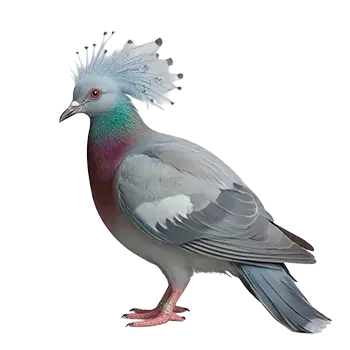
The Victoria Crowned Pigeon is one of the most photographed pigeon species in the world, and its image has graced the pages of leading natural history publications, photography annuals, and ornithological journals for well over a century. The bird's fan-shaped crest, with its intricate network of white-tipped lace-like plumes, presents a subject of uncommon visual complexity that rewards close-up photography. The interplay of deep blue-grey body plumage, maroon breast feathers, and the pale filigree of the crest creates a color palette that is both subtle and dramatic, a combination that has made the species a favorite among wildlife photographers seeking images that transcend simple documentation.

In the era of digital photography and high-resolution imaging, the Victoria Crowned Pigeon has become a staple subject at zoos and aviaries that maintain the species. Photographers visiting institutions such as the San Diego Zoo, the Bronx Zoo, and the Singapore Zoo regularly seek out the crowned pigeon enclosures, and images of the species are among the most frequently shared bird photographs on platforms dedicated to wildlife and nature photography. The bird's calm demeanor in well-managed captive settings allows for extended photographic sessions and the capture of behavioral details, such as courtship displays and parent-chick interactions, that would be far more difficult to document in the wild.

Beyond photography, the Victoria Crowned Pigeon has inspired artists working in a variety of media. Natural history illustrators from the 19th century onward have depicted the species in watercolor, gouache, and lithography, contributing to a visual record that parallels the scientific literature. Contemporary artists have drawn on the bird's aesthetic qualities in textile design, ceramic art, jewelry, and digital illustration. The crest, in particular, has proven to be a rich source of design inspiration, its fractal-like structure lending itself to both realistic and abstracted interpretations.

The species has also appeared in fine art contexts that engage with broader themes of biodiversity, conservation, and the relationship between humans and the natural world. Several contemporary painters and mixed-media artists have incorporated the Victoria Crowned Pigeon into works that comment on habitat loss, the ethics of captivity, and the cultural meaning of exotic animals in Western societies. These artistic engagements extend the bird's cultural reach beyond the realm of natural history and into the broader conversation about how humans perceive and value wildlife.

Social Media & Digital Culture

The rise of social media platforms has given the Victoria Crowned Pigeon a new and rapidly expanding audience. The species is a frequent subject of viral posts on platforms such as Instagram, TikTok, Reddit, and X, where images and short video clips of the bird's resplendent crest and dignified posture regularly attract tens of thousands of reactions. The common refrain accompanying these posts is one of disbelief that such an animal exists, with commenters expressing surprise that a pigeon, a bird family often associated with urban grit rather than tropical splendor, could be so visually magnificent.

Zoo-based social media accounts have been particularly effective in amplifying the Victoria Crowned Pigeon's digital presence. Institutions including the Bronx Zoo, Chester Zoo, and the Melbourne Zoo regularly feature their crowned pigeon residents in curated posts timed to coincide with awareness campaigns, breeding milestones, or simply the bird's photogenic daily routines. These posts often include educational captions that provide information about the species' natural history, conservation status, and the role of captive breeding programs, blending entertainment with public outreach.

The species has also become a recurring subject in the genre of online content that celebrates obscure or underappreciated animals. Listicles, video compilations, and educational threads highlighting unusual bird species frequently include the Victoria Crowned Pigeon alongside other visually striking but relatively unfamiliar avian species. This type of content serves as a gateway for viewers who may have limited prior exposure to tropical ornithology, introducing them to the diversity of the pigeon family and the ecological richness of New Guinea.

Digital culture has also generated a modest but dedicated community of Victoria Crowned Pigeon enthusiasts who share information, photographs, and husbandry advice through forums, Facebook groups, and specialized aviculture websites. These online communities connect private keepers, zoo professionals, and wildlife biologists in ways that would have been difficult or impossible before the internet era, facilitating the exchange of knowledge about breeding techniques, dietary management, and veterinary care. The resulting network of expertise represents a valuable informal resource for the species' long-term welfare in captivity.

In Print & Literature

The Victoria Crowned Pigeon has been a subject of sustained interest in natural history publishing since its formal description in the early 19th century. The species features prominently in comprehensive reference works on pigeons and doves, including Derek Goodwin's authoritative Pigeons and Doves of the World and David Gibbs, Eustace Barnes, and John Cox's Pigeons and Doves: A Guide to the Pigeons and Doves of the World. These volumes provide detailed accounts of the species' morphology, ecology, behavior, and distribution, and are frequently cited in both academic and popular literature.

Beyond technical ornithology, the Victoria Crowned Pigeon has appeared in travel writing and narrative nonfiction about New Guinea, a region that has long fascinated Western authors for its ecological and cultural complexity. Writers describing expeditions into the island's interior have frequently invoked the crowned pigeon as an emblem of the forest's grandeur, using encounters with the bird as narrative set pieces that convey the richness and otherness of the Papuan landscape. These literary treatments, while varying in scientific rigor, have contributed to the species' broader cultural profile in the English-speaking world.

Children's literature and educational publishing have also drawn on the Victoria Crowned Pigeon's visual appeal. The species appears in illustrated guides to birds of the world aimed at young readers, in activity books and coloring books featuring exotic animals, and in classroom materials designed to teach students about tropical ecosystems and biodiversity. Its unusual appearance makes it an effective tool for engaging young audiences who might otherwise show limited interest in avian biology, and educators have noted that the crowned pigeon's resemblance to no other familiar bird can spark genuine curiosity and further inquiry.

The species' presence in philatelic and numismatic publications is also noteworthy. Papua New Guinea has issued postage stamps featuring the Victoria Crowned Pigeon on multiple occasions, reflecting the bird's status as a national natural heritage icon. Indonesia has similarly recognized the species on stamps and commemorative materials. These small but widely distributed images have contributed to the bird's recognition among collectors and enthusiasts around the world, reinforcing its identity as one of the signature species of the New Guinea region.

Symbolism in Conservation Messaging

The Victoria Crowned Pigeon has emerged as one of the most effective flagship species for conservation campaigns focused on New Guinea's lowland rainforests. Flagship species are selected for their ability to capture public attention and generate support for broader conservation goals, and the Victoria Crowned Pigeon's combination of visual impact, ecological vulnerability, and association with a globally significant biodiversity hotspot makes it exceptionally well suited to this role. Conservation organizations including BirdLife International, the Wildlife Conservation Society, and the World Wildlife Fund have used images and narratives of the species in fundraising materials, public awareness campaigns, and policy advocacy efforts.

The species' effectiveness as a conservation symbol derives in part from its capacity to challenge preconceptions about pigeons. In much of the Western world, pigeons are associated with urban environments and are often regarded with indifference or disdain. The Victoria Crowned Pigeon disrupts this stereotype dramatically, presenting a member of the pigeon family that is large, visually spectacular, and unmistakably wild. This element of surprise can be a powerful tool in conservation communication, prompting audiences to reconsider their assumptions about familiar animal groups and to engage with the broader message of biodiversity loss.

In Papua New Guinea, the Victoria Crowned Pigeon has been adopted as an emblem of national natural heritage, appearing on currency, government publications, and the branding of domestic conservation initiatives. This national identification with the species has facilitated community-level engagement with conservation programs, particularly in rural areas where the bird is known through direct experience rather than media representation. Local conservation organizations have leveraged the bird's cultural resonance to promote sustainable hunting practices, habitat protection agreements, and ecotourism ventures that provide economic alternatives to forest clearance.

The species also plays a role in zoo-based conservation education, where its presence in exhibits provides an entry point for discussions about tropical deforestation, the wildlife trade, and the interconnectedness of global ecosystems. Interpretive signage, keeper talks, and digital content associated with crowned pigeon exhibits at major zoos consistently rank among the most engaging avian educational experiences offered by these institutions. The Victoria Crowned Pigeon's ability to hold visitor attention and stimulate conversation about conservation issues underscores its value as a living educational resource.

Representation in Philately, Currency & National Identity

Few bird species are as closely identified with a single nation's visual identity as the Victoria Crowned Pigeon is with Papua New Guinea. The species has appeared on Papua New Guinean postage stamps on multiple occasions since the country's independence in 1975, reflecting both the bird's prominence in the national consciousness and its value as a symbol of the country's extraordinary natural heritage. These stamps have circulated internationally among collectors and postal services, serving as miniature ambassadors for Papua New Guinea's biodiversity and contributing to the species' global recognition in a medium that predates digital communication.

Beyond philately, the Victoria Crowned Pigeon has been featured on Papua New Guinean currency and official government materials. The species' image on banknotes and coins reinforces its status as a national treasure and signals the government's recognition of biodiversity as a component of national identity. In a country where natural resources are central to both the economy and the cultural landscape, the selection of the Victoria Crowned Pigeon for such prominent representation is a meaningful statement about the value placed on the nation's endemic wildlife.

Indonesia, which administers the western half of New Guinea, has similarly recognized the Victoria Crowned Pigeon in official and semi-official contexts. The species has appeared on Indonesian postage stamps and has been highlighted in materials produced by the country's Ministry of Environment and Forestry in connection with conservation initiatives in the Papuan provinces. This dual national recognition, spanning two countries that share the island of New Guinea, underscores the species' importance as a transboundary conservation concern and a shared element of regional natural heritage.

The Victoria Crowned Pigeon's presence in national iconography has practical implications for conservation. By embedding the species in the visual language of national identity, governments and conservation organizations create a cultural context in which the bird's protection can be framed not merely as an environmental obligation but as a matter of national pride. This framing has been shown to enhance public support for conservation measures and to facilitate the integration of biodiversity considerations into land-use planning and economic development decisions, particularly in regions where the species is known to occur.

The cumulative effect of these representations across stamps, currency, official publications, and conservation branding is a layered public identity for the Victoria Crowned Pigeon that transcends any single medium. For audiences in Papua New Guinea and Indonesia, the bird is encountered in daily transactions, government communications, and community outreach. For international audiences, it appears in collections, documentaries, and digital content. This multi-channel presence ensures that the Victoria Crowned Pigeon remains visible and culturally relevant, a status that is itself a form of protection in an era when public attention is among the most valuable resources a threatened species can possess.

Always consult a qualified professional before making any health-related decisions. This content is provided for informational reference only and should not replace professional guidance specific to your animal.