
Origins & Natural Habitat

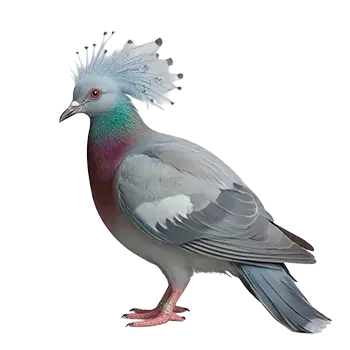
The Victoria Crowned Pigeon (Goura victoria) is native to the lowland and swamp forests of northern New Guinea, including portions of the Indonesian provinces of Papua and West Papua as well as smaller offshore islands such as Biak, Yapen, and the western Papuan Islands. It belongs to the genus Goura, which contains four recognized species of crowned pigeons, all of them endemic to New Guinea and its satellite islands. Of the four, the Victoria Crowned Pigeon is widely regarded as the most ornate, distinguished by its elaborate fan-shaped crest of white-tipped blue feathers, a deep maroon breast, and striking blue-grey plumage across the body.

The species inhabits the forest floor and lower canopy of tropical rainforests, favoring areas of relatively flat terrain with dense undergrowth. Its diet consists primarily of fallen fruits, seeds, and the occasional invertebrate gleaned from the leaf litter. Unlike many pigeon species that have adapted to open or semi-urban environments, the Victoria Crowned Pigeon is overwhelmingly a bird of primary and mature secondary forest, rarely venturing far from heavy cover. This dependence on intact lowland forest has made it particularly vulnerable to the logging and land conversion that continue to reshape the landscapes of New Guinea.

Socially, Victoria Crowned Pigeons tend to move in small groups of two to ten individuals, foraging quietly on the ground and roosting in mid-canopy branches at night. They are generally sedentary, maintaining home ranges within a given stretch of forest rather than migrating seasonally. Their low reproductive rate, typically producing a single egg per clutch, means that populations recover slowly from disturbances such as hunting or habitat fragmentation. This combination of ecological sensitivity and low fecundity has made the species a focal point for conservationists working in the Papuan region.

Fossil and molecular evidence places the crowned pigeons among the closest living relatives of the extinct dodo (Raphus cucullatus) and Rodrigues solitaire (Pezophaps solitaria), underscoring the deep evolutionary heritage of this lineage. The crowned pigeons are thought to have diverged from other pigeon lineages in the late Miocene or early Pliocene, adapting to the dense equatorial forests of the New Guinea landmass as it rose and expanded through tectonic activity. This ancient lineage gives the Victoria Crowned Pigeon a significance that extends beyond aesthetics, positioning it as a living window into the evolutionary history of the Columbidae family.

Early Encounters & Colonial History

European awareness of the Victoria Crowned Pigeon dates to the era of Dutch and British exploration in the western Pacific. Naturalists accompanying colonial expeditions to New Guinea in the 18th and early 19th centuries described immense, ground-dwelling pigeons with spectacular crests, though it took several decades for the species to be formally classified. The Scottish naturalist James Francis Stephens provided the first scientific description of Goura victoria in 1819, naming the species in honor of the British Queen Victoria, whose coronation would not occur until 1838 but whose family name was already prominent in scientific circles of the day. The attribution to Queen Victoria was later cemented by common usage, linking the bird permanently to one of the most recognized monarchs in Western history.

During the second half of the 19th century, as European colonial powers consolidated their control over New Guinea and the surrounding archipelago, live Victoria Crowned Pigeons began to appear in the aviaries and zoological gardens of London, Amsterdam, Paris, and Berlin. The birds' extraordinary appearance made them instant attractions, and demand from private collectors and public institutions alike drove a modest but sustained trade in live specimens captured by indigenous hunters. The difficulty of keeping the birds healthy during long sea voyages meant that mortality was high, and only a fraction of captured individuals survived to reach their final destinations.

Colonial administrators and missionaries stationed in New Guinea during this period also documented the cultural importance of the Victoria Crowned Pigeon among the indigenous communities of the northern coastal lowlands. The birds' feathers were prized for ceremonial headdresses and decorative objects, and the pigeons themselves were hunted for food. European observers noted that certain communities regulated hunting of the birds through customary law, reflecting an awareness of the species' relative scarcity compared to smaller, more prolific pigeon species.

The colonial period thus established a dual dynamic that would persist into the modern era: widespread admiration for the Victoria Crowned Pigeon's beauty and a growing awareness of the threats posed by overexploitation and habitat loss. By the early 20th century, zoological institutions in Europe and North America had begun to recognize the need for captive breeding programs, laying the groundwork for conservation efforts that would become increasingly urgent in the decades to come.

Cultural Symbolism & Indigenous Significance

For the indigenous peoples of New Guinea's northern lowlands, the Victoria Crowned Pigeon has long occupied a place of cultural importance that extends well beyond its value as a food source. In many Papuan communities, the bird's elaborate crest feathers are incorporated into ceremonial headdresses, dance regalia, and personal adornments worn during initiations, marriages, and intergroup negotiations. The large, iridescent plumes are often combined with feathers from birds of paradise and cassowaries to create headdresses of remarkable complexity, each element carrying specific symbolic weight related to the wearer's status, clan affiliation, or spiritual authority.

In some coastal and riverine communities of Papua and West Papua, the Victoria Crowned Pigeon features in oral traditions that attribute the bird's distinctive appearance to acts of ancestral spirits or culture heroes. These narratives often emphasize the pigeon's dignified bearing and its association with the forest floor, a domain that in many Papuan cosmologies carries meanings related to the earth, fertility, and the dwelling place of ancestral spirits. The bird's deep booming call, audible at considerable distances through the forest, is sometimes interpreted as a communication from the spirit world, adding a layer of reverence to the species' cultural profile.

The feather trade associated with the Victoria Crowned Pigeon also played a role in intergroup exchange networks that connected coastal, lowland, and highland communities across New Guinea long before European contact. Crowned pigeon feathers were among the valued trade goods that moved through these networks, alongside shells, stone tools, and pigments. The incorporation of these feathers into exchange relationships underscores their economic as well as symbolic value, and highlights the extent to which the Victoria Crowned Pigeon was embedded in the social and economic fabric of Papuan life.

In the contemporary era, cultural organizations in Papua New Guinea and the Indonesian provinces of Papua have worked to document and preserve the traditional knowledge associated with the Victoria Crowned Pigeon and other culturally significant species. These efforts recognize that the relationship between indigenous communities and the crowned pigeon is not merely historical but continues to inform local attitudes toward wildlife conservation and land management, sometimes in ways that complement and sometimes in ways that complicate formal conservation strategies.

Scientific Study & Taxonomic Recognition

The taxonomic history of the Victoria Crowned Pigeon reflects the broader challenges of classifying the avifauna of New Guinea, a region whose remoteness and ecological complexity delayed systematic ornithological study well into the modern era. Following Stephens' original description in 1819, subsequent naturalists debated the relationships among the crowned pigeons, with some treating all populations as variants of a single species and others recognizing multiple distinct forms. By the mid-20th century, three species of Goura were generally accepted: Goura victoria, Goura cristata (the Western Crowned Pigeon), and Goura scheepmakeri (the Scheepmaker's Crowned Pigeon). In 2018, a fourth species, Goura sclaterii (the Sclater's Crowned Pigeon), was split from Goura scheepmakeri based on genetic and morphological evidence, further refining the taxonomy of this charismatic group.

Field studies of the Victoria Crowned Pigeon in its native habitat have been relatively limited, owing to the logistical difficulties of conducting research in the remote forests of northern New Guinea. What field work has been carried out confirms that the species is a specialist of lowland alluvial forests, rarely found above elevations of 300 meters. Researchers have documented the bird's breeding biology in some detail, noting the construction of a bulky stick nest in the mid-canopy, the incubation of a single white egg by both parents over a period of roughly 28 to 30 days, and a prolonged period of parental care during which the squab is fed crop milk before transitioning to a diet of regurgitated fruit and seeds.

Behavioral research has highlighted the species' relatively sophisticated social dynamics. Victoria Crowned Pigeons establish subtle dominance hierarchies within foraging groups, communicated through postural displays, crest erection, and low-frequency vocalizations. Males perform elaborate courtship displays that involve bowing, tail fanning, and rhythmic cooing, behaviors that have been studied both in the wild and in captive settings. These displays are among the most complex courtship rituals observed in any pigeon species and have attracted the attention of researchers interested in sexual selection and signal evolution.

Genetic studies have confirmed the crowned pigeons' position as one of the most basal lineages within the family Columbidae, supporting the hypothesis that they share deep evolutionary affinities with the extinct dodo and solitaire. This phylogenetic placement has made Goura a subject of interest for researchers studying the biogeographic history of the Indo-Pacific region and the evolutionary processes that generated the extraordinary avian diversity of New Guinea and its surrounding islands.

The Species Today

The Victoria Crowned Pigeon is currently classified as Near Threatened on the IUCN Red List, a designation that reflects ongoing population declines driven primarily by habitat loss and hunting. Lowland rainforest in northern New Guinea continues to be converted for agriculture, logging, and palm oil cultivation, and the species' dependence on undisturbed primary forest means that even selective logging can degrade the quality of its habitat. Hunting for food and feathers persists in many areas, and the bird's large size, ground-dwelling habits, and relative tameness make it an easy target for hunters using traditional and modern methods alike.

In response to these pressures, conservation organizations working in Papua New Guinea and the Indonesian provinces of Papua have implemented a range of strategies aimed at protecting the Victoria Crowned Pigeon and its habitat. These include the establishment of protected areas such as the Mamberamo Foja Wildlife Reserve and the Rawa Biru Nature Reserve, community-based conservation programs that engage local landowners in sustainable land management, and public awareness campaigns that highlight the species' ecological and cultural value. The effectiveness of these initiatives varies widely, and enforcement of protected area boundaries remains a challenge in many remote regions.

In captivity, the Victoria Crowned Pigeon is maintained by a network of accredited zoos and private aviculturists around the world. The Species Survival Plan (SSP) coordinated by the Association of Zoos and Aquariums (AZA) manages the North American captive population, working to maintain genetic diversity through carefully planned pairings. European institutions participate in a parallel European Endangered Species Programme (EEP). These managed breeding programs have been moderately successful, though the species' low reproductive rate and sensitivity to stress continue to present challenges for captive management.

Aviculturists who keep Victoria Crowned Pigeons outside of institutional settings report that the birds can be rewarding but demanding charges. They require spacious, well-planted aviaries that allow for ground-level foraging, a varied diet rich in fruits and supplemented with high-quality pellets and occasional protein sources, and careful attention to hygiene and veterinary care. The birds are generally docile and can become quite tame with consistent, patient handling, but they are not well suited to small enclosures or environments that lack the complexity needed to support their natural behaviors.

Notable Individuals & Institutional Contributions

While the Victoria Crowned Pigeon has not achieved the individual celebrity status of some parrot species, several specimens have played important roles in advancing public awareness and scientific understanding of the species. Among the most historically significant were the birds kept at the London Zoo beginning in the late 19th century, which were among the first Victoria Crowned Pigeons successfully maintained in a European institution over extended periods. These early captive birds provided naturalists with opportunities to observe the species' behavior, diet, and breeding biology at close range, generating records that remain valuable to researchers today.

The San Diego Zoo has been one of the most prominent institutions in the modern history of the Victoria Crowned Pigeon in captivity. The zoo has successfully bred multiple generations of the species and has contributed birds to other AZA-accredited institutions as part of the Species Survival Plan. San Diego's crowned pigeons have served as ambassadors for New Guinea's biodiversity, featuring in educational programs that highlight the ecological challenges facing the island's lowland forests and the species that depend on them.

In Europe, the Rotterdam Zoo (Diergaarde Blijdorp) and the Berlin Zoological Garden have maintained notable breeding populations of Victoria Crowned Pigeons, contributing to the EEP and supporting research into the species' reproductive biology and nutritional requirements. The Rotterdam Zoo's aviary exhibits have been particularly influential in demonstrating how captive environments can be designed to accommodate the species' ground-foraging behavior and need for dense vegetative cover, setting standards that have been adopted by other institutions.

Beyond institutional contributions, the Victoria Crowned Pigeon has become a flagship species for conservation messaging related to New Guinea's imperiled lowland ecosystems. Its striking appearance and association with one of the most biodiverse regions on earth have made it a compelling symbol in fundraising campaigns, documentary films, and educational materials produced by organizations working to protect Papuan forests. The species' ability to capture public attention and inspire concern for a geographically remote ecosystem represents one of its most valuable, if intangible, contributions to global conservation efforts.

Always consult a qualified professional before making any health-related decisions. This content is provided for informational reference only and should not replace professional guidance specific to your animal.