
Victoria Crowned Pigeon Species Guide - Furry Critter Network

Victoria Crowned Pigeon

Quick Facts

🔬 Scientific Name
Goura victoria
📊 Care Level
Expert
😊 Temperament
Gentle
📏 Adult Size
28-30 inches
⏱️ Lifespan
20-25 years
🔊 Noise Level
Moderate
🗣️ Talking Ability
None
🍽️ Diet Type
Frugivore
🌍 Origin
Northern New Guinea
🏠 Min Cage Size
10x10x8 feet walk-in aviary
📐 Size
Large

Victoria Crowned Pigeon - Names & Recognition

The Victoria Crowned Pigeon carries one of the most fitting names in aviculture — a direct tribute to Queen Victoria of Great Britain, bestowed by naturalist George Robert Gray in 1844 at the time of formal scientific description. The species epithet victoria honors the same monarch, making the bird's common and scientific names a unified royal dedication.

Within the genus Goura, three crowned pigeon species are recognized: the Victoria Crowned Pigeon (Goura victoria), the Western Crowned Pigeon (Goura cristata), and the Sclater's Crowned Pigeon (Goura sclaterii). The Victoria Crowned Pigeon is distinguished from its relatives by the crisp white tips on its elaborately laced blue crest feathers — a feature that sets it apart at a glance.

Two subspecies are currently recognized. Goura victoria victoria is found in the islands of Yapen and Biak and in the northern mainland of New Guinea. Goura victoria beccarii, described by Salvadori in 1876, inhabits the Mayr Islands and parts of the Huon Peninsula, and is considered slightly larger with marginally different crest patterning by some authorities, though subspecies distinctions remain debated.

In the pet trade and avicultural community, the bird is most consistently referred to simply as the Victoria Crowned Pigeon or occasionally the Blue Crowned Pigeon, though the latter name creates confusion with the unrelated Blue-crowned Parakeet. Zoos and bird parks may also list the species as the Great Crowned Pigeon in older literature, reflecting earlier taxonomic grouping of all Goura species under a broad common name.

Locally in Papua New Guinea and the surrounding region, the birds are hunted for food and prized decorative feathers, contributing to population pressure alongside habitat loss. International trade is regulated under CITES Appendix II, meaning commercial export requires documentation and permits, and prospective keepers must ensure any acquired bird originates from a licensed captive-bred source.

Victoria Crowned Pigeon Physical Description

The Victoria Crowned Pigeon is the undisputed giant of the pigeon family Columbidae, with adults measuring between 28 and 30 inches from bill tip to tail and weighing between 4.4 and 5.5 pounds. This places them roughly comparable in size to a large domestic chicken, making their presence in an aviary genuinely impressive. Males and females are similar in overall size, though males tend to be very slightly heavier and may display marginally more elaborate crest development.

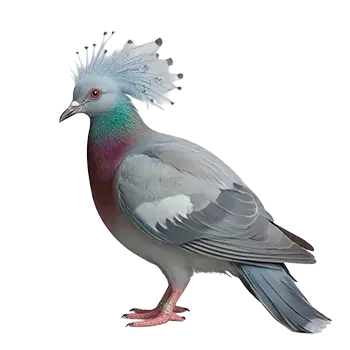
The body plumage is a rich blue-grey across the head, neck, back, wings, and tail. The breast is a deep maroon-purple, creating a striking contrast against the cooler tones of the rest of the body. The wings are grey with a broad pale lavender-grey panel across the wing coverts, bordered by dark blue-black, giving the bird a layered, almost painted appearance in good light. The tail is square-tipped and dark grey with a pale terminal band.

The defining feature of the species is the extraordinary head crest — a broad fan of elongated, lace-tipped feathers that stand permanently erect above the head. Unlike the crests of cockatoos, which are raised and lowered expressively, the Victoria Crowned Pigeon's crest is always displayed. Each crest feather is a fine blue-grey rachis that branches into delicate lateral filaments terminating in a crisp white or pale blue-white tip, creating a cobweb or snowflake-like appearance that must be seen in person to be fully appreciated.

The eyes are a vivid deep red to crimson, providing a dramatic focal point to the face. The bill is dark grey and relatively short and stout for efficient fruit and seed manipulation. The legs and feet are dark red-grey and well-proportioned for a primarily terrestrial bird that spends much of its time walking along the forest floor.

Sexual dimorphism is minimal. Both sexes display the full crest and similar body coloration, making visual sexing unreliable in the field. DNA sexing or endoscopy is recommended for aviculture and breeding programs.

Affection Level
Victoria Crowned Pigeons can become calm and trusting with dedicated keepers when hand-raised from youth. They tolerate close proximity and may accept gentle interaction, but rarely seek physical contact the way parrots do. Most birds prefer quiet, unhurried companionship over active handling.
Sociability
In the wild these pigeons live in small groups, and captive birds generally do well housed in bonded pairs in spacious aviaries. They are not aggressive toward their keeper but require ample space to avoid territorial tension, particularly between males during the breeding season.
Vocalization
Victoria Crowned Pigeons produce deep, resonant booming calls and soft repetitive hooting, especially during courtship displays. While not piercing like parrots, their low-frequency calls carry well through walls and are produced regularly throughout the day, making them unsuitable for noise-sensitive settings.
Intelligence
These birds show modest cognitive abilities typical of ground-feeding pigeons. They learn keeper routines, recognize familiar people, and can be conditioned to accept basic handling. They do not exhibit the advanced problem-solving, puzzle engagement, or vocal mimicry associated with psittacine species.
Exercise Needs
Victoria Crowned Pigeons are primarily terrestrial walkers that require a large, naturalistic aviary floor space for daily foraging activity. They also benefit from elevated perches for roosting. A spacious walk-in aviary is essential; small enclosures cause stress and physical deterioration quickly.
Maintenance Level
Care demands are high due to the need for large specialized aviaries, humidity control, temperature management, and a varied frugivore diet. Daily spot-cleaning of droppings on the aviary floor is essential. These birds also require access to an avian veterinarian experienced with large softbill species.
Trainability
Victoria Crowned Pigeons are not trained in the conventional parrot sense. With consistent, patient conditioning they can learn to accept the keeper's presence, walk toward a target, and tolerate basic health examinations. Trick training and command-based learning are not realistic expectations for this species.
Independence
These pigeons are largely self-sufficient within a well-designed aviary environment. They do not develop the separation anxiety or attention-seeking behaviors common in parrots. Provided their physical and social needs are met, they entertain themselves through foraging, walking, and natural courtship behaviors.

Natural Habitat & Range

The Victoria Crowned Pigeon is native to the island of New Guinea, distributed across the northern lowland regions of what is now Papua New Guinea and the Indonesian provinces of Papua and West Papua. Its range extends across the northern mainland and several offshore islands including Yapen, Biak, and the Mayr Islands, with the subspecies Goura victoria beccarii found on the Huon Peninsula.

This species inhabits lowland tropical rainforest, swamp forest, and forest edges typically below 600 meters elevation, though occasional records exist up to around 3,000 feet in foothill zones. It strongly favors dense, undisturbed primary forest with a deep leaf litter layer on the forest floor, where it spends the majority of its time foraging for fallen fruits and seeds. Sago palm swamps and riverine forest corridors are particularly favored habitats.

Victoria Crowned Pigeons are sedentary birds that maintain established home ranges within suitable forest, showing little tendency for long-distance movement. They are highly sensitive to habitat disturbance and are among the first species to disappear from selectively logged or degraded forest. Deforestation for agriculture, logging, and human settlement in New Guinea represents the most significant long-term threat to wild populations, alongside hunting pressure for food and feathers. The species is listed as Vulnerable on the IUCN Red List, and wild population trends are considered declining across much of the range.

Temperament

Among the crowned pigeons, the Victoria Crowned Pigeon has earned a reputation as a remarkably calm and dignified bird. In contrast to the nervous flightiness of many wild-caught or poorly socialized exotic species, hand-raised Victoria Crowned Pigeons often develop a quiet confidence around their keepers that makes daily care genuinely rewarding. They move with deliberate, unhurried grace and tend to observe new stimuli cautiously rather than panic.

Hand-raised birds from reputable breeders typically accept the keeper's presence without alarm and may approach voluntarily during feeding. Some individuals develop recognizable preferences for specific caregivers and will walk toward them when they enter the aviary. This is not the effusive social bonding seen in parrots — it is subtler, more akin to the trust a large, calm animal develops for a familiar caretaker.

Despite their gentle reputation, Victoria Crowned Pigeons are not hands-on companion birds in the conventional sense. They do not enjoy being lifted, cuddled, or restrained, and stress responses in this species can be severe. A frightened crowned pigeon may crash into aviary walls or objects with enough force to cause serious injury to the delicate crest feathers or even internal trauma. Any necessary handling for veterinary purposes should be performed calmly and with appropriate technique.

During the breeding season, males become noticeably more animated and may engage in elaborate bowing and cooing courtship displays directed at females. These displays are impressive to observe but can also introduce a degree of territorial behavior, and pairs should have sufficient aviary space to allow the female to move away if she is not receptive. Same-sex male pairs are generally not recommended during the breeding season due to the risk of sustained conflict.

Victoria Crowned Pigeons are diurnal and spend the majority of daylight hours foraging along the aviary floor, walking methodically and pecking at food items. They roost at height on sturdy branches or elevated platforms and should always have access to appropriate roosting structures well above floor level. Activity levels taper naturally toward evening, and the birds settle into quiet roosting behavior well before dark.

Care Requirements

Housing a Victoria Crowned Pigeon correctly is the single most important factor in its long-term health and wellbeing. These birds cannot be kept in standard bird cages or small enclosures under any circumstances. The minimum acceptable housing is a fully enclosed walk-in aviary of at least 10 feet long by 10 feet wide by 8 feet tall, and larger is always better. For a bonded pair, an aviary of 15 by 20 feet with full-height clearance is closer to the appropriate scale.

The aviary must include both a sheltered indoor section and a secure outdoor flight area if climate permits. Victoria Crowned Pigeons are native to tropical lowland environments and are sensitive to cold temperatures. They should not be exposed to temperatures below 60°F (15°C) for extended periods, and an indoor area maintained between 65–80°F (18–27°C) is essential in temperate climates. High humidity levels between 60 and 80 percent are beneficial and reflect their native rainforest conditions.

The floor of the aviary is critically important. These birds are primarily terrestrial and spend most of their active time walking and foraging on the ground. A floor of natural soil, sand, or bark mulch allows for natural foraging behavior and is preferable to concrete. If a hard floor is unavoidable, a thick layer of clean substrate must be maintained. The floor must be kept clean, as damp or contaminated substrate rapidly becomes a source of bacterial and fungal infection.

Perches should be provided at varying heights using thick, natural branches of at least 3–4 inches in diameter to comfortably support the bird's weight. Multiple roosting positions prevent competition and allow the birds to choose resting spots according to temperature and light conditions.

Aviary plantings with non-toxic shrubs and ground-cover plants enrich the environment and provide psychological security. All plants must be verified non-toxic before introduction. The aviary should be predator-proof with double-entry doors to prevent escape, as Victoria Crowned Pigeons that escape captivity are extremely unlikely to survive.

Non-stick (PTFE/Teflon) cookware and any Teflon-coated appliances must never be used in areas where fumes could reach the birds, as PTFE fumes are rapidly fatal to all avian species.

Feeding & Nutrition

In their native New Guinea rainforests, Victoria Crowned Pigeons feed primarily on fallen fruits, seeds, and small invertebrates encountered during ground foraging. They are classified as frugivores with an opportunistic component, consuming a wide variety of fruit species as they come into season and supplementing their diet with protein sources such as snails, worms, and insects when available.

In captivity, the diet must reflect this frugivore profile while ensuring complete nutritional coverage. The foundation of the captive diet should be a mix of fresh fruits offered daily. Appropriate fruits include papaya, mango, banana, figs, berries, grapes, melon, and pears. Citrus fruits can be offered in moderation. Fruits should be fresh, ripe, and washed, and any uneaten portions removed within a few hours to prevent spoilage and fermentation in the aviary.

In addition to fresh fruit, a high-quality low-iron softbill or frugivore pellet should be offered as a nutritional base. This is important because many frugivore species, including crowned pigeons, are susceptible to iron storage disease (hemochromatosis), a condition in which excess dietary iron accumulates in the liver with potentially fatal results. For this reason, keepers must actively avoid high-iron foods including spinach, certain berries, and fortified seed mixes. Pellets formulated specifically for low-iron softbill diets are the safest option.

Ground corn, millet, and pigeon grain mix can be offered in modest quantities as part of the diet to reflect the seed component of the wild diet. Whole grains such as cooked brown rice and cooked corn on the cob are accepted readily and provide enrichment through foraging behavior.

Protein should be offered several times per week in the form of mealworms, waxworms, cooked egg, or small amounts of low-fat cooked poultry. Live or dried invertebrates offered in scattered foraging portions encourage natural ground-pecking behavior.

Fresh clean water must be available at all times in heavy, stable dishes that cannot easily be tipped. Water dishes should be cleaned and refreshed daily. Calcium supplementation via a cuttlebone or mineral block is beneficial, particularly for breeding females.

Victoria Crowned Pigeon Health & Lifespan

Victoria Crowned Pigeons are generally robust birds when housed and fed correctly, with documented lifespans of 20 to 25 years in well-managed captive environments. However, their specialized needs mean that errors in husbandry — particularly in diet, temperature, and hygiene — can have serious health consequences. The single greatest dietary health threat to this species is iron storage disease (hemochromatosis), which is insidious, difficult to diagnose early, and often fatal if not caught in time. Regular veterinary oversight by an avian specialist experienced with softbill and large pigeon species is not optional for responsible ownership — it is a fundamental requirement. Annual wellness exams with baseline bloodwork allow early detection of developing conditions.

With expert-level care, a proper low-iron diet, and regular avian veterinary oversight, Victoria Crowned Pigeons can live 20 or more years in captivity, remaining healthy and visually stunning throughout their lives. Any sudden change in posture, appetite, droppings, or breathing should be treated as a veterinary emergency, as deterioration in large softbill species can be rapid. Proactive husbandry and early intervention are the cornerstones of long-term success with this extraordinary species.

Common Health Issues

  • Iron storage disease - Hemochromatosis, is the most serious dietary health risk for Victoria Crowned Pigeons, causing progressive liver failure from accumulated dietary iron. A strict low-iron diet and avoidance of high-iron foods are essential preventive measures.
  • Respiratory infections including bacterial and fungal pneumonia can develop in birds housed in poorly ventilated - Damp, or cold conditions. Symptoms include labored breathing, tail bobbing, nasal discharge, and lethargy requiring prompt veterinary intervention.
  • Trichomoniasis, caused by the protozoan Trichomonas gallinae - Can affect pigeons and doves, causing lesions in the mouth and upper digestive tract that impair eating. The condition is treatable when caught early with appropriate antiprotozoal medication.
  • Coccidiosis, a parasitic intestinal infection - Can cause diarrhea, weight loss, and lethargy in aviary pigeons, particularly in warm, humid conditions where oocysts persist in the substrate. Regular fecal screening and aviary hygiene are the primary defenses.
  • Feather and crest damage can occur from stress-induced wall-crashing - Territorial conflict with other birds, or inadequate aviary space. Damaged crest feathers will regrow after molting but represent an indicator of underlying environmental problems that must be addressed.
  • Nutritional deficiencies - Particularly vitamin A deficiency from fruit-only diets lacking variety, can cause immune suppression, eye problems, and poor feather condition. A balanced diet incorporating pellets and dietary variety prevents most deficiency-related issues.

Preventive Care & Health Monitoring

  • Schedule annual wellness examinations with an avian veterinarian experienced in softbill and large pigeon species - Including physical assessment, weight monitoring, and fecal parasitology screening to detect subclinical health issues before they become critical.
  • Maintain a strict low-iron diet based on appropriate frugivore pellets and fresh fruit - Actively avoiding high-iron foods such as spinach, fortified feeds, and iron-enriched supplements that contribute to hemochromatosis over time.
  • Keep the aviary floor substrate clean with daily removal of droppings and uneaten food - Weekly deep cleaning of perches and food dishes, and monthly replacement of floor substrate to prevent bacterial, fungal, and parasitic buildup.
  • Ensure the aviary maintains appropriate temperature - 65–80°F, and humidity (60–80%), provides natural foraging opportunity through scattered feeding, and includes environmental complexity such as plantings and varied substrates to support physical and psychological health.

Training & Vocalization

Victoria Crowned Pigeons are not trainable in the way most people associate with pet birds. They do not learn verbal commands, perform tricks on cue, or develop the human-oriented responsiveness of parrots. Expectations must be calibrated to the reality of the species: these are large, terrestrial, ground-foraging birds whose behavioral repertoire is oriented toward their natural ecological role rather than human interaction.

That said, meaningful behavioral conditioning is both achievable and important for practical husbandry. The most valuable training goal for this species is target training — teaching the bird to approach and touch a target stick for a food reward. This simple behavior has enormous practical value because it allows the keeper to move the bird within the aviary, guide it off the floor for cleaning, and accustom it to voluntary movement toward or away from the handler without the need for physical restraint.

Target training should begin with the keeper simply sitting quietly in or near the aviary at feeding time, allowing the bird to become fully habituated to human presence before any active training attempts are made. Once the bird feeds calmly with the keeper present, a target stick (a simple dowel rod) can be introduced, offering a small food reward whenever the bird approaches or touches it. Sessions should be kept very short — five minutes or less — and always end on a positive interaction. Patience is essential; progress is measured in weeks, not days.

Crate training for veterinary transport is another high-priority conditioning goal. Birds that have been introduced gradually and positively to a transport crate and that associate it with food rewards are far less stressed during unavoidable veterinary visits. Forcing an unconditioned bird into a crate is highly stressful and risks serious crest and feather damage.

Vocally, Victoria Crowned Pigeons are expressive in their own way. Their primary call is a deep, resonant, repetitive boom — a low-frequency sound produced from the chest that carries considerable distance. Males produce elaborate multi-note bowing displays during courtship, combining visual crest fanning and lowering with rhythmic hooting vocalizations. Alarm calls are sharper and more abrupt. There is no talking ability, no mimicry, and no capacity for learning human speech.

The vocal output is not typically disruptive by parrot standards, but the deep carrying quality of the boom means neighbors in adjacent properties may hear it. This is a consideration for urban or suburban aviaries.

Children & Other Pets

Victoria Crowned Pigeons are not appropriate birds for households with young children in any direct interactive sense. They are specialist aviary birds whose welfare depends on a calm, predictable, low-stress environment. The unpredictable movements, loud voices, and enthusiastic approach typical of young children are precisely the stimuli most likely to cause stress-induced panic in this species, which can result in serious self-injury as the bird crashes into aviary walls or structures.

Older children and teenagers with a genuine interest in aviculture and the patience to move slowly and quietly around birds can learn to appreciate and observe these birds from a respectful distance. Education about the bird's sensitivity, wild origins, and specialized needs can make engagement with this species a meaningful learning experience, but direct handling by children should not occur under any circumstances.

In terms of other birds, Victoria Crowned Pigeons should generally not be housed with species of dramatically different sizes or temperaments. They can coexist peacefully with other large, calm ground-dwelling birds in very spacious aviaries if introduced carefully and monitored, but crowding of any kind must be avoided. Housing multiple males together is inadvisable during breeding season due to territorial conflict.

Cats and dogs represent a serious threat and must never have unsupervised access to the aviary structure, let alone the birds themselves. Even a dog or cat simply sitting at the aviary mesh and staring can cause repeated panic responses in the birds over time, leading to chronic stress and associated health decline. The aviary must be constructed to completely exclude predator access, including from above.

Other household pets such as rabbits or guinea pigs housed in separate areas pose no direct threat but aviary placement should still be considered thoughtfully. The priority is ensuring the birds' environment is as calm and visually predictable as possible, as this species thrives under conditions of quiet routine and minimal disturbance.