
In Wildlife Art & Illustration

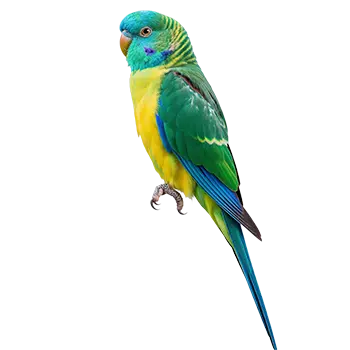
The Turquoisine Parakeet has been a subject of admiration in wildlife art since the earliest days of European exploration in Australia. John Gould's celebrated lithographs, produced for The Birds of Australia in the 1840s, remain among the most iconic depictions of the species, capturing the turquoise facial markings and luminous green plumage with a precision that still impresses ornithologists and art historians alike. Gould's plates helped establish the Turquoisine as one of Australia's most visually appealing birds in the European imagination, and reproductions of his work continue to circulate in fine art prints, field guides, and natural history exhibitions.

Subsequent generations of Australian wildlife artists built on Gould's legacy, finding in the Turquoisine a subject that rewards close observation and careful color work. Neville Cayley, whose What Bird Is That? became a household reference in Australia from the 1930s onward, included detailed illustrations of the species that introduced it to a broad popular audience. Later artists working in watercolor, gouache, and acrylic have explored the play of light on the parakeet's plumage, often depicting the bird in its natural setting of dappled eucalyptus woodland to emphasize the interplay between the vivid feathers and the muted tones of the Australian bush.

The species also features in the decorative and applied arts. Australian ceramicists, textile designers, and jewelers have drawn on the Turquoisine's color palette, translating its distinctive turquoise, green, and yellow tones into pieces that reference native fauna without necessarily depicting the bird literally. This abstracted use of the parakeet's coloring speaks to the broader role that Australia's unique avifauna plays in national design identity, where native species serve as a shorthand for ecological distinctiveness and aesthetic originality.

In the international avicultural art community, the Turquoisine Parakeet is a perennial favorite for illustrators producing breed profiles, avicultural society logos, and exhibition materials. The bird's compact proportions and striking color contrasts make it an effective subject for both detailed scientific illustration and more stylized graphic treatments. Annual exhibitions organized by avicultural societies in Europe, North America, and Australasia frequently feature artwork showcasing Neophema species, with the Turquoisine typically commanding particular attention from judges and audiences.

In Documentary & Film

While the Turquoisine Parakeet has not achieved the mainstream documentary fame of larger, more vocal parrot species, it has appeared in a number of wildlife productions focused on Australian ecosystems and the broader story of Australian bird conservation. Natural history documentaries exploring the woodlands of southeastern Australia frequently include footage of Neophema parakeets foraging quietly on the ground or perched in the canopy, and the Turquoisine's vivid coloration makes it a visually rewarding subject for cinematographers working in these habitats.

Australian broadcasting networks, including the Australian Broadcasting Corporation, have produced segments and short features highlighting the Turquoisine's dramatic conservation history. The narrative of a species that nearly vanished and then gradually recovered lends itself naturally to the redemptive arc that documentary filmmakers favor, and the bird's photogenic appearance ensures that such segments have strong visual appeal. These productions have helped raise public awareness of the challenges facing woodland birds in Australia and have occasionally prompted renewed interest in habitat restoration initiatives.

The species has also featured in educational and institutional films produced by Australian wildlife agencies and conservation organizations. These shorter works, often screened at visitor centers in national parks and nature reserves within the Turquoisine's range, use the parakeet as a focal species to communicate broader messages about the importance of woodland conservation, the role of nest-box programs, and the impact of introduced predators on native fauna. The Turquoisine's story serves as an accessible entry point for audiences who may have little prior knowledge of Australian woodland ecology.

In the international context, the Turquoisine Parakeet occasionally appears in aviculture-focused video content produced by breeders and hobbyists. The growth of online video platforms has made it possible for enthusiasts around the world to share footage of their birds, document breeding successes, and offer husbandry tutorials that feature the species prominently. While these productions lack the polish of professional documentaries, they have played an important role in building global awareness of the Turquoisine and in creating a distributed archive of behavioral and avicultural knowledge.

In Literature & Field Guides

The Turquoisine Parakeet's literary presence begins with the scientific and expedition literature of the late 18th and early 19th centuries, where accounts by colonial naturalists introduced the species to European readership. George Shaw's initial description in 1792 and the subsequent entries in early ornithological catalogues established the bird as a recognized member of Australia's remarkable avifauna. These early texts, though primarily taxonomic in purpose, often included observations on behavior and habitat that gave readers a vivid sense of the living bird behind the preserved specimen.

The species occupies a secure place in Australian field guide literature, appearing in every major identification guide published for the region. From Cayley's classic What Bird Is That? through to the modern volumes by Simpson and Day, Pizzey and Knight, and Morcombe, the Turquoisine is described and illustrated with attention to the distinguishing features that separate it from other Neophema species, particularly the closely related Scarlet-chested Parakeet. These guides have been instrumental in enabling generations of birdwatchers to identify and appreciate the species in the field, contributing directly to the citizen-science observations that inform conservation management.

Beyond identification guides, the Turquoisine has featured in broader works of Australian natural history writing. Authors exploring the ecological transformations wrought by European settlement have cited the species as a case study in the vulnerability of woodland birds to habitat loss and introduced predators. The parakeet's near-disappearance and gradual recovery provide compelling narrative material for writers seeking to illustrate both the damage inflicted on Australian ecosystems and the potential for restoration when sustained effort is applied.

In international avicultural literature, the Turquoisine Parakeet is covered extensively in handbooks devoted to Australian parakeets and the broader Neophema genus. Publications by avicultural societies in Europe, North America, and Australia provide detailed accounts of captive husbandry, breeding protocols, genetics of color mutations, and veterinary considerations specific to the species. These texts serve a dual function, guiding practical aviculture while also recording the accumulated knowledge of decades of captive management in a form that is accessible to both hobbyists and professional breeders.

In Photography & Social Media

The Turquoisine Parakeet's extraordinary plumage has made it a prized subject for wildlife photographers in Australia, and images of the species circulate widely in both print and digital media. Capturing a Turquoisine in the wild requires patience and fieldcraft, as the bird's quiet habits and preference for dense woodland edges make it considerably more challenging to photograph than many of Australia's more conspicuous parrots. The resulting images, often showing the parakeet foraging on the ground amid native grasses or perched against a backdrop of peeling bark and eucalyptus leaves, are valued for both their aesthetic quality and their documentary significance.

Bird photography competitions and exhibitions in Australia and internationally have featured Turquoisine Parakeet images among their selected and award-winning entries. The species' combination of intense color and naturalistic setting creates opportunities for photographers to produce images that are simultaneously striking and authentic, avoiding the artificial quality that can result from photographing birds in captivity. For wildlife photography publications and calendars, the Turquoisine offers the appealing combination of visual impact and relative obscurity, introducing audiences to a species they may not have previously encountered.

On social media platforms, the Turquoisine Parakeet has developed a following that spans birdwatchers, aviculturists, and casual nature enthusiasts. Instagram accounts dedicated to Australian birds regularly feature the species, and avicultural groups on Facebook and dedicated forums provide spaces where breeders share photographs of their birds, discuss color mutations, and celebrate breeding milestones. These platforms have democratized access to images and information about the Turquoisine, making a species that was once known primarily to specialist audiences visible to a global public.

The social media presence of the Turquoisine Parakeet has also created new dynamics in avicultural culture. High-quality photographs of well-maintained birds and successful breeding setups set visible standards for husbandry, and the immediate feedback loop of online platforms allows breeders to share solutions to common challenges in real time. The species' photogenic qualities ensure consistent engagement, and the communities that have formed around it online represent a significant extension of the traditional avicultural society model into the digital age.

In Avicultural Shows & Exhibitions

The Turquoisine Parakeet has been a fixture of avicultural shows and exhibitions for well over a century, and the species consistently ranks among the most popular entries in the Neophema and Australian parakeet divisions at competitive events. Avicultural societies in Australia, the United Kingdom, continental Europe, and North America host annual shows where breeders present their finest specimens for evaluation by expert judges, and the Turquoisine's striking appearance and well-defined breed standards make it a perennial crowd favorite.

Judging standards for the Turquoisine Parakeet at competitive exhibitions emphasize plumage quality, color intensity, body conformation, and overall condition. The ideal show bird displays bright, cleanly defined turquoise facial markings, rich green upperparts free of barring or discoloration, and a clear, well-colored breast. Separate classes typically exist for normal (wild-type) birds and for recognized color mutations, including yellow, dilute, olive, and red-bellied variants. The proliferation of color mutations has added depth and complexity to the exhibition scene, attracting breeders who specialize in particular genetic lines and contributing to a rich competitive landscape.

Beyond the competitive element, avicultural exhibitions serve important educational and community functions. Display aviaries at major shows allow members of the public to observe the Turquoisine Parakeet at close range, and experienced breeders are often available to answer questions about the species' care, behavior, and breeding requirements. For many attendees, an avicultural show provides the first opportunity to see a live Turquoisine, and the impression the bird makes in person frequently inspires new entrants into the hobby. Societies use these events to distribute care guides, promote responsible breeding practices, and recruit new members.

International avicultural exhibitions have also played a role in the genetic management of the captive Turquoisine Parakeet population. By bringing together breeders from different regions and facilitating the exchange of breeding stock, these events help counteract the genetic bottlenecks that can develop in small, isolated captive populations. The networking opportunities afforded by shows and exhibitions have been instrumental in maintaining the health and diversity of the global captive population, ensuring that the Turquoisine remains a viable and vibrant avicultural species for future generations.

Online Communities & Modern Fandom

The growth of online communication has transformed the culture surrounding the Turquoisine Parakeet, connecting enthusiasts across continents and creating communities of shared knowledge that would have been unimaginable to the species' early admirers. Dedicated forums, Facebook groups, and subreddits devoted to Neophema parakeets and Australian bird species provide spaces where breeders, pet owners, and field observers exchange information, troubleshoot problems, and celebrate their birds. The Turquoisine, with its broad appeal across experience levels, is consistently one of the most discussed species in these spaces.

These online communities have played a meaningful role in the standardization and dissemination of best practices in Turquoisine husbandry. Discussions about diet, aviary design, breeding management, and veterinary care draw on the collective experience of hundreds of keepers, producing a body of practical knowledge that complements and sometimes challenges the guidance found in published avicultural literature. The immediacy of online communication means that emerging issues, such as disease outbreaks or newly identified nutritional requirements, can be flagged and addressed far more rapidly than was possible through traditional channels.

The digital landscape has also given rise to a form of Turquoisine Parakeet fandom that blends avicultural interest with broader cultural engagement. Artists create and share original illustrations, digital paintings, and even animated content featuring the species, contributing to a growing body of fan-created media. Citizen-science platforms such as eBird and iNaturalist have enabled field observers to log and share sightings of wild Turquoisines, building a publicly accessible dataset that informs conservation management while also fostering a sense of personal connection between individual observers and the species.

The international scope of these online communities has reshaped the cultural geography of the Turquoisine Parakeet. A species that was historically known primarily within Australian ornithological and avicultural circles now has devoted followers in Europe, Asia, and the Americas, many of whom will never encounter the bird in its native habitat but who engage deeply with its biology, husbandry, and conservation through digital channels. This global community represents a new chapter in the Turquoisine's cultural history, one defined by connectivity, shared purpose, and an expanding circle of appreciation for a small, quiet parakeet from the Australian bush.

Always consult a qualified professional before making any health-related decisions. This content is provided for informational reference only and should not replace professional guidance specific to your animal.