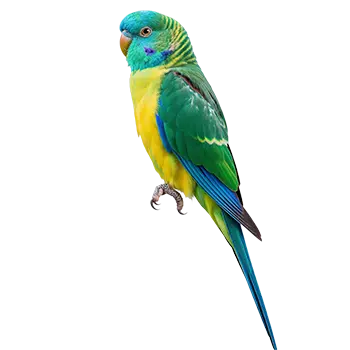

The Turquoisine Parakeet (Neophema pulchella) is endemic to the eucalyptus woodlands, open forests, and grassy edges of southeastern Australia. Its historical range extended from southeastern Queensland through New South Wales and into northern and eastern Victoria, occupying a corridor of temperate habitat characterized by scattered trees, tussock grasslands, and the transitional zones between dense forest and open pasture. Within this landscape the species evolved alongside other Neophema grass parakeets, carving out a niche that favored ground-level foraging combined with tree-hollow nesting.
The genus Neophema comprises six small parakeet species, all confined to Australia, and the Turquoisine is widely considered the most strikingly colored of the group. Males display a vivid turquoise-blue face and wing patch set against bright green upperparts and a yellow breast, while females present a subtler version of the same palette. This coloration, combined with the bird's relatively quiet and gentle disposition, would later prove central to its appeal in aviculture, but in the wild it serves a more immediate function: the green plumage blends remarkably well with the dappled light of the eucalyptus understory, while the blue facial markings play a role in mate recognition and social signaling.
Ecologically the Turquoisine Parakeet feeds primarily on the seeds of native grasses and herbaceous plants, supplemented by small fruits, flowers, and occasional invertebrates. It forages on the ground or in low vegetation, often in pairs or small family groups rather than the large flocks typical of many Australian parrots. This comparatively solitary habit and its preference for dense woodland edges made the species less conspicuous than noisier, more gregarious parakeets, contributing to periods of apparent rarity that would later alarm ornithologists.
The bird's dependence on mature tree hollows for nesting links its reproductive success directly to the health and age structure of its woodland habitat. Competition for hollows with other cavity-nesting species, including introduced European Starlings and feral honeybees, has been a persistent ecological pressure. Combined with land clearing for agriculture that accelerated from the mid-19th century onward, these habitat dynamics set the stage for significant population declines that would define the Turquoisine's modern conservation narrative.