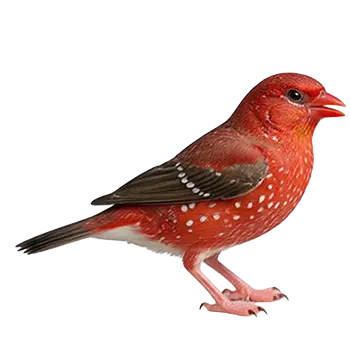

The Strawberry Finch has a long and distinguished presence in the visual arts of South and Southeast Asia. Indian miniature painting, particularly the schools that flourished under Mughal, Rajput, and Pahari patronage from the 16th through the 19th centuries, frequently depicted small ornamental birds in garden and courtly settings. While individual species are not always identifiable with certainty in these works, brightly colored red finches consistent with the Avadavat appear alongside flowering plants, fountains, and human figures in compositions designed to evoke the beauty and order of the cultivated natural world.
The Mughal emperors were famously devoted to natural history, and court artists such as Ustad Mansur produced remarkably precise studies of birds and animals during the reigns of Jahangir and Shah Jahan. The tradition of bird portraiture that Mansur helped establish influenced generations of Indian painters, and the Strawberry Finch, with its vivid red plumage and distinctive white spotting, was among the species that lent itself particularly well to the exacting detail these artists favored. Ornithological illustration in this tradition served both aesthetic and documentary purposes, creating a visual record of avian diversity that remains valuable to historians and scientists today.
In European art, the Strawberry Finch appeared primarily in the context of natural history illustration rather than fine art. As the species became established in European aviculture during the 18th and 19th centuries, it was depicted in the ornithological plates that accompanied major scientific works. Artists such as John Gould, whose monumental volumes on the birds of Asia included hand-colored lithographs of extraordinary quality, depicted the Red Avadavat with the precision and elegance for which Victorian-era bird illustration is celebrated. These images helped establish the species' visual identity in Western consciousness and remain widely reproduced.
Beyond formal painting and illustration, the Strawberry Finch has appeared in decorative arts across its native range. Textile designs, ceramic motifs, and carved ornamental panels in Indian and Southeast Asian craft traditions sometimes incorporate small red birds that likely reference the Avadavat or closely related species. These appearances in applied and decorative art speak to the bird's integration into the broader aesthetic vocabulary of cultures that have lived alongside it for centuries.