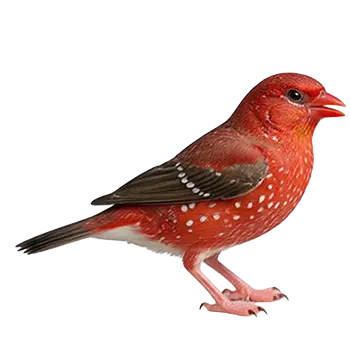

The Strawberry Finch (Amandava amandava) is a small passerine bird belonging to the family Estrildidae, the waxbills and allies. Its native range spans an enormous swath of tropical and subtropical Asia, stretching from the lowlands of Pakistan across the Indian subcontinent through Nepal, Bangladesh, and Myanmar, and onward into Thailand, Cambodia, Vietnam, and parts of southern China. Within this broad geographic band the species favors open grasslands, marshes, reed beds, and the margins of cultivated fields, particularly areas where tall grasses and scrubby vegetation provide cover and nesting sites near dependable water sources.
Three subspecies are generally recognized by ornithologists. Amandava amandava amandava occupies the western portion of the range, from Pakistan through most of India. Amandava amandava flavidiventris is found in Myanmar, southern China, and parts of mainland Southeast Asia. Amandava amandava punicea occurs in Southeast Asian populations extending into the Indonesian archipelago. While the subspecies differ subtly in the extent and intensity of red coloration and in the precise patterning of the white spots that give the bird its common name, all share the compact body plan, conical bill, and active foraging behavior characteristic of estrildid finches.
The Strawberry Finch thrives in habitats shaped by the seasonal rhythms of the monsoon. During the wet season, tall grasses surge to heights that can conceal the diminutive bird entirely, and breeding activity peaks as insect availability rises. Males in full breeding plumage display a vivid crimson coloration across the head, breast, and flanks, punctuated by delicate white spots that have been compared to seeds on the surface of a ripe strawberry, giving the species its most evocative common name. Outside the breeding season the red fades to a more subdued brownish tone, though the white spotting remains a reliable field mark.
Ecologically, the Strawberry Finch occupies a niche typical of small granivorous birds in grassland ecosystems. It feeds primarily on grass seeds, supplementing with small invertebrates during the breeding season when protein demands are highest. Flocks can number from a handful of individuals to several dozen, and in areas where rice paddies or sugarcane fields adjoin natural wetlands the species can be locally abundant. This proximity to human agriculture has been a defining feature of the Strawberry Finch's ecological story, shaping both human perceptions of the bird and the trajectory of its eventual domestication.