
Origins & Natural Habitat

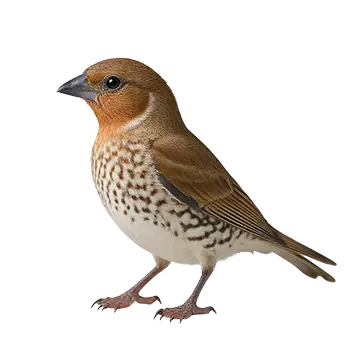
The Spice Finch (Lonchura punctulata), also widely known as the Nutmeg Mannikin or Scaly-breasted Munia, is a small estrildid finch native to an expansive range stretching from the Indian subcontinent through Southeast Asia. Its natural distribution encompasses the lowlands and foothills of India, Sri Lanka, Nepal, Bangladesh, Myanmar, Thailand, Malaysia, Indonesia, the Philippines, and southern China. Within this broad territory the species has adapted to an impressive variety of habitats, from irrigated rice paddies and cultivated grasslands to scrubby forest edges, mangrove margins, and suburban gardens. This ecological flexibility is one of the key factors behind both its historical abundance and its eventual success as a domesticated companion.

In its native ecosystems the Spice Finch is a gregarious, seed-eating bird that congregates in flocks ranging from a dozen individuals to several hundred. It favors the seed heads of grasses, rice, millet, and other cereal crops, and its feeding behavior has placed it in close proximity to human agriculture for millennia. Breeding pairs construct bulky, domed nests woven from grass blades and plant fibers, typically situated in dense shrubs, tall grasses, or the eaves of rural structures. This comfort around human settlements distinguished the Spice Finch from many of its forest-dwelling relatives and facilitated its early capture and domestication.

Taxonomically the species belongs to the family Estrildidae, a diverse group of small passerines distributed across the Old World tropics. Within the genus Lonchura it is one of the most widespread and morphologically variable members, with ornithologists recognizing numerous subspecies that differ subtly in plumage tone, breast scaling intensity, and bill coloration. The nominate subspecies, L. p. punctulata, is found across much of peninsular India, while forms such as L. p. topela in Southeast Asia and L. p. cabanisi in the Philippines reflect the species' long history of geographic radiation and local adaptation.

The Spice Finch's dependence on grassland and agricultural habitats means that its population dynamics have been closely tied to human land use patterns for centuries. In regions where traditional rice cultivation persists, wild populations remain robust. However, intensification of agriculture, pesticide use, and urbanization have reduced suitable habitat in parts of its historical range. Despite these pressures, the species as a whole is classified as Least Concern by the International Union for Conservation of Nature, a testament to its adaptability and the sheer breadth of its distribution across tropical Asia.

Early Domestication & the Asian Tradition

The Spice Finch holds the distinction of being one of the earliest passerine birds to be kept by humans, with a domestication history that stretches back well over a thousand years. In the Indian subcontinent, references to small seed-eating birds kept in cages appear in Sanskrit literature and in the artistic traditions of medieval Hindu and Buddhist courts. While precise identification of species in ancient texts is often debated, ornithological historians generally agree that the munia group, and the Spice Finch in particular, figured prominently among the cage birds of classical South Asian civilization.

In China and Southeast Asia the keeping of munias and related finches was deeply embedded in cultural life by the Tang Dynasty period. Chinese aviculturists valued the Spice Finch for its hardiness, its willingness to breed in captivity, and its pleasant, unobtrusive chirping. The bird's small size and modest dietary requirements made it accessible even to households of limited means, and it became one of the most commonly kept cage birds across the Chinese cultural sphere. Selective breeding during this era may have produced early color variants, though documented records of deliberate mutation breeding in munias do not appear until considerably later.

Japanese aviculture absorbed the Spice Finch tradition from Chinese and Southeast Asian sources, and the bird became established in Japan by the Edo period. Japanese breeders, already renowned for their meticulous approach to cultivating ornamental plants and animals, applied similar discipline to finch keeping. The closely related Bengalese Finch, or Society Finch, which is widely believed to have been domesticated from the closely allied White-rumped Munia (Lonchura striata) with possible munia hybridization, owes part of its developmental lineage to the broader Asian tradition of munia husbandry in which the Spice Finch played a foundational role.

Throughout this long Asian history the Spice Finch occupied a cultural niche distinct from that of more flamboyant cage birds such as parrots or mynas. It was valued not for showmanship or speech but for its quiet companionship, its sociability in mixed-species aviaries, and the aesthetic pleasure of its neatly scaled plumage. This understated appeal would later translate seamlessly into the Western avicultural tradition, where the Spice Finch found a welcoming audience among hobbyists who prized ease of care and gentle temperament.

Introduction to the Western World

The Spice Finch first reached European shores during the great age of colonial trade in the 17th and 18th centuries. Dutch, Portuguese, and British merchants operating in South and Southeast Asia encountered the bird in local markets and recognized its potential as a novel cage bird for European consumers. Early shipments were small and suffered high mortality during the long sea voyages, but by the mid-18th century a trickle of live Spice Finches was reaching Amsterdam, Lisbon, and London with sufficient regularity to establish the species in the European pet trade.

The bird's common English names reflect this colonial-era introduction. The name Spice Finch almost certainly derives from the bird's association with the spice-producing regions of South and Southeast Asia, while Nutmeg Mannikin references both the warm brown tones of the plumage and the bird's geographic overlap with the nutmeg-growing islands of the East Indies. These evocative names helped market the bird to European buyers who associated it with the exotic allure of the tropical spice trade, and the names have persisted in avicultural usage to this day.

By the 19th century the Spice Finch had become one of the most commonly imported exotic finches in Europe. Advances in maritime technology reduced transit times and improved survival rates, and the expanding colonial infrastructure in India and Southeast Asia made large-scale collection and export increasingly practical. German aviculturists in particular embraced the species, and German-language avicultural literature from the late 1800s contains detailed accounts of breeding, housing, and dietary recommendations that remain remarkably relevant. The bird's affordability and adaptability made it a gateway species for many European hobbyists entering the world of exotic finch keeping.

The Spice Finch reached North America through similar channels, arriving with European immigrants and through direct importation from Asia. By the early 20th century it was a staple of the American pet trade, available in pet shops and through bird dealers across the country. Its popularity in the United States grew steadily through the mid-century decades, and the species became a foundational member of the American finch-keeping community that would eventually coalesce around clubs, shows, and dedicated publications.

Cultural Symbolism & Folklore

In the cultural traditions of South and Southeast Asia the Spice Finch and its close relatives carry symbolic meanings that have accumulated over centuries. In Hindu culture, birds as a group are frequently associated with the soul, freedom, and divine messengers, and small seed-eating birds like the munia appear in folk art, textile patterns, and temple carvings as emblems of domesticity, fertility, and the rhythms of the agricultural year. The Spice Finch's close association with rice paddies links it symbolically to prosperity and the harvest, a connection that resonates across the rice-growing civilizations of monsoon Asia.

In parts of Indonesia and the Philippines, munias including the Spice Finch have featured in traditional bird-keeping competitions and community festivals. These events, which involve singing contests, plumage exhibitions, or simply the communal enjoyment of cage birds displayed in public spaces, reflect a deep-rooted cultural relationship between humans and small passerines that predates Western influence. The birds serve as social connectors, bringing together enthusiasts across lines of class, age, and occupation in shared appreciation of avian beauty.

In Western culture the Spice Finch has not achieved the mythological stature of parrots or birds of prey, but it occupies a respected niche as a symbol of accessible, responsible pet keeping. Avicultural societies in Europe and North America have long held up the Spice Finch as an ideal beginner bird, and its image appears frequently in introductory guides, club logos, and educational materials aimed at new hobbyists. This ambassadorial role has given the species an outsized influence on how the broader public perceives exotic finch keeping as a hobby.

The bird's scalloped breast pattern has also drawn attention from artists and designers. The repeating crescent motif of the plumage has been likened to fish scales, overlapping roof tiles, and the geometric patterns found in Islamic and South Asian decorative arts. While no direct causal link between the finch's plumage and any specific artistic tradition has been established, the visual resonance has made the Spice Finch a favorite subject for natural history illustrators and bird artists seeking to capture the elegance of pattern in miniature form.

Avicultural Development & Breeding History

The history of Spice Finch breeding in captivity is one of gradual refinement rather than dramatic transformation. Unlike domesticated canaries, which underwent centuries of intensive selective breeding that produced dozens of distinct breeds and color varieties, the Spice Finch has remained relatively close to its wild form throughout its long association with humans. This is partly a function of the species' genetics, which have proven less prone to the dramatic color mutations that drive variety creation in other finch species, and partly a reflection of the avicultural community's appreciation for the bird's natural appearance.

Nevertheless, captive breeding efforts have produced a modest range of color mutations and plumage variants. Chocolate, fawn, and dilute forms have been established in aviculture, and pied variants occasionally appear. European breeders, particularly in the Netherlands, Belgium, and Germany, have been at the forefront of stabilizing these mutations and developing exhibition standards. The COM (Confederation Ornithologique Mondiale) and its affiliated national organizations have established judging criteria for Spice Finch exhibition classes, evaluating birds on conformation, feather quality, scaling definition, and overall condition.

The Spice Finch's breeding behavior in captivity is well documented and generally straightforward, which has contributed to its enduring popularity among hobbyist breeders. Pairs typically accept a variety of nest boxes and woven baskets, constructing untidy but functional nests from provided materials such as coconut fiber, dried grass, and soft plant stems. Clutch sizes average four to six eggs, and both parents share incubation duties over a period of approximately twelve to fourteen days. The cooperative parenting strategy and the species' tolerance of colony breeding arrangements make it one of the more productive finches in captive settings.

The species has also played a quiet but significant role in the broader history of aviculture as a foster parent. Spice Finches and their close relative the Society Finch have been used extensively to incubate and rear the chicks of more difficult-to-breed finch species, including various waxbills, parrotfinches, and Gouldian Finches. This fostering tradition, which dates back at least to the 19th century, has been instrumental in establishing captive populations of species that might otherwise have struggled to reproduce reliably in aviary settings.

The Spice Finch Today

In the contemporary avicultural landscape the Spice Finch remains one of the most widely kept and readily available exotic finches in the world. It is a fixture of pet shops, bird fairs, and online breeders across North America, Europe, Australia, and Asia. Its affordability, hardiness, and gentle disposition continue to make it one of the first species recommended to newcomers interested in finch keeping, and it serves as a reliable anchor species in mixed-species aviaries where its peaceable nature rarely causes conflict with other small birds.

The species has also established feral populations in several regions outside its native range, a phenomenon driven by escaped or deliberately released cage birds. In the United States, self-sustaining colonies of Spice Finches exist in parts of southern California, Florida, Texas, and Hawaii. In Australia, introduced populations have become well established in the tropical north and along the eastern seaboard. These feral populations are generally regarded as ecologically benign, as the birds occupy niches similar to those of native granivorous species without significantly displacing them, though monitoring continues in areas of conservation sensitivity.

Online communities and social media have expanded the Spice Finch's cultural reach in recent years. Dedicated Facebook groups, forums, and YouTube channels attract thousands of members who share breeding records, aviary designs, dietary tips, and photographs of their birds. These digital communities have democratized access to avicultural knowledge that was once confined to printed journals and local club meetings, and they have fostered international connections among breeders who might otherwise never have encountered one another.

Despite its long history and widespread availability, the Spice Finch continues to reward attentive keepers with behaviors and subtleties that defy its reputation as a simple beginner bird. Experienced aviculturists note the complexity of its flock dynamics, the variety of its vocalizations, and the satisfaction of successfully breeding and rearing healthy clutches. For many finch enthusiasts, the Spice Finch is not merely a starting point but a lifelong companion species whose modest appearance belies a depth of character that reveals itself over years of careful observation and care.

Always consult a qualified professional before making any health-related decisions. This content is provided for informational reference only and should not replace professional guidance specific to your animal.