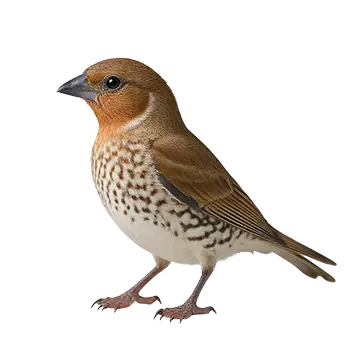

The Spice Finch and its close relatives within the munia family have been subjects of Asian visual art for centuries. In the classical painting traditions of China and Japan, small seed-eating birds perched on stalks of millet or rice are a recurring motif, and the Spice Finch's distinctive scalloped breast pattern makes it identifiable in a number of surviving scroll paintings and screen panels from the Song, Ming, and Edo periods. These works typically situate the bird within carefully composed natural scenes that emphasize seasonal themes, the harmony between cultivated landscapes and wildlife, and the quiet beauty of everyday rural life.
Indian miniature painting, particularly the naturalistic tradition that flourished under Mughal patronage in the 16th through 18th centuries, produced detailed bird studies that occasionally feature munias among the species depicted. Mughal court painters such as Ustad Mansur, celebrated for their precise renderings of flora and fauna, worked in a tradition that valued accurate observation alongside decorative elegance. While the Spice Finch did not receive the singular attention lavished on more spectacular species like peacocks or falcons, its presence in broader avian inventories reflects its familiarity as a common bird of the Indian landscape.
In Southeast Asian decorative arts the munia group appears in textile patterns, lacquerware, and temple ornamentation. Balinese and Javanese artistic traditions, which draw heavily on the natural world for motifs, incorporate small finch-like birds into carved panels, batik designs, and ceremonial objects. The stylized representations in these media often blend multiple species into generalized forms, making precise identification difficult, but the cultural significance of small grain-eating birds as symbols of abundance and agricultural prosperity is unmistakable.
The cumulative effect of this artistic legacy is that the Spice Finch, while rarely the singular star of a masterwork, occupies a persistent and meaningful position in the visual culture of the regions where it has been most closely associated with human life. Its appearance in art mirrors its role in nature: unassuming, communal, and woven into the fabric of landscapes shaped by centuries of cultivation.