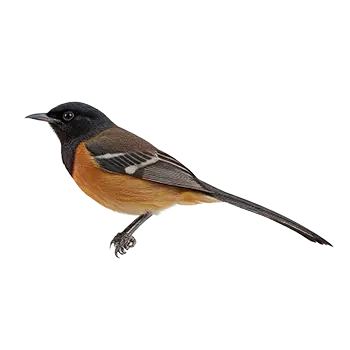

The Shama Thrush has occupied a distinguished place in the literary traditions of South and Southeast Asia for centuries. In classical Malay literature, the bird appears under various regional names as a recurring motif in pantun and syair, traditional verse forms that draw heavily on the natural world for imagery and metaphor. Poets invoked the Shama's song to express themes of longing, beauty, and the passage of time, often pairing the bird's voice with descriptions of twilight or dawn to evoke a mood of contemplative melancholy. The pantun form, with its characteristic opening couplet drawn from nature followed by a human parallel in the closing couplet, proved especially well suited to the Shama, whose persistent, emotionally resonant singing served as a natural analogue for the human heart.
In the literary traditions of the Indian subcontinent, the Shama Thrush is less explicitly named than in Malay poetry, but references to melodious forest songbirds in Sanskrit, Tamil, and later vernacular literatures are widely understood to encompass the species among others. The Sanskrit concept of the kokila, the supreme songbird of the forest, has sometimes been extended beyond the Asian Koel to include the Shama in regional interpretations, particularly in the hill regions of southern India and Sri Lanka where the species is abundant. British colonial-era naturalist-writers, including E.C. Stuart Baker and Hugh Whistler, produced detailed literary-scientific accounts that blended field observation with appreciative prose, helping to introduce the Shama Thrush to English-language readers.
In Thai literary tradition, the Shama Thrush, known locally as nok krating thong, appears in folk tales and classical court poetry. Thai verse traditions that catalog the beauties of the natural world frequently include the Shama among the birds whose voices exemplify the harmony of the forest. These literary references reinforced the bird's cultural status and helped establish the aesthetic framework within which Thai songbird-keeping traditions developed, linking the practice of keeping a fine Shama to a broader appreciation of art and natural beauty.
The Shama Thrush's literary presence has continued into the modern era, though in different forms. Contemporary nature writers and essayists in Malaysia, Indonesia, and India have drawn on the bird's cultural associations while also addressing the conservation challenges it faces. These writers often use the Shama as a lens through which to examine broader questions about the relationship between traditional culture and environmental sustainability, asking whether practices rooted in genuine aesthetic appreciation can coexist with the ecological realities of the 21st century.