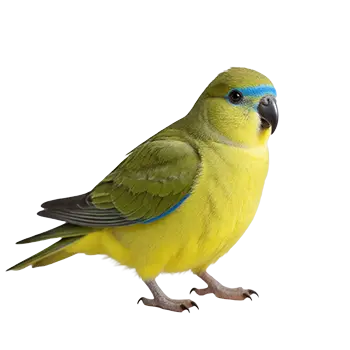

Origins & Natural Habitat

The Rock Parrot (Neophema petrophila) is a small, predominantly olive-green parrot endemic to the southern coastline of Australia. Its range extends from the shores of western Victoria across the coast of South Australia and along the southern and southwestern margins of Western Australia, including numerous offshore islands. Unlike most parrots, which are associated with forests, woodlands, or grasslands, the Rock Parrot is an obligate coastal species whose entire life cycle is tied to the narrow interface between land and sea.

The species occupies a habitat niche that is remarkably specific among parrots. Rocky shorelines, coastal dune systems, samphire flats, and the low scrubby vegetation that fringes southern Australian beaches constitute the Rock Parrot's primary environment. It forages on the seeds of coastal plants such as sea rocket, ice plant, and various saltbush species, supplementing its diet with the seeds of grasses and herbs found in the dune hinterland. This dietary specialization reflects a long evolutionary association with maritime plant communities that are themselves shaped by salt spray, wind exposure, and sandy substrates.

The Rock Parrot's most distinctive ecological trait is its nesting behavior. It is one of very few parrot species in the world that routinely nests on the ground or in rocky crevices rather than in tree hollows. Nest sites are typically located among boulders, in gaps between rocks, beneath overhanging ledges on coastal cliffs, or even in the burrows and rubble of offshore islands. This ground-nesting habit is highly unusual for a psittacine and has significant implications for the species' vulnerability to introduced predators, a factor that has shaped its modern conservation trajectory.

The genus Neophema, to which the Rock Parrot belongs, comprises a small group of Australian grass parrots that also includes the Elegant Parrot, Blue-winged Parrot, Orange-bellied Parrot, Turquoise Parrot, and Scarlet-chested Parrot. Within this genus, the Rock Parrot is the most strictly coastal and arguably the most habitat-specialized. Genetic and morphological studies suggest that the Neophema lineage diverged from other Australian parrots millions of years ago, and the Rock Parrot's adaptation to coastal rocky environments represents a relatively ancient ecological specialization within the group.

Early Scientific Description & European Encounter

The Rock Parrot was formally described by the naturalist John Gould in 1841, based on specimens collected along the southern coast of Australia. Gould assigned the species the binomial name Euphema petrophila, with the specific epithet derived from the Greek words petros (rock) and philos (loving), a direct reference to the bird's well-known association with rocky coastal habitats. The genus was later revised to Neophema, but the descriptive accuracy of Gould's original name has endured. Few species carry a common name so precisely aligned with their ecology.

Gould's encounter with the Rock Parrot took place during his extensive travels through Australia between 1838 and 1840, a period that produced his monumental illustrated work The Birds of Australia. In his accompanying text, Gould noted the species' preference for rocky islets and shoreline boulders and remarked on its relatively subdued plumage compared to other Australian parrots. He observed that the Rock Parrot was not particularly wary of human approach, a behavioral trait that later observers would confirm and that likely reflected the species' historical isolation from terrestrial predators on offshore islands.

Prior to Gould's formal description, European settlers along the southern Australian coast had undoubtedly encountered the Rock Parrot, though written records from the colonial period are sparse. Early accounts from South Australia and the Swan River Colony in Western Australia occasionally mention small green parrots on the coast, but these references are often too vague to attribute with certainty to Neophema petrophila rather than to related species such as the Elegant Parrot or Blue-winged Parrot, which share portions of the Rock Parrot's range.

The scientific classification of the Rock Parrot remained relatively stable through the 19th and 20th centuries, though periodic revisions to the Neophema genus prompted reassessments of its phylogenetic relationships. Modern molecular studies have confirmed the Rock Parrot's position within Neophema and have clarified its relationship to congeners, placing it as a sister species to the Elegant Parrot. This taxonomic stability reflects the distinctiveness of the Rock Parrot's morphology and ecology, which have left little ambiguity about its identity since Gould first described it nearly two centuries ago.

Indigenous Knowledge & Pre-Colonial Context

Long before European naturalists documented the Rock Parrot, the Indigenous peoples of southern Australia were intimately familiar with the bird and its coastal environment. The Aboriginal nations whose traditional lands encompass the Rock Parrot's range include the Noongar people of southwestern Western Australia, the Mirning and Wirangu peoples of the Great Australian Bight region, and the Kaurna and Ngarrindjeri peoples of the Adelaide Plains and Lower Murray area in South Australia. Each of these groups possessed detailed ecological knowledge of their local fauna, accumulated over tens of thousands of years of continuous habitation.

The Rock Parrot, as a small and relatively inconspicuous bird, did not occupy the same prominent place in Indigenous cultural narratives as larger or more dramatically plumaged species such as cockatoos, emus, or wedge-tailed eagles. However, Aboriginal ecological knowledge systems encompassed the full spectrum of local biodiversity, and coastal bird species were recognized as seasonal indicators, components of broader ecological relationships, and elements of the Dreaming stories that organized and explained the natural world. The Rock Parrot's presence along specific stretches of coastline would have been noted as part of the broader pattern of life in coastal Country.

The shellfish middens, fish traps, and other archaeological evidence found throughout the Rock Parrot's range attest to the deep and sustained relationship between Indigenous Australians and the coastal environments the bird inhabits. These communities managed their landscapes through practices such as cultural burning, which shaped vegetation patterns and indirectly influenced the habitat available to species like the Rock Parrot. The health of coastal dune vegetation, the distribution of seed-bearing plants, and the condition of rocky island ecosystems were all elements of a landscape that had been actively managed for millennia before European arrival disrupted those patterns.

The colonial period brought dramatic changes to southern Australian coastlines, including the introduction of livestock, the clearing of native vegetation, and the arrival of foxes, cats, and rats. These changes altered the ecological context in which the Rock Parrot had evolved and in which Indigenous communities had lived alongside it. Understanding the Rock Parrot's history requires acknowledging this pre-colonial baseline, a period of relative ecological stability during which the bird's ground-nesting habits were not the vulnerability they would become in the post-contact era.

Role in Australian Ornithological Tradition

The Rock Parrot holds a distinctive if understated place in the tradition of Australian ornithology. Australia's parrot fauna is among the richest and most diverse in the world, encompassing species that range from the massive Palm Cockatoo to the tiny Double-eyed Fig Parrot. Within this extraordinary assemblage, the Rock Parrot occupies a quiet corner, attracting less attention than the continent's more flamboyant or endangered psittacines but offering ornithologists a compelling case study in ecological specialization.

Throughout the late 19th and early 20th centuries, Australian field ornithologists documented the Rock Parrot's habits along the southern coast, contributing observations to journals such as The Emu and South Australian Ornithologist. These accounts described the species' feeding ecology, nesting behavior, and seasonal movements with increasing precision, building a detailed portrait of a bird whose lifestyle differed markedly from that of its forest- and woodland-dwelling relatives. The Rock Parrot's willingness to nest in accessible rocky sites made it relatively easy to study compared to tree-hollow-nesting species, and several detailed nest studies from this period remain valuable references.

The mid-20th century saw growing recognition of the conservation challenges facing Australian ground-nesting birds, and the Rock Parrot became one of several species included in broader assessments of the impact of introduced predators on island and coastal fauna. Research conducted on islands in the Recherche Archipelago off Western Australia and on various islands in South Australia's Spencer Gulf and Gulf St Vincent documented the effects of rat and cat introductions on Rock Parrot breeding success, contributing to the evidence base for predator-control programs that would later benefit the species.

In the contemporary era, the Rock Parrot has attracted renewed scientific interest as part of studies on the Neophema genus, particularly in comparison with its critically endangered cousin, the Orange-bellied Parrot. Researchers investigating the genetic diversity, population structure, and adaptive traits of Neophema species have included the Rock Parrot in comparative analyses, and its relatively stable population status has provided a useful benchmark against which to measure the decline of more threatened congeners. The Rock Parrot's contribution to Australian ornithology may be modest in scale, but it has been consistent and scientifically valuable.

Conservation History & Turning Points

The Rock Parrot's conservation history is less dramatic than those of Australia's most imperiled parrot species, but it is nonetheless instructive. The species has never been considered abundant, and its specialized coastal habitat has always limited its total population size. However, the Rock Parrot has avoided the catastrophic declines experienced by close relatives such as the Orange-bellied Parrot, which is now one of the rarest birds in the world. Understanding why the Rock Parrot has fared comparatively well, and where it remains vulnerable, has been a recurring theme in Australian avian conservation.

The introduction of European red foxes and feral cats to the Australian mainland in the 19th century represented the most significant threat to the Rock Parrot's persistence. As a ground-nesting species, the Rock Parrot is inherently vulnerable to mammalian predators that can access nest sites. On the mainland, predation by foxes and cats has reduced breeding success in many areas, and some formerly occupied stretches of coastline have seen local declines or extirpations. The species' survival has been disproportionately dependent on offshore islands where introduced predators are absent or have been removed.

Island conservation programs have been pivotal in securing the Rock Parrot's future. Across southern Australia, wildlife agencies and conservation organizations have undertaken predator-eradication campaigns on key offshore islands, removing rats, cats, and in some cases foxes from sites that support breeding Rock Parrots. These efforts, often conducted in concert with programs targeting seabird colonies and other vulnerable island fauna, have yielded measurable improvements in Rock Parrot nesting success. The experience gained from island predator control has also informed mainland management strategies, including fox-baiting programs in coastal reserves.

Habitat loss remains a secondary but persistent concern. Coastal development, recreational use of beaches and dune systems, and the spread of invasive plant species have degraded Rock Parrot habitat in parts of its range. Climate change adds a further layer of uncertainty, with rising sea levels and changing storm patterns potentially affecting the low-lying coastal and island habitats on which the species depends. Conservation managers have responded with habitat-restoration projects, revegetation of degraded dune systems, and the inclusion of Rock Parrot habitat considerations in coastal planning frameworks, though the long-term adequacy of these measures remains an open question.

The Rock Parrot Today

Today the Rock Parrot is listed as Least Concern by the International Union for Conservation of Nature, though this global assessment masks regional variation in population health and trajectory. In Western Australia, the species remains reasonably widespread along the coast from Perth south and eastward, with strongholds on offshore islands such as Rottnest Island, the islands of the Recherche Archipelago, and the Abrolhos group. In South Australia, populations persist along the coast of the Eyre Peninsula, on islands in Spencer Gulf and Gulf St Vincent, and in pockets along the Fleurieu Peninsula and Kangaroo Island. Victorian populations are small and localized, and the species' eastern range limit has likely contracted over the past century.

The Rock Parrot's profile within the Australian birdwatching community is that of a sought-after but unflashy species. It lacks the vivid plumage of the Scarlet-chested Parrot or the charismatic vocal abilities of larger psittacines, and its coastal habitat means that encounters are most likely on rocky shorelines, offshore islands, or dune-fringed beaches rather than in the bushland settings where most Australian birding takes place. For visiting international birders, the Rock Parrot is often a target species precisely because of its restricted habitat and the fact that it cannot be seen anywhere outside Australia.

In aviculture, the Rock Parrot is kept by a small number of specialist breeders, primarily within Australia. The species has never achieved the popularity of more colorful Neophema parrots such as the Turquoise Parrot or Scarlet-chested Parrot, and its quiet, somewhat secretive temperament makes it less immediately appealing as a cage bird. Australian avicultural societies maintain studbook records and breeding programs for the species, and some breeders have produced color mutations, though these remain uncommon compared to mutations in other Neophema species.

The Rock Parrot's cultural footprint is modest but genuine. It appears in regional wildlife guides, interpretive signage at coastal parks and reserves, and the promotional materials of nature-based tourism operations in southern Australia. For the communities that live along its stretch of coastline, the Rock Parrot is a familiar if easily overlooked neighbor, a small green bird that slips between the rocks at dawn and dusk, its presence a quiet indicator of the health of the coastal ecosystems it has inhabited for millennia.

Always consult a qualified professional before making any health-related decisions. This content is provided for informational reference only and should not replace professional guidance specific to your animal.