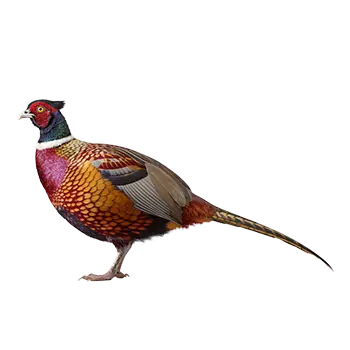

In Literature & Poetry

The Ring-necked Pheasant has occupied a distinctive niche in world literature, appearing most consistently in two overlapping traditions: the pastoral and sporting genres of European writing and the nature poetry and philosophical traditions of East Asia. In English literature, the pheasant figures prominently in country-life writing from the 18th century onward, where it serves as both a literal subject and a symbolic marker of the rural landscape. Poets and essayists evoked the cock pheasant's explosive flush from cover and the metallic brilliance of its plumage to convey the vitality and unpredictability of the natural world, often in contrast to the ordered rhythms of agricultural life.

In Chinese and Japanese literary traditions, pheasants appear in classical poetry stretching back more than two thousand years. Chinese poets of the Tang and Song dynasties referenced pheasants in verses exploring themes of seasonal change, natural beauty, and the transience of worldly splendor. The male pheasant's ornate plumage made it a ready metaphor for vanity, fleeting glory, and the tension between outward beauty and inner substance. In Japanese haiku and nature poetry, the pheasant appears as a seasonal reference word associated with spring, when the male's crowing call and territorial displays mark the turning of the year.

The pheasant's literary presence extends into children's literature and folk tale collections as well. In Roald Dahl's celebrated novel Danny, the Champion of the World, pheasant poaching serves as the central narrative engine, and the book's detailed depictions of pheasant behavior, habitat, and the culture surrounding game estates introduced millions of young readers to a bird they might otherwise have known only as a fleeting shape at the roadside. Dahl's treatment captured the pheasant's cultural entanglement with class, land ownership, and rural tradition with characteristic sharpness and humor.

Beyond these well-known examples, pheasants appear throughout the broader canon of sporting literature, a genre that encompasses memoirs, natural histories, and instructional texts produced by and for hunters. Writers in this tradition have often used the pheasant as a vehicle for reflecting on landscape, memory, and the ethical complexities of hunting. The result is a body of writing that ranges from purely practical field guides to deeply personal meditations on the relationship between humans, animals, and the land, with the Ring-necked Pheasant serving as a constant thread connecting disparate voices and eras.

In Visual Art & Illustration

Few birds have been as frequently or as lavishly depicted in the visual arts as the pheasant. The male Ring-necked Pheasant's combination of iridescent greens, burnished coppers, deep crimsons, and intricate barring has made it an irresistible subject for painters, illustrators, and decorative artists across cultures and centuries. In Chinese painting, pheasants appear on silk scrolls and porcelain as early as the Han Dynasty, rendered with the meticulous attention to plumage detail that characterizes the gongbi tradition. These works frequently pair pheasants with flowering trees or rocky outcroppings, creating compositions that balance naturalistic observation with symbolic resonance.

In Japan, pheasants are prominent subjects in the painted screens and hanging scrolls of the Kano, Rimpa, and Maruyama-Shijo schools. Japanese artists developed distinctive approaches to depicting pheasant plumage, using mineral pigments and gold leaf to capture the interplay of light on feathers. The pheasant's association with spring and renewal made it a popular choice for screens intended to adorn rooms during the New Year season, and the bird's image was incorporated into textile designs, lacquerware, and metalwork as well.

The European tradition of natural history illustration produced some of the most technically accomplished pheasant imagery ever created. John Gould's monumental work on the birds of Asia, published in the mid-19th century, featured hand-colored lithographic plates of multiple pheasant species that remain benchmarks of ornithological art. Artists working within the Audubon tradition in North America later contributed their own depictions as the Ring-necked Pheasant became established on the continent, and wildlife art featuring pheasants became a staple of sporting prints, waterfowl stamp competitions, and conservation-themed galleries.

In the decorative arts, pheasant motifs have adorned everything from Meissen porcelain to Arts and Crafts wallpapers to mid-century textile prints. The bird's elongated tail feathers and richly patterned body lend themselves to stylized interpretation, and designers have repeatedly drawn on pheasant imagery to evoke themes of natural elegance, autumnal warmth, and the aesthetic pleasures of the countryside. Pheasant feathers themselves have been used as decorative objects in millinery, interior design, and ceremonial dress, further extending the bird's visual presence beyond the gallery and into everyday material culture.

In Film & Television

The Ring-necked Pheasant's appearances in film and television tend to cluster around two thematic poles: the rural landscape drama and the nature documentary. In fictional cinema, pheasants most often appear as environmental markers that establish a scene's setting in the agricultural countryside. The sudden eruption of a cock pheasant from a hedgerow has been used by directors as a moment of visual surprise and auditory punctuation, injecting bursts of wild energy into otherwise pastoral compositions. British period dramas, in particular, have employed pheasant shooting scenes to convey the social dynamics, class tensions, and seasonal rituals of country estate life.

The 2009 animated adaptation of Roald Dahl's Fantastic Mr. Fox, directed by Wes Anderson, brought pheasants into mainstream animated cinema as central plot elements. The film's depiction of the three farmers and their pheasant-rearing operations, rendered in Anderson's distinctive stop-motion style, introduced the cultural politics of game bird management to a global audience unfamiliar with the traditions of the English countryside. The pheasants in the film function simultaneously as comedic props, narrative catalysts, and symbols of the contested resources around which the story's conflicts revolve.

Nature documentaries have provided audiences with intimate views of Ring-necked Pheasant behavior that would be difficult or impossible to observe in the field. Productions by the BBC Natural History Unit and similar organizations have captured courtship displays, territorial confrontations, nesting behavior, and the hazards pheasants face from predators and agricultural machinery. These documentaries have contributed significantly to public understanding of the species, presenting the pheasant not merely as a target for sport but as a complex animal navigating a challenging and often human-dominated landscape.

Television programs focused on rural life, farming, and country pursuits have also featured the Ring-necked Pheasant prominently. In the United Kingdom, long-running series covering the agricultural calendar and estate management regularly include segments on pheasant rearing, habitat management, and the economics of the shooting industry. In the United States, outdoor and hunting programs have dedicated extensive coverage to pheasant hunting techniques, dog training, and habitat conservation, making the Ring-necked Pheasant one of the most televised game birds on the continent.

In Photography & Nature Media

The Ring-necked Pheasant is among the most frequently photographed game birds in the world, and its prominence in nature photography reflects both its visual appeal and its accessibility. Unlike many bird species that inhabit remote or inaccessible environments, pheasants are commonly encountered along roadsides, field edges, and suburban margins, offering photographers opportunities for close observation without specialized expedition logistics. The male's vivid plumage photographs exceptionally well in the low-angled light of early morning and late afternoon, when the iridescent greens and coppers of the head and breast take on an almost metallic intensity.

Wildlife photography competitions and publications regularly feature Ring-necked Pheasant images, and the species has become a go-to subject for photographers developing skills in avian portraiture and action photography. Capturing the moment of a pheasant's flush, when the bird launches vertically from cover with an explosive burst of wingbeats and a harsh cackling call, is considered a challenging and rewarding exercise that tests a photographer's reflexes and equipment. The resulting images, with their sense of arrested motion and dynamic energy, are among the most striking in the upland bird photography genre.

Digital media and social platforms have expanded the audience for pheasant photography dramatically. Instagram, Flickr, and dedicated birding platforms host vast collections of Ring-necked Pheasant images contributed by amateur and professional photographers alike, ranging from intimate close-ups of plumage detail to sweeping landscape compositions that place the bird within its habitat context. Time-lapse and slow-motion video, made increasingly accessible by consumer-grade camera technology, has allowed creators to showcase pheasant behavior in ways that were previously available only to professional filmmakers.

Nature magazines and field guides have relied on pheasant imagery for decades, and the species is a standard inclusion in regional birding guides across North America and Europe. The Ring-necked Pheasant's combination of wide distribution, distinctive appearance, and behavioral approachability makes it an ideal subject for publications aimed at introducing newcomers to birdwatching, serving as a gateway species that draws attention to the broader avifauna of agricultural and grassland habitats.

As a Cultural Icon & Mascot

The Ring-necked Pheasant holds the distinction of serving as the official state bird of South Dakota, a designation adopted in 1943 that reflects the species' deep association with the identity and economy of the northern Great Plains. South Dakota's embrace of the pheasant as a symbol extends well beyond the formal designation. The bird appears on state promotional materials, tourism campaigns, license plates, and merchandise, and the annual pheasant hunting season is treated as a defining cultural event that draws visitors from across the country. The pheasant's image is woven into the state's brand in a way that few other state birds achieve, functioning as a symbol of landscape, tradition, and outdoor heritage.

Beyond South Dakota, the Ring-necked Pheasant serves as a mascot and emblem for numerous sporting organizations, conservation groups, and rural communities. Pheasants Forever, founded in 1982, has grown into one of the largest habitat-focused conservation organizations in North America, and its logo featuring a flushing rooster pheasant is one of the most recognized symbols in the American conservation movement. Local festivals celebrating the pheasant hunting season are held in communities across the Midwest, often featuring competitions, banquets, and community events that reinforce the bird's role as a rallying point for rural identity.

In the United Kingdom, the pheasant occupies a comparable but distinct cultural position. While it does not hold formal symbolic designations equivalent to a state bird, the Ring-necked Pheasant is arguably the most culturally visible bird in the English countryside, appearing on pub signs, country house crests, and the branding of rural businesses. The bird's association with the shooting estate and the country lifestyle has made it a kind of unofficial emblem of a particular vision of rural England, one that carries both admiring and critical connotations depending on the observer's perspective.

The pheasant's status as a cultural icon also extends into commercial branding. Restaurants, inns, and pubs named after the pheasant are common across the English-speaking world, and the bird's image appears on food packaging, beverages, and artisanal products marketed with associations of countryside provenance and sporting tradition. This commercial deployment of the pheasant's image reinforces its broader cultural visibility and ensures that even people who have never encountered a live pheasant are likely to recognize the bird as a symbol of rural life and field sport heritage.

In Digital & Contemporary Media

The Ring-necked Pheasant has transitioned into the digital age with a media presence that reflects both traditional interests and new platforms. Online forums and social media communities dedicated to upland bird hunting, bird watching, and wildlife conservation have made the pheasant a frequent topic of discussion, with users sharing field reports, habitat observations, hunting stories, and photographs in volumes that dwarf the output of print-era sporting publications. Platforms like YouTube and TikTok host thousands of pheasant-related videos, from hunting tutorials and dog-training demonstrations to slow-motion flight footage and backyard wildlife encounters.

Podcasts focused on hunting, conservation, and rural life regularly feature episodes dedicated to the Ring-necked Pheasant. These programs range from practical discussions of habitat management and hunting strategy to broader explorations of the pheasant's role in American and European culture, the economics of the shooting industry, and the policy debates surrounding agricultural conservation programs. The podcast format has allowed nuanced, long-form conversations about the pheasant that reach audiences who may not engage with traditional outdoor media.

The species has made appearances in video games and interactive media as well, though typically in supporting rather than starring roles. Hunting simulation games frequently include the Ring-necked Pheasant among their available quarry species, rendering the bird's appearance, flight behavior, and habitat with increasing graphical fidelity. These games expose a younger and more technologically oriented audience to the pheasant and the landscapes it inhabits, though the degree to which virtual hunting translates into real-world conservation engagement remains a subject of discussion.

Citizen science platforms have emerged as another important digital venue for the Ring-necked Pheasant. The Cornell Lab of Ornithology's eBird database contains millions of pheasant observations contributed by volunteers, creating a real-time picture of the species' distribution and abundance that supports both scientific research and public awareness. The integration of citizen science data with geographic information systems and predictive modeling tools has opened new avenues for understanding pheasant population trends and has given individual bird watchers and hunters a direct role in contributing to the knowledge base that informs conservation decisions.

Always consult a qualified professional before making any health-related decisions. This content is provided for informational reference only and should not replace professional guidance specific to your animal.