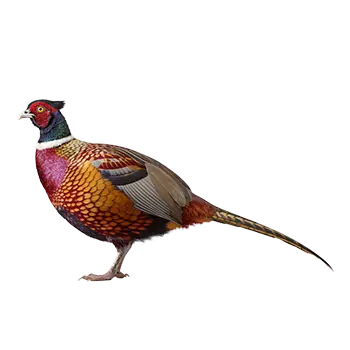

The Ring-necked Pheasant (Phasianus colchicus) is native to a vast swath of temperate Asia, with its ancestral range stretching from the Caucasus region and the shores of the Black Sea eastward through Central Asia, China, Korea, and into parts of Japan. The species thrives in a mosaic of grasslands, agricultural margins, scrubby woodlands, and river-valley wetlands, favoring habitats where dense ground cover for nesting sits adjacent to open feeding areas. This adaptable ecology, combined with a diet that ranges across seeds, grains, insects, and green vegetation, allowed the pheasant to occupy an enormous geographic footprint long before humans began deliberately moving it around the globe.
Within this native range, ornithologists have historically recognized more than thirty subspecies of Phasianus colchicus, distinguished primarily by variations in male plumage coloration. The common name Ring-necked Pheasant refers specifically to those subspecies and hybrid populations that display a prominent white collar around the neck, a trait most associated with the Chinese subspecies P. c. torquatus. In many parts of the world where pheasants have been introduced, decades of interbreeding among released stock from multiple subspecies have produced populations that blend characteristics, making neat taxonomic distinctions difficult in the field.
The species evolved within ecosystems shaped by seasonal extremes, from cold Central Asian winters to humid Chinese lowlands. This climatic versatility proved critical to the pheasant's later success as an introduced species. Its ability to endure harsh winters by shifting diet toward waste grain and persistent seeds, combined with a robust reproductive rate that can produce clutches of ten to fifteen eggs, provided the biological foundation that would allow Ring-necked Pheasants to establish themselves on continents far from their evolutionary origins.
Fossil and subfossil evidence suggests that pheasants as a genus have inhabited Asia for millions of years, with Phasianus diverging from related genera during the Miocene or Pliocene epochs. By the time recorded human history begins in the regions the pheasant inhabited, the bird was already a well-established and ecologically important species, deeply woven into the landscapes and food webs of temperate Asia.