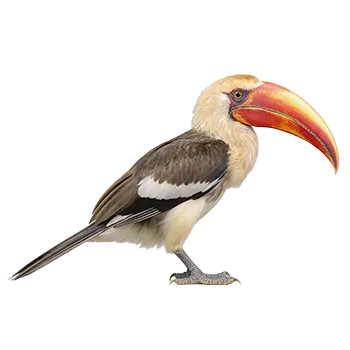

No single media event has done more to elevate the Red-Billed Hornbill's global profile than its prominent role in a landmark animated feature film set in the African savanna. The character of Zazu, the fussy, loyal majordomo to the lion king in Disney's 1994 film The Lion King, was modeled directly on the Red-Billed Hornbill. Voiced by Rowan Atkinson in the original animated version, Zazu became one of the film's most memorable supporting characters, combining comedic timing with a deep sense of duty that resonated with audiences worldwide.
The animators at Walt Disney Studios drew heavily on the physical characteristics of the Red-Billed Hornbill when designing Zazu. The character's elongated, curved red bill, compact body, and distinctive black-and-white wing patterning are all faithful to the species' actual appearance. The decision to use a hornbill rather than a more commonly recognized bird species reflected the filmmakers' commitment to grounding the story in a recognizably East African setting, and the Red-Billed Hornbill's abundance in the savannas of Kenya and Tanzania made it a natural choice for a character that would be constantly present in the landscape.
The Lion King became one of the highest-grossing animated films in history, and its cultural impact extended far beyond the box office. Zazu introduced the Red-Billed Hornbill to millions of viewers who had never seen the bird in the wild and might never have encountered it otherwise. The character's popularity generated a secondary wave of interest in the species, with wildlife organizations and zoos reporting increased inquiries about hornbills in the years following the film's release. For many people around the world, the Red-Billed Hornbill is, first and foremost, the bird from The Lion King.
The 2019 photorealistic computer-animated remake of The Lion King, directed by Jon Favreau, further cemented the association. In this version, Zazu was voiced by John Oliver and rendered with painstaking attention to anatomical detail, making the connection between the character and the real species even more explicit. The remake's global box office success ensured that a new generation of viewers would form their first impression of the Red-Billed Hornbill through this fictional lens, perpetuating a cultural association that shows no sign of fading.