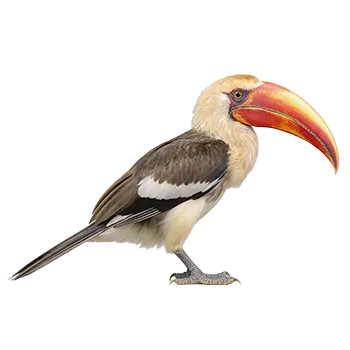

The Red-Billed Hornbill (Tockus erythrorhynchus) is a member of the family Bucerotidae, a group of Old World birds distinguished by their prominent curved bills and, in many species, elaborate casques atop the upper mandible. Unlike its larger hornbill relatives, the Red-Billed Hornbill is a comparatively modest bird in size, typically measuring between 35 and 40 centimeters in length, but what it lacks in stature it compensates for with abundance and ecological adaptability. The species ranges across a vast swathe of sub-Saharan Africa, from Senegal and Mauritania in the west through the Sahel, East Africa, and into parts of southern Africa.
The preferred habitat of the Red-Billed Hornbill is dry woodland, thorn scrub, and open savanna, environments characterized by scattered trees and seasonal rainfall. This contrasts with the dense tropical forests favored by many other hornbill species and has given the Red-Billed Hornbill a distinct ecological identity. It is commonly found in acacia and mopane woodland, where it forages on the ground and in low vegetation for insects, small vertebrates, seeds, and fruit. Its omnivorous diet and tolerance for arid conditions have allowed it to occupy habitats that would be inhospitable to more specialized feeders.
Several subspecies have been recognized across the Red-Billed Hornbill's extensive range, reflecting regional variations in plumage detail and bill coloration. Tockus erythrorhynchus erythrorhynchus occupies much of the eastern and southern range, while other populations in West Africa and the Sahel have at times been treated as distinct subspecies. Taxonomic revisions in recent decades have refined these groupings, and molecular studies continue to clarify the relationships within the Tockus genus.
The species' nesting behavior is among its most remarkable biological features. Like other hornbills, the female Red-Billed Hornbill seals herself inside a tree cavity during the breeding season, using mud, droppings, and food remnants to plaster the entrance until only a narrow slit remains. The male feeds the female and, later, the growing chicks through this opening for several weeks. This cooperative nesting strategy reduces predation risk and has fascinated naturalists since it was first documented, becoming a defining characteristic of the hornbill family in both scientific literature and popular imagination.