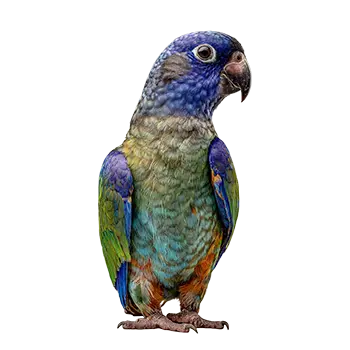

The Blue-headed Pionus (Pionus menstruus) is native to a vast stretch of Central and South America, ranging from southern Costa Rica through Panama and across much of tropical South America, including Colombia, Venezuela, Ecuador, Peru, Bolivia, and Brazil. The species thrives in humid and semi-humid forest habitats, where it occupies lowland and foothill elevations typically below 1,500 meters. Its broad geographic distribution has contributed to a relatively stable wild population, though regional pressures from habitat loss and trapping have affected certain local groups.
European naturalists first documented the Blue-headed Pionus during the era of colonial exploration in the Americas. The species was formally described in the mid-18th century and placed within the Pionus genus, a group of medium-sized, stocky parrots distinguished by their relatively quiet disposition and characteristic red undertail coverts. Early specimens were sent back to European collections and aviaries, where the bird's striking blue head plumage drew immediate attention from ornithologists and collectors alike.
Within its native range, the Blue-headed Pionus has long been a familiar sight to Indigenous communities and rural populations. These parrots are typically observed in small flocks moving through the forest canopy or visiting fruiting trees. Their presence in agricultural border zones has historically placed them in proximity to human settlements, contributing to a long-standing, if informal, relationship between the species and the people who share its habitat.
The taxonomy of the Blue-headed Pionus has remained relatively stable, though several subspecies have been recognized based on subtle differences in plumage coloration and geographic range. These include populations in Central America that tend to show slightly different tonal qualities in their blue head feathering compared to South American birds. Ongoing genetic studies continue to refine the understanding of population structure within the species.