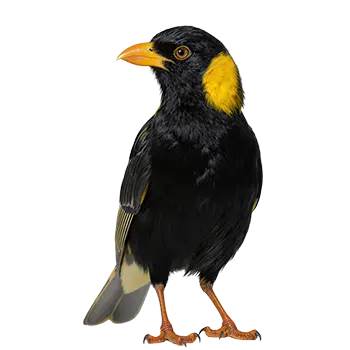

The mynah bird belongs to the starling family Sturnidae, a diverse group of passerines found across much of the Old World. The species most commonly kept as a pet and most widely recognized is the Hill Mynah (Gracula religiosa), native to the tropical forests of South and Southeast Asia. Wild populations range from the hills of India and Sri Lanka through Myanmar, Thailand, and the islands of Indonesia, where they inhabit dense canopy forests and feed on fruits, insects, and nectar.
The name "mynah" derives from the Hindi word "mainā," which itself traces back to the Sanskrit "madanā," meaning joyful or delightful. This etymology reflects the long relationship between humans and these birds on the Indian subcontinent, where their vivid calls and striking plumage have made them a familiar presence for thousands of years. Historical texts from ancient India reference talking birds that were almost certainly mynahs, suggesting domestication efforts that stretch back well over two millennia.
While the Hill Mynah is the most famous member of the group, the Common Mynah (Acridotheres tristis) has had an arguably larger impact on ecosystems worldwide. Originally native to Central and Southern Asia, the Common Mynah was deliberately introduced to regions across the Pacific, Indian Ocean islands, Australia, and parts of Africa during the 18th and 19th centuries, often as a means of insect control in agricultural areas. Its adaptability and aggressive territorial behavior have since made it one of the most successful invasive bird species on the planet.
The evolutionary history of the Sturnidae family places mynahs among a lineage that diversified across Asia and Africa millions of years ago. Their remarkable vocal mimicry is believed to have evolved as a social bonding mechanism within flocks, allowing individuals to communicate complex information about food sources, predators, and territory. This same vocal plasticity is what makes them such compelling companions in captivity, capable of reproducing human speech with a clarity that rivals even the most talented parrots.