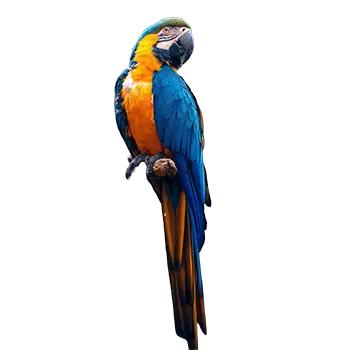

Origins & Natural History

The Blue and Gold Macaw (Ara ararauna) is native to a vast swath of Central and South America, ranging from eastern Panama through Colombia, Venezuela, and Brazil, and extending south into Bolivia and Paraguay. The species thrives in tropical and subtropical forests, particularly in areas near rivers, swamps, and floodplains where large palm and hardwood trees provide abundant nesting cavities. Fossil and subfossil evidence suggests that large macaws have inhabited the neotropical region for millions of years, evolving alongside the diverse ecosystems of the Amazon basin and its surrounding lowlands.

European naturalists first formally described the Blue and Gold Macaw in the mid-eighteenth century, though indigenous peoples of the Americas had been intimately familiar with the species for millennia. Carl Linnaeus included the bird in his foundational taxonomic work, cementing its place in Western scientific classification. Early European explorers returning from the New World brought vivid accounts of enormous, brilliantly colored parrots, and living specimens began arriving in European courts and menageries as early as the sixteenth century.

The species adapted remarkably well to a range of lowland habitats, from gallery forests along rivers to open savannas dotted with moriche palms. Their reliance on large tree cavities for nesting has made old-growth forests particularly important to their survival. Seasonal flooding patterns in much of their range influence food availability, and Blue and Gold Macaws have evolved to exploit a diverse diet of seeds, nuts, fruits, and clay-lick minerals that help neutralize plant toxins.

While the species remains relatively widespread compared to some of its rarer macaw relatives, habitat loss from deforestation and agricultural expansion has reduced populations in certain parts of their historic range. In Trinidad, for example, the species was extirpated in the twentieth century, though reintroduction efforts have been launched. Understanding the deep natural history of the Blue and Gold Macaw provides essential context for modern conservation strategies and for appreciating the ecological role these birds play as seed dispersers and forest architects.

Indigenous Cultural Roles

Long before European contact, indigenous peoples of Central and South America held macaws in high cultural regard. The Blue and Gold Macaw, along with its scarlet and green relatives, occupied a prominent place in the spiritual life, trade networks, and artistic traditions of numerous native communities. Feathers from macaws were among the most prized materials in the Americas, used in elaborate headdresses, ceremonial garments, and ritual objects that signified status, spiritual authority, and community identity.

Archaeological sites throughout the Amazon basin and the Andes have yielded macaw feathers, skeletal remains, and depictions in pottery and textiles, attesting to the bird's importance across a wide geographic area. In some communities, macaws were kept as companion animals and their feathers were harvested through gentle plucking rather than killing, reflecting a sustainable relationship between people and birds. Trade routes carried macaw feathers hundreds of miles from their tropical origins into highland and even desert communities, where they held enormous ceremonial value.

Among several Amazonian groups, macaws appear in creation stories and cosmological narratives, often serving as messengers between the human and spirit worlds. Their loud vocalizations, vivid colors, and long lifespans contributed to their symbolic association with the sun, vitality, and the continuity of community traditions. The keeping of macaws in villages also served practical social functions, as the birds acted as sentinels whose calls could alert residents to approaching visitors or predators.

This deep cultural integration means that macaws are not merely wildlife in the regions where they are native; they are woven into the identity and heritage of the communities that have lived alongside them for centuries. Modern indigenous advocacy for forest conservation frequently invokes the macaw as a symbol of the interconnectedness between cultural survival and ecosystem health.

Cultural Symbolism & Artistic Legacy

The striking blue-and-gold plumage of Ara ararauna has made it one of the most recognizable and frequently depicted parrots in global visual culture. From the earliest European natural history illustrations of the sixteenth and seventeenth centuries to contemporary wildlife photography, the species has served as an emblem of tropical exoticism, biodiversity, and the untamed beauty of the rainforest. Dutch and Flemish painters of the Golden Age occasionally included macaws in still-life and genre paintings, positioning them as symbols of wealth, global trade, and the curiosity cabinets that wealthy collectors assembled.

In the decorative arts, the Blue and Gold Macaw's color palette has inspired textile patterns, ceramic glazes, and interior design motifs across multiple centuries. Victorian-era fascination with natural history led to a surge of macaw imagery in wallpapers, fabrics, and illustration, coinciding with the bird's growing popularity in private aviaries and public zoological gardens. The species became a kind of visual shorthand for the tropics, appearing on travel posters, postage stamps, and national emblems of several Latin American countries.

Beyond visual art, the macaw has entered the broader cultural imagination as a symbol of intelligence, longevity, and companionship. Their capacity for vocal mimicry and complex social behavior has fascinated scientists and pet keepers alike, contributing to a popular image of parrots as clever, charismatic animals. Conservation organizations have leveraged this cultural cachet, using the Blue and Gold Macaw as a flagship species to generate public interest and funding for habitat protection across the neotropics.

The bird's symbolic resonance extends into modern branding and tourism as well. Ecotourism operators in countries such as Peru, Brazil, and Bolivia prominently feature macaws in promotional materials, and clay licks where dozens of macaws gather have become major wildlife tourism destinations. This cultural visibility, while beneficial for conservation awareness, also drives demand for captive birds, creating a tension between appreciation and exploitation that defines much of the species' modern story.

Aviculture & the Captive Breeding Movement

The history of keeping Blue and Gold Macaws in captivity stretches back centuries, but the modern avicultural movement took shape in the twentieth century as advances in nutrition, veterinary care, and breeding techniques made it possible to sustain healthy captive populations. Early European and American collectors often struggled to keep macaws alive for extended periods, lacking understanding of the birds' complex dietary, social, and environmental needs. As knowledge grew, dedicated breeders began to establish self-sustaining captive populations that reduced pressure on wild flocks.

The development of formulated pellet diets in the latter half of the twentieth century was a turning point for macaw husbandry, supplementing the seed-heavy diets that had previously led to nutritional deficiencies in captive birds. Breeders also learned the importance of socialization, environmental enrichment, and pair bonding, recognizing that macaws are highly social animals whose psychological well-being depends on meaningful interaction with conspecifics or human caregivers.

Organizations such as the American Federation of Aviculture and international studbook programs helped coordinate breeding efforts, maintain genetic diversity, and share best practices. The Blue and Gold Macaw proved to be one of the more successfully bred large parrot species in captivity, and domestic-bred birds gradually became the primary source for the pet trade in countries where importation of wild-caught parrots was restricted or banned.

Despite these successes, the captive breeding movement has faced criticism regarding the suitability of macaws as household pets. Their enormous space requirements, exceptional longevity, powerful beaks, and loud vocalizations present challenges that many owners are unprepared for, leading to rehoming and surrender to rescue organizations. The avicultural community continues to debate best practices for responsible breeding, buyer education, and lifetime care planning for a species that can easily outlive its owner.

Conservation Milestones

While the Blue and Gold Macaw is classified as a species of Least Concern by the International Union for Conservation of Nature, its conservation story is intertwined with broader efforts to protect neotropical forests and regulate the international wildlife trade. The listing of all macaw species under Appendix II of the Convention on International Trade in Endangered Species (CITES) in 1981 was a landmark moment, establishing a framework for monitoring and controlling cross-border commerce in live birds and feathers.

In the decades that followed, several countries enacted domestic legislation to further protect macaw populations. Brazil's wildlife protection laws, for instance, criminalized the capture and sale of native parrots, though enforcement has remained a persistent challenge in remote regions. The United States' Wild Bird Conservation Act of 1992 effectively ended the mass importation of wild-caught parrots, accelerating the shift toward captive-bred birds in the American pet trade and dramatically reducing demand-driven poaching.

Field conservation projects across the species' range have focused on habitat preservation, nest-box installation to compensate for the loss of natural tree cavities, and community-based programs that give local residents economic incentives to protect rather than exploit macaw populations. In Trinidad, a reintroduction program launched in the late 1990s sought to re-establish a breeding population of Blue and Gold Macaws on the island where they had been extirpated, drawing on captive-bred birds and intensive monitoring.

Climate change poses an emerging threat to macaw habitat, with shifting rainfall patterns and increased fire frequency potentially altering the forest and palm-swamp ecosystems on which the species depends. Conservation organizations are increasingly integrating climate modeling into their strategies, aiming to identify and protect climate-resilient corridors that will sustain macaw populations in the coming decades. The Blue and Gold Macaw's relative abundance makes it a valuable indicator species for the overall health of tropical lowland ecosystems.

The Blue and Gold Macaw Today

Today the Blue and Gold Macaw occupies a unique position at the intersection of wildlife conservation, aviculture, and popular culture. It remains one of the most commonly kept large parrot species worldwide, with robust captive-breeding programs ensuring a steady supply of domestically raised birds for the pet trade. At the same time, wild populations continue to face pressures from deforestation, illegal trapping, and habitat fragmentation, particularly at the edges of their range where human land use is expanding rapidly.

In avicultural circles, the species is often recommended as an entry point for experienced bird keepers considering their first large macaw, owing to its generally sociable disposition and relative breeding success in captivity. However, welfare organizations and experienced keepers emphasize that the commitment required is extraordinary: a healthy Blue and Gold Macaw can live sixty years or more, demands hours of daily social interaction, and requires a living space that can accommodate a bird with a wingspan exceeding three feet.

The species continues to serve as a powerful ambassador for tropical conservation. Wildlife sanctuaries and educational programs around the world feature Blue and Gold Macaws in outreach activities, using the birds' charisma and intelligence to engage audiences with messages about habitat loss, responsible pet ownership, and the interconnectedness of ecosystems. Social media has amplified this role, with individual macaws amassing large online followings that introduce millions of viewers to parrot behavior and conservation issues.

Looking ahead, the future of the Blue and Gold Macaw depends on the continued success of habitat conservation in the neotropics, the enforcement of trade regulations, and the evolution of avicultural practices toward ever-higher standards of animal welfare. As one of the most visible and culturally resonant parrot species on earth, the Blue and Gold Macaw carries an outsized symbolic weight, reminding us that the fate of individual species is inseparable from the health of the forests and communities that sustain them.

Always consult a qualified professional before making any health-related decisions. This content is provided for informational reference only and should not replace professional guidance specific to your animal.