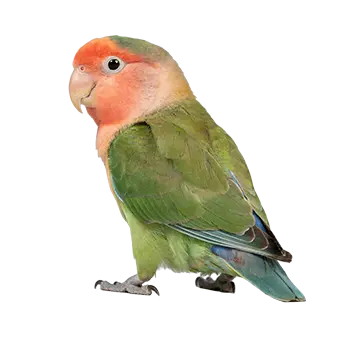

The Peach-faced Lovebird, known scientifically as Agapornis roseicollis, is native to the arid and semi-arid regions of southwestern Africa. Its natural range stretches across Namibia, western Angola, and parts of South Africa, where it inhabits dry woodlands, scrublands, and the edges of desert terrain. These small parrots are remarkably well adapted to harsh environments, traveling considerable distances each day in search of water and food sources such as seeds, berries, and leaf buds.
European naturalists first documented the species in the late eighteenth century, with French ornithologist Louis Jean Pierre Vieillot providing one of the earliest formal descriptions in 1818. Collectors and explorers were captivated by the bird's vivid peach-pink face, bright green plumage, and blue rump feathers, which stood out among the muted tones of its native landscape. Specimens were shipped back to European museums and private collections, sparking early interest in keeping these birds in captivity.
Indigenous communities in southwestern Africa had long been familiar with the Peach-faced Lovebird, observing its social habits and reliance on communal water sources. The species' tendency to forage and roost in tight-knit flocks made it a recognizable part of the regional ecosystem. Before the bird entered the global pet trade, it held a quiet but established place in the natural history of the region.