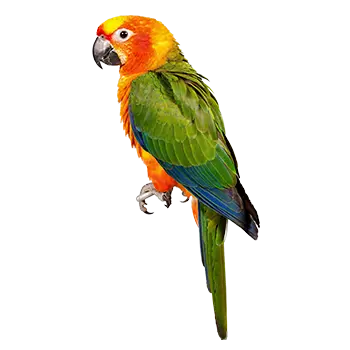

Parrots have been fixtures in cinema since the earliest days of filmmaking, their vivid plumage and vocal abilities making them natural scene-stealers. Macaws and cockatoos have historically dominated Hollywood's avian casting calls, appearing in pirate epics, adventure films, and animated features that have shaped public perceptions of parrots worldwide. The Jenday Conure, smaller and less immediately recognizable to general audiences than its larger cousins, has occupied a more subtle but growing presence in on-screen appearances.
When Jenday Conures do appear in film and television, they are typically cast in domestic settings that reflect their real-world role as companion animals. Their saturated yellow and orange coloring registers vividly on camera, and production designers have occasionally selected Jenday Conures to add a splash of tropical warmth to interior scenes. In several independent and foreign-language films set in Brazil, the species has appeared as a naturalistic detail, perched in background shots of rural homesteads or flying in loose flocks across establishing aerial footage of the northeastern sertao.
The animated film genre, which has done more than any other medium to introduce parrot species to mass audiences, has drawn heavily on the aesthetics of South American parrots without always specifying exact species. Characters in animated features about Brazilian wildlife have blended visual traits from multiple conure and macaw species, creating composite designs that evoke the general appeal of neotropical parrots. While no major animated character has been explicitly identified as a Jenday Conure, the species' coloration has clearly influenced character design in productions that celebrate Brazil's avian diversity.
Documentary filmmaking has provided the Jenday Conure with more precisely credited appearances. Nature documentaries focusing on the cerrado and caatinga biomes have featured the species in segments about parrot ecology, flock behavior, and the challenges of conservation in a rapidly changing landscape. These productions, distributed through streaming platforms and public broadcasting networks, have brought the Jenday to audiences who might otherwise never encounter the species, building awareness of both its natural beauty and the ecological pressures it faces.