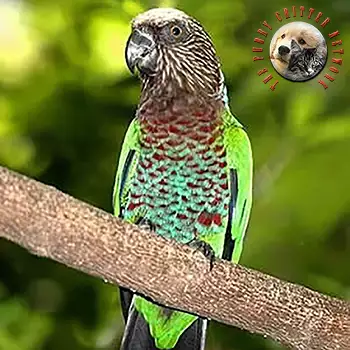

The Hawk-headed Parrot, known scientifically as Deroptyus accipitrinus, is one of the most visually striking parrots in the world and the sole member of its genus. Native to the tropical rainforests of the Amazon Basin, this species ranges across a vast territory that includes parts of Brazil, Colombia, Venezuela, Guyana, Suriname, and French Guiana. Its natural habitat consists of dense lowland and foothill forests, where it nests in tree cavities high in the canopy.
European naturalists first documented the Hawk-headed Parrot during expeditions into South America in the eighteenth century. The species was formally described in 1758 by Carl Linnaeus, who placed it within the broader classification of parrots before later taxonomists recognized it as distinct enough to warrant its own genus. The bird's remarkable erectile head feathers, which fan outward into a ruff resembling a hawk or bird of prey, immediately captured the attention of explorers and ornithologists alike.
Two subspecies are generally recognized today. The nominate form, Deroptyus accipitrinus accipitrinus, is found across much of the species' northern range, while the subspecies fuscifrons occupies portions of the southern Amazon. The differences between them are subtle, mainly involving slight variations in forehead coloring, but both share the species' signature fan of elongated nape feathers banded in red and blue.
The common name itself reflects how early European observers perceived the bird. When the Hawk-headed Parrot raises its ornamental head plumage, it takes on a silhouette that resembles a raptor far more than a typical parrot. This visual mimicry likely serves as a defensive display, making the bird appear larger and more intimidating to potential predators.