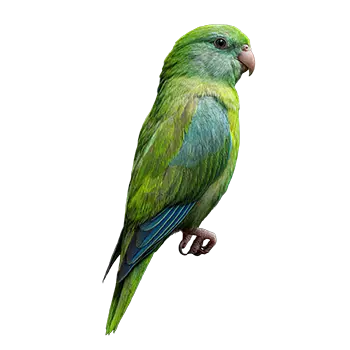

In Nature Documentaries & Television

The Green-Rumped Parrotlet's appearance in nature documentaries has been driven almost entirely by its scientific significance rather than the visual spectacle that typically earns larger parrots screen time. The species gained its most prominent documentary exposure through coverage of Dr. Karl Berg's research on vocal learning in wild parrotlets in Venezuela. Segments featuring this research have appeared in science-oriented television programming and streaming content, presenting footage of researchers monitoring nest boxes, recording parental contact calls, and analyzing the vocal development of chicks. These productions introduced audiences to the idea that even a small, visually unassuming parrot can exhibit cognitive and social behaviors sophisticated enough to merit serious scientific attention.

Regional nature programming in Venezuela, Trinidad, and other parts of the species' range has included the Green-Rumped Parrotlet in broader surveys of local wildlife. In Trinidad, where birdwatching tourism is a growing industry, the parrotlet appears in promotional materials and nature segments aimed at showcasing the island's avian diversity. These appearances tend to emphasize the species' abundance and approachability, framing it as an accessible entry point for birdwatchers who may be more familiar with North American or European species.

International nature productions have occasionally featured the genus Forpus in segments about small parrots or neotropical biodiversity, though the Green-Rumped Parrotlet is rarely the sole focus of a major production. Its inclusion in such programming typically serves to illustrate the diversity of parrot body sizes and ecological strategies, contrasting the tiny parrotlet with the macaws and amazons that dominate popular perceptions of the parrot family. When the species does appear, producers often highlight its social behavior and the surprising complexity of its vocalizations relative to its size.

The species has also been featured in educational content produced by zoos, aviaries, and conservation organizations. Short-form videos created for institutional websites and educational outreach programs have used the Green-Rumped Parrotlet to teach audiences about parrot biology, cavity-nesting behavior, and the ecological roles that even small seed-eating birds play in their native ecosystems. These productions, while lower profile than broadcast documentaries, reach significant audiences through school programs, museum exhibits, and online distribution channels.

Social Media & Online Communities

The Green-Rumped Parrotlet's most significant media presence exists on social media platforms, where individual owners and breeders share content that collectively reaches audiences far larger than any documentary or television segment. Video-sharing platforms host thousands of clips featuring pet parrotlets displaying characteristic behaviors: perching on fingers, engaging in playful aggression with household objects, bathing enthusiastically in shallow dishes, and interacting with their owners with a confidence that belies their tiny size. The contrast between the bird's diminutive frame and its bold, assertive personality is a recurring theme in viral parrotlet content, and this juxtaposition has proven highly shareable across platforms.

Dedicated parrotlet communities have established themselves on major social media platforms and discussion forums, creating spaces where keepers exchange husbandry advice, share photographs of color mutations, discuss behavioral challenges, and celebrate the daily antics of their birds. These communities range from casual groups with thousands of members to more specialized forums focused on breeding, genetics, or veterinary care. The Green-Rumped Parrotlet, as one of the most commonly kept Forpus species, features prominently in these spaces, though content about Pacific parrotlets and other related species also circulates widely.

The visual appeal of parrotlet color mutations has made the species particularly well-suited to image-driven platforms. Breeders regularly post photographs of blue, lutino, and pied variants alongside wild-type green birds, and these images generate significant engagement from both dedicated aviculturists and casual viewers attracted by the birds' vivid coloration. Some breeders have built substantial followings by documenting breeding projects, hatching sequences, and the hand-feeding and socialization of chicks, creating serialized content that keeps audiences invested over weeks and months.

Short-form video content featuring parrotlets has introduced the species to demographics that might never encounter traditional avicultural media. Clips of parrotlets performing tricks, responding to their names, or simply displaying their personalities in everyday domestic settings have accumulated millions of views, driving interest in the species among younger audiences and first-time bird owners. This exposure has had measurable effects on demand for the species, with breeders reporting increased inquiries that they attribute directly to social media visibility. The phenomenon illustrates how user-generated content has become a primary driver of species popularity in the modern pet market, operating largely independently of traditional media channels.

In Scientific Journalism & Popular Science

The Green-Rumped Parrotlet has achieved a level of visibility in scientific journalism that is remarkable for a species of its size and public profile. The catalyst for this coverage was the publication of research demonstrating that parrotlet parents assign unique vocal signatures to their offspring, a finding that resonated with both scientific audiences and the general public. Major science journalism outlets covered the discovery extensively, drawing parallels to human naming practices and exploring its implications for understanding the evolution of vocal communication. The story was picked up by newspapers, science magazines, radio programs, and online publications across multiple continents, generating a wave of public interest in a species that most readers had never encountered.

Subsequent research findings involving Green-Rumped Parrotlets have continued to attract journalistic attention, though none has matched the impact of the initial naming-call discovery. Studies on parrotlet social learning, mate selection, and the acoustic structure of flock calls have been covered in academic press releases and translated into accessible articles by science writers. These pieces typically frame the Green-Rumped Parrotlet as a model organism whose accessibility and behavioral complexity make it unusually productive for field research, a narrative that has helped sustain media interest in the species beyond the initial burst of coverage.

Popular science books and long-form magazine articles about animal cognition and communication have incorporated the Green-Rumped Parrotlet as a supporting case study, positioning it alongside more famous subjects like Alex the African Grey and the New Caledonian crow. In these contexts, the parrotlet serves as evidence that sophisticated cognitive and communicative abilities are not confined to the largest-brained bird species, a point that carries significant theoretical weight in discussions about the evolution of intelligence. The species' inclusion in these broader narratives has elevated its profile among readers who may not follow ornithological research directly.

The cumulative effect of this scientific media coverage has been to establish the Green-Rumped Parrotlet as a recognized reference point in popular discussions of animal intelligence. When journalists write about new findings in avian cognition, the parrotlet naming-call study is frequently cited as context, keeping the species in circulation in a way that few other small parrots have achieved. This sustained visibility in science journalism has also fed back into the companion bird community, where owners take pride in the species' scientific credentials and frequently reference published research when discussing their birds' intelligence and social capabilities.

In Art, Literature & Photography

The Green-Rumped Parrotlet occupies a modest but growing place in artistic and literary representations of the avian world. In the rich tradition of neotropical bird illustration, the species appears in field guides and ornithological plates produced by artists working in South America and the Caribbean. These scientific illustrations, while functional in purpose, often capture the subtle beauty of the species' plumage, including the males' distinctive blue wing patches and the soft, varied greens of the body feathers. The parrotlet's small size presents a particular challenge for illustrators, who must convey diagnostic field marks at a scale that rewards close attention.

Wildlife photographers working in the species' native range have produced striking images of Green-Rumped Parrotlets in natural settings, from pairs perched on weathered fence posts to flocks lifting from savanna grasslands in coordinated flight. The species' tolerance of human proximity and its tendency to perch in open, well-lit environments make it a cooperative photographic subject by the standards of neotropical birds, many of which inhabit dense forest canopy where light and sight lines are limited. These photographs circulate through nature photography communities, birding publications, and regional tourism materials.

In the broader literary landscape, the Green-Rumped Parrotlet appears most frequently in non-fiction writing about ornithology, aviculture, and animal behavior. Science writers who have covered the species' vocal learning research often devote extended passages to describing the experience of observing wild parrotlets in their natural habitat, using the species as a narrative vehicle for exploring larger questions about animal minds and the challenges of field biology. The parrotlet's combination of familiarity and scientific novelty makes it an effective subject for this kind of writing, accessible enough to engage general readers while offering sufficient depth to sustain a detailed treatment.

Avicultural literature devoted to parrotlets has expanded significantly over the past two decades, with dedicated care manuals, breeding guides, and species profiles available in multiple languages. These publications, while practical in orientation, often include appreciative descriptions of the species' personality and behavior that border on the literary. The affection that parrotlet keepers bring to their writing about these birds infuses the avicultural literature with a warmth and specificity that distinguishes it from more clinical species accounts, creating a body of work that serves simultaneously as reference material and as a record of the human-parrotlet bond.

Parrotlet Culture & Online Identity

A distinct parrotlet culture has emerged within the broader companion bird community, characterized by shared humor, vocabulary, and behavioral observations that reflect the unique experience of living with these small parrots. Parrotlet owners frequently describe their birds using a specific set of personality descriptors, including terms like feisty, fearless, and pocket parrot, that have become defining elements of the species' cultural identity. The notion that parrotlets possess personalities disproportionate to their physical size is the central organizing idea of this culture, and it surfaces in everything from forum signatures and social media bios to the names of breeding businesses and parrotlet-focused merchandise.

Online parrotlet culture has developed its own aesthetic sensibility, reflected in the photography, graphic design, and video editing styles that characterize popular parrotlet accounts. Content creators in this space tend to emphasize close-up imagery that highlights the birds' expressive eyes, detailed plumage patterns, and comically assertive postures. The visual language of parrotlet social media is intimate and warm, reflecting the close physical relationship that owners typically maintain with birds small enough to perch on a finger or tuck into a shirt pocket. This aesthetic has contributed to a distinctive brand identity for parrotlets within the crowded landscape of pet-focused social media.

The parrotlet community also engages in a form of collective knowledge-building that functions as both practical resource and cultural activity. Experienced keepers routinely share detailed accounts of their birds' dietary preferences, behavioral quirks, health histories, and social dynamics, creating a richly textured communal record that informs care practices and deepens the community's understanding of the species. Newcomers are welcomed into this knowledge-sharing ecosystem, and the mentorship relationships that form between experienced and novice keepers are a valued feature of parrotlet culture.

Merchandise and creative products inspired by parrotlets have proliferated alongside the species' growing popularity. Independent artists sell prints, stickers, enamel pins, and apparel featuring parrotlet designs, often emphasizing the color mutations that make the species visually striking. These products serve a dual function, expressing the owner's identity as a parrotlet enthusiast and contributing to the visibility of the species in everyday settings. The market for parrotlet-themed goods, while small compared to that for dogs or cats, is growing steadily and reflects the passionate, tightly knit nature of the parrotlet keeping community.

The Species' Evolving Public Profile

The Green-Rumped Parrotlet's public profile has undergone a significant transformation over the past three decades, shifting from near-total obscurity outside specialist circles to a recognized and increasingly popular presence in the broader pet-keeping world. This evolution has been driven by a confluence of factors: the publication of compelling scientific research, the rise of social media as a platform for pet-related content, the growing appeal of small companion birds to urban dwellers with limited space, and the sustained advocacy of dedicated breeders and keepers who have championed the species through clubs, expos, and online communities.

The species' trajectory in media and public awareness contrasts markedly with that of larger, more traditionally famous parrots. While African Greys, cockatoos, and macaws have long occupied prominent positions in the cultural imagination, the Green-Rumped Parrotlet's rise has been quieter and more grassroots in character. Its visibility has been built primarily from the ground up, through the accumulated contributions of individual owners sharing their experiences rather than through major media productions or celebrity endorsements. This organic growth pattern has given the species' public profile an authenticity and community-driven quality that resonates with the values of many contemporary pet keepers.

Looking ahead, the Green-Rumped Parrotlet's media presence appears likely to continue expanding as the companion bird market trends toward smaller species and as social media platforms evolve to support new forms of content creation. The species is well-positioned to benefit from growing interest in animal cognition and behavior, given its established track record as a research subject and the ongoing potential for new scientific discoveries. Continued research into parrotlet communication, social behavior, and genetics will provide fresh material for science journalism and popular science writing, sustaining the species' visibility in media channels that value intellectual substance.

The challenge for the parrotlet community going forward will be to ensure that increased media exposure translates into informed, responsible ownership rather than impulse acquisitions driven by the appeal of viral content. Community leaders and breeders have expressed awareness of this tension, and efforts to pair engaging media content with substantive educational messaging about the species' care requirements represent an important ongoing project. The Green-Rumped Parrotlet's cultural story is still being written, shaped by the same combination of scientific curiosity, personal affection, and communal enthusiasm that has brought the species to its current level of recognition.

Always consult a qualified professional before making any health-related decisions. This content is provided for informational reference only and should not replace professional guidance specific to your animal.