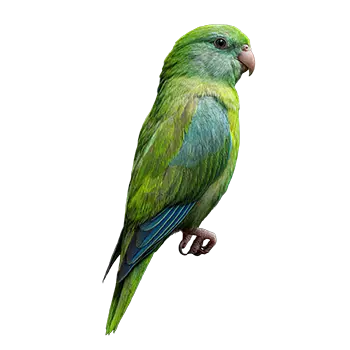

Origins & Natural Habitat

The Green-Rumped Parrotlet (Forpus passerinus) is the smallest parrot species commonly found in the wild across northern South America and the southernmost reaches of the Caribbean. Its native range extends from the coastal lowlands of Venezuela through Guyana, Suriname, and French Guiana, southward into the northern reaches of Brazil, and westward into parts of Colombia. The species also maintains a well-established population on the island of Trinidad, where it is among the most frequently encountered psittacines. Throughout this range, the parrotlet inhabits open and semi-open landscapes including savannas, scrublands, agricultural margins, forest edges, and suburban gardens, distinguishing it from many parrot species that depend on dense primary forest.

The species thrives in disturbed and edge habitats where low scrub, scattered trees, and cultivated land provide foraging opportunities. Its diet in the wild consists primarily of grass seeds, small fruits, berries, and flower buds, supplemented by occasional leaf matter and insects. Green-Rumped Parrotlets typically forage in small flocks of six to twenty individuals, moving through their territory with rapid, darting flight patterns that can make them difficult to spot despite their abundance. Their diminutive size, roughly comparable to a house sparrow, allows them to exploit food sources that larger parrots cannot access, including the seed heads of tall grasses and the thin terminal branches of fruiting shrubs.

Nesting behavior in the wild is cavity-based, with pairs selecting natural tree hollows, abandoned woodpecker holes, fence posts, and even gaps in human-made structures. The species is notably adaptable in its nesting site selection, a trait that has contributed to its success in agricultural and suburban environments where natural cavities may be scarce. Clutch sizes typically range from four to seven eggs, and both parents share incubation and chick-rearing duties, a cooperative strategy that supports relatively high reproductive success compared to larger parrot species with smaller clutches.

Ecologically, the Green-Rumped Parrotlet occupies a niche that has proven remarkably resilient to habitat modification. Unlike many neotropical parrots whose populations have suffered dramatic declines due to deforestation, Forpus passerinus has actually expanded its range in some areas as forest clearance has created the open and edge habitats it favors. This ecological flexibility is a defining feature of the species and helps explain why it remains common throughout most of its native range, even as other psittacines in the same regions face mounting conservation pressure.

Early History with Humans

The Green-Rumped Parrotlet's relationship with humans in its native range predates European colonization by centuries, though documentation from this period is sparse. Indigenous communities across Venezuela, the Guianas, and Trinidad would have encountered these small parrots daily in and around agricultural plots, where the birds foraged on cultivated and wild seed sources. Unlike the larger macaws and amazons that featured prominently in indigenous ceremonial life and trade networks, the diminutive parrotlet occupied a more modest cultural position, generally regarded as a familiar and unremarkable neighbor rather than a prestige item or ritual object.

European naturalists first formally described the species in the 18th century. Carl Linnaeus included it in his taxonomic framework, and subsequent ornithologists working in South America documented its abundance and behavior in field notes and expedition reports. These early scientific observers noted the species' tameness around human settlements, its willingness to nest in close proximity to houses and farms, and its habit of forming large post-breeding flocks that could number in the dozens. However, the Green-Rumped Parrotlet attracted far less attention from the European collector and pet trade than its larger, more colorful relatives during this period. The bird trade of the 18th and 19th centuries was dominated by macaws, amazons, and cockatoos whose size and vocal abilities commanded higher prices.

The parrotlet's transition from a locally familiar wild bird to a recognized companion species began in earnest during the mid-20th century. As aviculture expanded in Europe and North America, breeders began to explore smaller psittacine species that were better suited to apartment living and more modest cage setups. The Green-Rumped Parrotlet, with its manageable size, relatively quiet voice, and willingness to breed in captivity, emerged as an attractive candidate. Early captive breeding efforts in the 1960s and 1970s established the foundation of the avicultural lines that would eventually supply the companion bird market worldwide.

By the 1980s, the Green-Rumped Parrotlet had gained a dedicated following among aviculturists in the United States and Western Europe. Breeders developed reliable husbandry protocols, and the species' reputation as an engaging, personality-rich companion began to circulate through bird clubs, avian magazines, and the early networks of specialty breeders. This period marked the beginning of the parrotlet's modern identity as a companion bird, distinct from its longstanding role as an unremarkable component of the South American avifauna.

Cultural Symbolism & Folklore

In the rural communities of Venezuela and Trinidad, the Green-Rumped Parrotlet has long been a fixture of everyday life, woven into the informal cultural fabric of regions where the bird is abundant. While it does not carry the mythological weight of larger parrots in indigenous cosmologies, the species is recognized in local folk knowledge for its lively social behavior, its habit of chattering in animated groups, and its resilience in the face of environmental change. In Venezuelan Spanish, the common name periquito captures both the affection and the casual familiarity with which the bird is regarded, a small and spirited presence that belongs to the landscape as naturally as the grasses it feeds upon.

In Trinidad, where the parrotlet is one of the most visible members of the local avifauna, the species appears informally in expressions and references that evoke smallness, quickness, and sociability. The Trinidadian tradition of birdwatching and bird appreciation, which extends well beyond the famous scarlet ibis, has given the parrotlet a quiet but consistent cultural presence. Local birders and naturalists have championed the species as an example of the island's ecological richness, and the parrotlet appears regularly in regional field guides and nature education programs aimed at fostering environmental awareness among young people.

In the broader context of aviculture, the Green-Rumped Parrotlet has come to symbolize the idea that compelling companionship and genuine personality do not require a large bird. Parrotlet enthusiasts frequently describe these birds as having the spirit of an amazon or macaw compressed into a body that weighs less than an ounce. This characterization has become a central element of the species' identity in the pet-keeping community, shaping how breeders market the birds, how care guides describe their temperament, and how owners narrate their experiences with individual parrotlets on social media and in club newsletters.

The species also holds a distinctive place in the symbolism of avian conservation. Because the Green-Rumped Parrotlet is one of the few neotropical parrots that has not experienced significant population decline, it is sometimes cited as a counterpoint to the crisis narratives that dominate discussions of parrot conservation. Conservationists have used the species as a case study in ecological adaptability, illustrating how certain life history traits, including small body size, dietary flexibility, and tolerance of habitat disturbance, can buffer a species against the pressures that have devastated many of its larger relatives.

Scientific Study & Recognition

The Green-Rumped Parrotlet has been the subject of sustained scientific research, particularly in the fields of behavioral ecology, social learning, and communication. Among the most significant long-term studies is the work conducted by Dr. Karl Berg and colleagues in Venezuela, which began in the late 1990s and produced groundbreaking findings about vocal learning in wild parrotlets. Berg's research demonstrated that Green-Rumped Parrotlet parents assign unique contact calls to their chicks before the young birds are capable of vocalizing, a process analogous to human naming. This discovery, published in prominent journals, challenged existing assumptions about the origins of vocal identity in birds and attracted widespread attention from both the scientific community and the general public.

The species' accessibility in the wild has made it an unusually productive subject for field research. Because Green-Rumped Parrotlets readily nest in artificial nest boxes, researchers have been able to monitor breeding pairs, chick development, and social interactions with a level of detail that is difficult to achieve with cavity-nesting species that inhabit dense forest canopy. Long-term nest box studies have generated extensive datasets on clutch size variation, mate fidelity, extra-pair paternity, and the effects of environmental variables on reproductive success, contributing to the broader understanding of parrot life history strategies.

In captive settings, the Green-Rumped Parrotlet has also proven valuable as a research subject. Its small size, relatively short generation time compared to larger parrots, and ease of maintenance in laboratory conditions have made it a practical model for studies of avian cognition, hormonal regulation of behavior, and the genetics of plumage coloration. The species' sexual dimorphism, with males displaying blue wing markings absent in females, has provided a convenient system for investigating the mechanisms and functions of sex-specific plumage traits in parrots.

Taxonomically, the Green-Rumped Parrotlet belongs to the genus Forpus, a group of seven recognized species distributed across Central and South America. Within this genus, Forpus passerinus is the most widely distributed and the most intensively studied. Several subspecies have been described, corresponding to geographically distinct populations across the species' range, though the validity and boundaries of these subspecies remain subjects of ongoing taxonomic revision informed by molecular phylogenetic data. The species' systematic position within the broader parrot family (Psittacidae) has been clarified by DNA-based studies that confirm Forpus as a distinct lineage within the neotropical parrot radiation.

The Breed Today

The Green-Rumped Parrotlet has become one of the most popular small companion parrots in the world, with a well-established presence in the avicultural communities of North America, Europe, and increasingly in Asia and Australia. Its appeal rests on a combination of practical advantages and genuine personality traits that distinguish it from other small psittacines. At roughly five inches in length and under an ounce in weight, the species is among the smallest parrots available in the pet trade, making it suitable for keepers with limited space. Its vocal output, while constant and communicative, is far quieter than that of larger parrots, a significant consideration for apartment dwellers and those with noise-sensitive neighbors.

Captive breeding programs have produced a variety of color mutations beyond the wild-type green, including blue, lutino, American yellow, and various pied combinations. These mutations have expanded the species' appeal to hobbyist breeders and collectors, and mutation breeding has become a significant component of the parrotlet aviculture community. Dedicated breeders maintain careful pedigree records, participate in bird shows and expos, and contribute to online knowledge bases that document the genetics and phenotypic expression of each mutation. The availability of color mutations has also made the Green-Rumped Parrotlet more commercially competitive with other small parrot species, particularly budgerigars and lovebirds.

Despite its small size, the Green-Rumped Parrotlet has a reputation for bold, assertive behavior that experienced keepers find endearing but that can catch unprepared owners off guard. Individual birds frequently display strong pair bonding, territorial defense of their cage space, and a confident willingness to interact with much larger birds and even household pets. Proper socialization from an early age is widely regarded as essential to producing a well-adjusted companion, and experienced breeders emphasize the importance of handling chicks regularly and exposing young birds to a variety of people, sounds, and environments before placement in a permanent home.

The species' care community has matured considerably over the past two decades. Online forums, social media groups, and regional parrotlet clubs provide keepers with access to experienced mentorship, veterinary referrals, and peer support. Avian veterinarians have developed species-specific knowledge regarding common health concerns, including egg binding in females, obesity related to seed-heavy diets, and respiratory infections. The collective expertise available to contemporary Green-Rumped Parrotlet owners represents a significant improvement over the limited information that was accessible to early adopters of the species, and this growing knowledge base continues to improve outcomes for both birds and their human companions.

Notable Individuals & Community Contributions

While the Green-Rumped Parrotlet has not produced the kind of individually famous birds that characterize the African Grey or budgerigar world, certain individuals and community efforts have played outsized roles in shaping the species' profile. The wild parrotlets studied by Dr. Karl Berg in Venezuela became minor scientific celebrities when the naming-call research was published and covered by major media outlets. The footage of parent birds apparently assigning vocal signatures to their nestlings circulated widely, introducing millions of people to a species they had never heard of and reframing public perceptions of parrot cognition and social complexity.

In the avicultural community, several pioneering breeders in the United States and Europe are credited with establishing the captive lines and husbandry standards that made the Green-Rumped Parrotlet widely available as a companion bird. These breeders, many of whom began working with the species in the 1970s and 1980s, shared their knowledge through avian society publications, conference presentations, and mentorship of newer breeders. Their collective contributions built the infrastructure of expertise that supports parrotlet keeping today, from standardized dietary recommendations to breeding pair management protocols.

Rescue and rehoming organizations have also become an important part of the Green-Rumped Parrotlet community. As the species' popularity has grown, so too has the number of birds surrendered by owners who underestimated the commitment involved in keeping even a small parrot for fifteen or more years. Parrot rescue groups, including several that specialize in small psittacines, provide foster care, veterinary rehabilitation, and adoption services for displaced parrotlets. These organizations play a critical educational role as well, working to ensure that prospective adopters understand the species' social needs, dietary requirements, and behavioral tendencies before taking on a new bird.

The Green-Rumped Parrotlet community has benefited significantly from the rise of social media, where individual bird owners share videos, photographs, and anecdotes that collectively paint a vivid picture of life with these small parrots. Viral clips of parrotlets displaying their characteristic boldness, engaging in play, or demonstrating affection toward their owners have introduced the species to audiences far beyond the traditional avicultural world. This organic, community-driven visibility has arguably done more to boost the species' popularity in recent years than any formal marketing or breeding initiative, creating a self-reinforcing cycle of interest, adoption, and shared experience.

Always consult a qualified professional before making any health-related decisions. This content is provided for informational reference only and should not replace professional guidance specific to your animal.