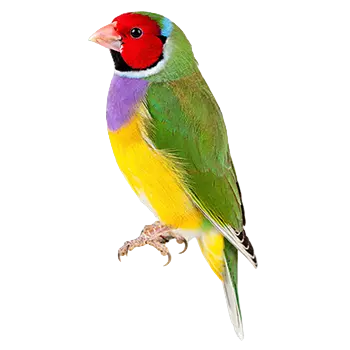

The Gouldian Finch entered the visual record through one of the most celebrated achievements in ornithological illustration. John Gould's hand-colored lithographs of the species, published as part of his monumental work The Birds of Australia between 1840 and 1848, set the standard for how the bird would be depicted for generations. Gould and his collaborators, including his wife Elizabeth and the artist Henry Constantine Richter, rendered the finch's plumage with meticulous accuracy, capturing the sharp boundaries between the green mantle, yellow breast, and purple chest band that make the species so visually distinctive. These original plates remain highly sought after by collectors and are regularly featured in exhibitions of natural history art.
The tradition of painting and illustrating the Gouldian Finch continued throughout the 19th and 20th centuries as successive generations of bird artists took on the challenge of capturing its colors. The species presents a unique test of an illustrator's skill, because the transitions between color zones on the bird's body are unusually crisp and geometric, demanding precision that more uniformly colored birds do not require. Artists working in watercolor, gouache, and later in digital media have all grappled with rendering the interplay of pigment and structural color that gives the Gouldian its brilliance.
Beyond scientific illustration, the Gouldian Finch has inspired fine artists who draw on natural history subjects for aesthetic rather than documentary purposes. Contemporary painters and printmakers have used the bird as a subject for explorations of color theory, pattern, and the relationship between natural forms and abstract design. Gallery exhibitions featuring Australian wildlife frequently include the Gouldian as a centerpiece, leveraging its visual impact to attract audiences who may have little prior interest in ornithology.
The species' influence extends into decorative arts as well. Its plumage patterns have appeared on ceramics, textiles, and jewelry produced by both Australian and international makers. The bird's combination of vivid color and compact form translates effectively across media and scales, making it one of the most versatile natural history subjects in applied design. From Gould's original lithographic stones to contemporary screen prints, the Gouldian Finch has sustained a visual presence in the art world that few other passerine species can match.