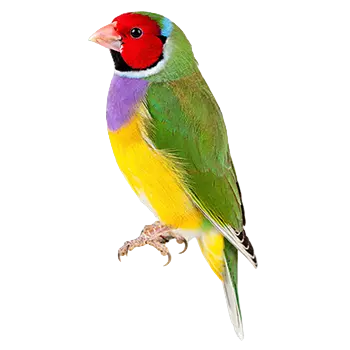

The Gouldian Finch (Erythrura gouldiae) is endemic to the tropical savanna woodlands of northern Australia, occupying a range that stretches across parts of the Kimberley region in Western Australia, the Top End of the Northern Territory, and the western reaches of Queensland's Cape York Peninsula. This habitat is characterized by open eucalyptus and melaleuca woodland interspersed with grasslands that provide the seeding grasses essential to the species' diet. The climate is monsoonal, with a distinct wet season that floods lowland areas and a prolonged dry season during which surface water becomes scarce and grasses cure to seed.
Within this landscape, Gouldian Finches have evolved to exploit a narrow ecological niche centered on the seeds of native grasses, particularly sorghum species. During the wet season, the birds disperse across the savannas to breed, nesting in tree hollows or, less commonly, in termite mounds. As the dry season progresses and food and water become concentrated at fewer sites, Gouldian Finches congregate in larger flocks around permanent water sources, sometimes mixing with other finch species in spectacular multi-species assemblages.
The species' dependence on specific grassland conditions and hollow-bearing trees has made it sensitive to changes in fire regimes, land management practices, and pastoral development. Aboriginal Australians managed the savannas with carefully timed burning for thousands of years, creating a mosaic of vegetation stages that benefited grass-seed-eating birds. The disruption of these traditional fire patterns following European colonization is widely considered one of the key factors in the Gouldian Finch's population decline during the 20th century.
Despite its relatively restricted range, the Gouldian Finch occupies a landscape of considerable ecological complexity. The interplay of geology, hydrology, and fire across northern Australia creates microhabitats that support different grass species at different times of year, and the finch's seasonal movements track these resources with remarkable precision. Understanding the species' deep connection to this dynamic environment is essential context for appreciating both its evolutionary history and the conservation challenges it faces today.