
In Classical Art & Illustration

The Golden Pheasant has been a subject of artistic fascination for centuries, occupying a place of particular prominence in Chinese painting and decorative arts. During the Song dynasty, bird-and-flower painting (huaniao hua) reached extraordinary heights of refinement, and the Golden Pheasant was among the species most frequently depicted. Court painters rendered the bird with meticulous attention to the layered textures of its cape, the metallic sheen of its crest, and the precise geometry of its barred tail feathers. These works were not merely decorative; they carried symbolic weight, associating the Golden Pheasant with beauty, official rank, and moral virtue.

One of the most celebrated depictions of the species in Chinese art is attributed to the Song dynasty, in which a Golden Pheasant perches on a rock amid blossoming branches. This composition and its many variations became a recurring motif in Chinese painting for centuries, reproduced and reinterpreted by generations of artists working in ink, watercolor, and silk embroidery. The Golden Pheasant's visual complexity made it a demanding subject that tested an artist's technical skill, and mastery of the bird's plumage was considered a mark of accomplishment.

In Europe, the Golden Pheasant entered the artistic record through the tradition of natural history illustration. John Gould, the prolific Victorian ornithologist and illustrator, produced detailed lithographic plates of the Golden Pheasant in several of his major works, including The Birds of Asia. Gould's depictions, hand-colored by his wife Elizabeth and other collaborators, brought the species to the attention of a broad audience and established an iconographic standard that influenced subsequent illustrators. The tradition continued through the 20th century with artists such as Archibald Thorburn and George Edward Lodge, whose sporting and wildlife paintings featured the Golden Pheasant as a subject of both scientific interest and aesthetic admiration.

Beyond painting and illustration, the Golden Pheasant's image has appeared across a wide spectrum of decorative arts. The bird has been rendered on porcelain, woven into tapestries, carved into jade and ivory, and printed on textiles. In both Chinese and European traditions, the species' visual impact has made it a natural choice for objects intended to convey luxury, refinement, and an appreciation of the natural world. Museum collections worldwide hold examples of Golden Pheasant-themed decorative objects spanning several centuries and multiple cultural contexts.

In Literature & Poetry

The Golden Pheasant appears in Chinese literature across genres and periods, from classical poetry to prose narratives. Tang dynasty poets, writing during a period of extraordinary literary productivity, occasionally referenced pheasants in imagery that evoked the splendor of the natural world and the fleeting quality of beauty. While not always identified by species, the pheasant's association with official rank and courtly display meant that references carried political and social resonance that literate readers would have recognized immediately.

In the broader tradition of Chinese nature poetry, the Golden Pheasant served as a vehicle for reflections on concealment and revelation. The male bird's extraordinary plumage contrasts sharply with its shy, secretive behavior in the wild, a juxtaposition that poets found rich with metaphorical potential. A brilliant creature that hides in the shadows of the mountain forest offered an apt parallel for themes of unrecognized talent, hidden virtue, and the tension between outward appearance and inner nature that run through much of Chinese philosophical and literary thought.

In European literature, the Golden Pheasant appears less as a literary symbol and more as a marker of exotic spectacle. Victorian and Edwardian nature writers, including those who contributed to the burgeoning genre of popular natural history, described the species in vivid terms that emphasized its otherworldly coloration and the drama of its courtship display. These accounts, published in journals, magazines, and collected volumes, shaped public perception of the Golden Pheasant as a creature of almost unreal beauty, a living jewel from the distant mountains of China.

Contemporary nature writing has revisited the Golden Pheasant from ecological and conservationist perspectives. Authors writing about the birdlife of China, the history of introduced species in Britain, or the ethics of ornamental aviculture have found in the Golden Pheasant a compelling case study. The bird's dual identity as a wild species and a domesticated ornamental, as a symbol of Chinese cultural heritage and a fixture of English country estates, provides writers with a layered subject that resists simple categorization and invites nuanced exploration.

In Film & Television

The Golden Pheasant has made numerous appearances in wildlife documentaries, where its dazzling courtship display makes it a natural candidate for sequences designed to illustrate the principles of sexual selection and avian behavior. Major natural history series produced by the BBC, National Geographic, and other broadcasters have featured footage of male Golden Pheasants fanning their ornate capes and circling females in the dappled light of Chinese mountain forests. These sequences often serve as visual centerpieces within broader episodes about bird evolution, the diversity of pheasant species, or the ecology of temperate Asian forests.

Filming the Golden Pheasant in the wild presents significant challenges due to the bird's reclusive habits and the dense, often steep terrain it inhabits. Wildlife cinematographers have employed remote cameras, camouflaged hides, and extended staking periods to capture natural behavior, and the resulting footage has rewarded these efforts with some of the most visually arresting sequences in the natural history genre. The contrast between the male's vivid plumage and the shadowy forest floor creates a visual impact that translates powerfully to high-definition and ultra-high-definition broadcast formats.

In animated film and television, the Golden Pheasant's appearance has inspired character designs that draw on the species' dramatic color palette and silhouette. Production designers working on animated features set in East Asian contexts have referenced the Golden Pheasant as a model for avian characters intended to convey regal bearing, vanity, or visual spectacle. While these characters are rarely identified explicitly as Golden Pheasants, the influence of the species' distinctive crest, cape, and tail on their design is readily apparent to viewers familiar with the bird.

Beyond dedicated wildlife programming, the Golden Pheasant has appeared in travel and culture documentaries exploring the natural heritage of China. Programs focusing on Chinese nature reserves, traditional art, or the relationship between wildlife and cultural identity have used the Golden Pheasant as a visual throughline, connecting ecological content to the broader cultural significance the species holds in Chinese civilization. These appearances have helped introduce the bird to international audiences who might not otherwise encounter it.

In Photography & Social Media

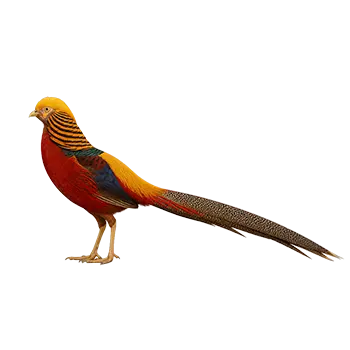
The Golden Pheasant is among the most frequently photographed ornamental birds in the world, and its image circulates widely across photography platforms, social media networks, and online birding communities. The male's plumage presents a compelling photographic subject that challenges and rewards photographers in equal measure. Capturing the full chromatic range of the golden crest, the orange-and-black barring of the cape, the scarlet breast, and the intricate patterning of the tail demands careful attention to lighting, exposure, and composition, making the species a favorite among both amateur and professional wildlife photographers.

Images of Golden Pheasants routinely perform well on visual platforms, where the species' vivid coloration stands out in feeds and galleries. Photographs of males in full courtship display, with the cape fanned and angled toward the viewer, are among the most shared and commented-upon bird images online. These viral moments have introduced the Golden Pheasant to audiences far beyond the traditional birding and avicultural communities, sparking curiosity and occasionally disbelief among viewers encountering the species for the first time and questioning whether the colors are digitally enhanced.

The rise of digital photography and social media has also created new documentation opportunities for Golden Pheasant keepers and breeders. Aviculturists regularly share images and videos of their birds on dedicated forums, social media groups, and video platforms, creating a visual record of color mutations, breeding successes, and husbandry practices. These online communities serve as both a showcase for the species and a practical resource for keepers seeking advice on care, genetics, and aviary design.

Wildlife photographers who specialize in Chinese avifauna have produced portfolio-quality images of Golden Pheasants in their native habitat, contributing to both artistic and scientific understanding of the species. These images, published in books, exhibitions, and online galleries, document the bird in ecological context and provide a counterpoint to the aviary photographs that dominate most visual representations. The contrast between wild and captive imagery highlights the Golden Pheasant's dual existence as a creature of remote mountain forests and a familiar resident of ornamental collections worldwide.

On Stamps, Currency & Official Emblems

The Golden Pheasant has appeared on postage stamps issued by China and several other countries, reflecting its status as one of the most visually recognizable bird species in the world. Chinese postal authorities have featured the Golden Pheasant on multiple stamp issues, often as part of series celebrating the country's native wildlife or cultural heritage. These stamps typically reproduce paintings or illustrations of the bird in a style that references classical Chinese artistic traditions, reinforcing the connection between the species and the broader visual culture of China.

Beyond China, the Golden Pheasant has appeared on stamps from countries in Asia, Europe, and Africa, often in wildlife or biodiversity themed sets. The bird's dramatic appearance makes it a popular choice for stamp designers seeking to create visually striking miniature compositions, and philatelic collectors recognize Golden Pheasant stamps as desirable items within the broader category of bird-themed philately. Some issues have reproduced famous artistic depictions of the species, while others have used photographic references or original illustrations.

The Golden Pheasant's image has also been adopted by various organizations and institutions as an emblem or logo element. In China, the species has been used in branding for tourism, hospitality, and cultural organizations, drawing on its associations with beauty, prestige, and Chinese heritage. In the United Kingdom, where feral populations have persisted for over a century, the Golden Pheasant has occasionally served as a local emblem in regions associated with the bird's presence, appearing on pub signs, village crests, and regional promotional materials.

The species' presence on official and semi-official emblems reflects its unusual position among birds. Unlike many species that appear on national symbols due to their ecological importance or endangered status, the Golden Pheasant's emblematic use derives primarily from its aesthetic impact and cultural resonance. The bird's image communicates a specific set of values, beauty, rarity, and a connection to the natural world, that organizations and institutions find useful for branding and identity purposes. This practical use of the Golden Pheasant's visual identity ensures that the species remains visible in public life well beyond the boundaries of aviculture and ornithology.

The Golden Pheasant in Contemporary Culture

In contemporary culture, the Golden Pheasant occupies an interesting niche as a species that is simultaneously familiar and surprising. Aviculturists and bird enthusiasts know it intimately, yet the general public often encounters the bird with a sense of astonishment, reacting to photographs or video as though the species were too colorful to be real. This recurring pattern of surprise and delight has made the Golden Pheasant a reliable source of viral content, with images and clips periodically surfacing across social platforms and attracting millions of views from audiences worldwide.

The species has also found a place in the broader cultural conversation about the relationship between humans and ornamental animals. Discussions about the ethics of keeping exotic birds, the environmental impact of introduced species, and the role of private aviculture in conservation sometimes reference the Golden Pheasant as a case study. The bird's long history in captivity, its stable wild population, and its established presence as a feral species in the United Kingdom make it a useful example in debates that often lack concrete, well-documented instances to ground their arguments.

In fashion and design, the Golden Pheasant's plumage continues to inspire patterns, color palettes, and motifs. Textile designers, jewelers, and graphic artists draw on the species' distinctive combination of gold, scarlet, orange, and black, producing work that references the bird explicitly or abstracts its color relationships into decorative compositions. The Golden Pheasant's influence on design is often subtle, filtering into broader aesthetic trends without direct attribution, but knowledgeable observers can trace the lineage of certain patterns and color schemes back to the bird's plumage.

The Golden Pheasant's cultural footprint is likely to grow as wildlife photography, nature documentary production, and online content creation continue to expand. The species possesses a combination of visual impact, cultural depth, and accessibility that makes it well suited to the demands of modern media. Whether encountered in a Chinese nature reserve, a British country estate, or a high-resolution photograph shared across continents in seconds, the Golden Pheasant continues to fulfill the role it has occupied for centuries: a living embodiment of the extravagant beauty the natural world is capable of producing.

Always consult a qualified professional before making any health-related decisions. This content is provided for informational reference only and should not replace professional guidance specific to your animal.