
Origins & Natural Habitat

The Golden Pheasant (Chrysolophus pictus) is native to the mountainous forests of central China, where it inhabits dense bamboo thickets, rocky slopes, and mixed coniferous-broadleaf woodland at elevations ranging from roughly 500 to 2,000 meters. Its historic range centers on the provinces of Gansu, Shaanxi, Sichuan, Guizhou, Hubei, and Hunan, though precise boundaries have always been difficult to establish due to the bird's secretive habits and preference for heavy undergrowth. Despite its extraordinary plumage, the Golden Pheasant is remarkably difficult to observe in the wild, spending much of its time foraging quietly on the forest floor among dense vegetation.

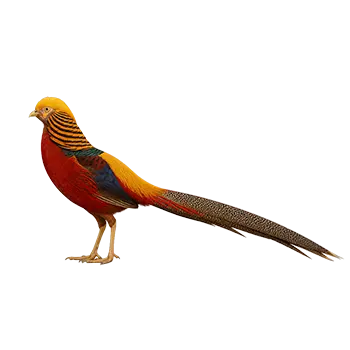
The species belongs to the family Phasianidae, which includes pheasants, partridges, and their relatives. Within this family, the Golden Pheasant is placed in the genus Chrysolophus alongside its close relative, the Lady Amherst's Pheasant (Chrysolophus amherstiae), with which it can hybridize in areas where their ranges overlap or in captive settings. The male Golden Pheasant is among the most visually striking of all birds, displaying a brilliant golden-yellow crest, a cape of orange and black barred feathers that fans across the nape and shoulders, a scarlet breast, and a long, sweeping barred tail that can account for more than half the bird's total length.

In its native habitat, the Golden Pheasant feeds on a varied diet of seeds, grains, berries, grubs, and tender plant shoots. It roosts in trees at night to avoid ground-dwelling predators, and during the breeding season males perform elaborate courtship displays in which the ornate cape is spread wide and angled toward the hen, creating a visual spectacle that has captivated human observers for centuries. Females, by contrast, are cryptically colored in mottled brown and buff, allowing them to remain inconspicuous while nesting on the ground.

Wild populations of the Golden Pheasant are considered stable across much of their range, though habitat fragmentation due to agriculture and timber harvesting has reduced their extent in some areas. The species is currently classified as Least Concern by the International Union for Conservation of Nature, a status supported in part by the large captive population maintained by aviculturists worldwide, which provides a genetic reservoir independent of wild stocks.

Early History with Humans

The Golden Pheasant's relationship with humans is ancient and deeply rooted in Chinese civilization. Chinese texts and artistic depictions referencing brilliantly plumaged pheasants date back more than two thousand years, and the Golden Pheasant is widely believed to be among the species that inspired the legendary Fenghuang, the mythical bird often translated in Western sources as the Chinese phoenix. While the Fenghuang is a composite creature drawing on multiple avian forms, the Golden Pheasant's vivid coloring and dramatic courtship display made it one of the most prominent real-world models for this powerful cultural symbol.

During the imperial era, the Golden Pheasant held specific significance within the rigid hierarchy of the Chinese court. Under the Qing dynasty and its predecessors, the plumage of various bird species was used to denote official rank on the mandarin squares worn by civil officials. The Golden Pheasant was designated as the emblem of the second-rank civil official, a position of considerable authority and prestige. This formal association between the bird and governmental power cemented the species as a symbol of ambition, merit, and public service in Chinese culture.

The species first reached Europe during the early 18th century, when specimens were brought to England by traders and diplomats returning from China. Early records suggest that Golden Pheasants were present in British aviaries by the 1720s, and their spectacular appearance quickly attracted the attention of aristocratic collectors and natural history enthusiasts. Carl Linnaeus formally described the species in 1758, assigning it the binomial name Phasianus pictus before it was later reclassified into the genus Chrysolophus.

By the 19th century, the Golden Pheasant had become a staple of ornamental bird collections across Europe and North America. Wealthy estate owners in England released birds into their parks, and feral populations established themselves in parts of East Anglia, Wales, and Scotland. These introduced populations, some of which persist to the present day, represent one of the earliest and most enduring examples of a non-native gamebird becoming semi-established in the British countryside.

Cultural Symbolism & Folklore

In Chinese culture, the Golden Pheasant carries layers of symbolic meaning that extend well beyond its association with the imperial court. The bird is traditionally regarded as an emblem of good fortune, prosperity, and beauty. Its radiant plumage, particularly the golden crest and scarlet breast, has been interpreted as a manifestation of yang energy and solar vitality, linking the species to warmth, renewal, and auspicious beginnings. Golden Pheasant motifs appear frequently on traditional textiles, ceramics, screens, and lacquerware, where the bird is often depicted amid peonies or chrysanthemums to reinforce themes of wealth and longevity.

The Fenghuang connection gives the Golden Pheasant a mythological dimension shared by few other real-world birds. In Chinese cosmology, the Fenghuang represents the union of yin and yang and is associated with the empress, complementing the dragon's association with the emperor. When the Golden Pheasant is invoked as a living echo of the Fenghuang, it inherits these associations with harmony, virtue, and the balance of natural forces. This symbolic weight elevated the species above mere ornamental curiosity and gave it a place in philosophical and spiritual discourse.

In the folklore of rural Chinese communities, pheasants more broadly are sometimes cast as messengers or omens, and the Golden Pheasant's brilliance made it a particularly powerful figure in such traditions. Encountering a Golden Pheasant in the wild was sometimes regarded as a sign of forthcoming good luck or a reminder to attend to one's duties with diligence and integrity. The bird's elusive nature in its dense forest habitat only reinforced its mystique, giving sightings a quality of rarity and significance.

Outside China, the Golden Pheasant's symbolism evolved differently. In European aviculture, the species came to represent the exotic beauty of the East and the prestige of maintaining a private collection of rare birds. Victorian and Edwardian collectors prized the Golden Pheasant as a centerpiece of their aviaries, and its image appeared on decorative objects, sporting prints, and natural history illustrations that circulated among the upper classes. The bird's cultural identity in the West has always been shaped primarily by its visual impact, a living ornament whose presence spoke to the collector's taste, resources, and worldly connections.

Scientific Study & Classification

The formal scientific classification of the Golden Pheasant began with Linnaeus in the tenth edition of Systema Naturae in 1758, where the species was placed among the pheasants under the name Phasianus pictus. The epithet pictus, meaning painted, was a direct reference to the male's extraordinary plumage. Later taxonomists recognized that the Golden Pheasant and the Lady Amherst's Pheasant shared sufficient morphological and behavioral characteristics to warrant their own genus, and the name Chrysolophus, derived from the Greek for golden crest, was erected to house both species.

Ornithological research on the Golden Pheasant in the wild has been constrained by the bird's secretive habits and the rugged terrain it inhabits. Much of what is known about wild populations comes from surveys conducted in Chinese nature reserves during the late 20th and early 21st centuries. These studies have documented the species' habitat preferences, breeding ecology, and seasonal movements, revealing a bird that is far more adaptable in its dietary and habitat requirements than its exotic appearance might suggest. Golden Pheasants have been recorded foraging at forest edges, in bamboo groves, and even in agricultural margins adjacent to primary forest.

Genetic studies have clarified the relationship between the Golden Pheasant and the Lady Amherst's Pheasant, confirming their close evolutionary kinship while also revealing that hybridization between the two species occurs more readily than was once thought. In captivity, hybrids are fertile and exhibit a range of intermediate plumage patterns, which has complicated the management of purebred lines in avicultural collections. Molecular phylogenetics has placed Chrysolophus firmly within the broader radiation of Old World pheasants, allied to genera such as Lophura and Syrmaticus.

The Golden Pheasant has also contributed to broader scientific understanding of sexual selection and ornamental trait evolution. The male's extravagant plumage is a textbook example of a sexually selected trait driven by female choice, and researchers have studied the costs and benefits of maintaining such conspicuous coloring in a habitat where ground predators are common. The species offers valuable comparative data for evolutionary biologists working on the mechanisms by which elaborate male ornamentation evolves and is maintained across generations.

The Golden Pheasant Today

Today the Golden Pheasant is one of the most widely kept ornamental pheasants in the world. Aviculturists on every continent maintain breeding populations, and the species is a familiar presence at poultry shows, bird expos, and private collections. Several color mutations have been established in captivity, including yellow, cinnamon, salmon, and dark-throated variants, which have broadened the bird's appeal to breeders interested in genetics and selective breeding while also raising questions within the avicultural community about the importance of preserving the wild-type phenotype.

In its native China, the Golden Pheasant remains a culturally resonant species. It serves as the national bird of the country in popular (though not formally codified) recognition, and its image continues to appear in contemporary art, design, and branding. Chinese nature reserves in Shaanxi, Gansu, and Sichuan include the Golden Pheasant among their flagship species for ecotourism and conservation education, and the bird draws birdwatchers from around the world who travel to these remote mountain forests for a chance to observe the species in its natural setting.

Feral populations of the Golden Pheasant persist in several locations outside China, most notably in parts of the United Kingdom. The population in the Breckland region of East Anglia and scattered groups in mid-Wales and southwest Scotland are descended from birds released or escaped from estates during the 19th and early 20th centuries. These feral groups are small and genetically limited, and their long-term viability is a subject of ongoing monitoring by British ornithological organizations. Hybridization with Lady Amherst's Pheasants, which were also introduced, has been documented in some of these populations.

The avicultural community has played an important role in ensuring the Golden Pheasant's genetic diversity in captivity, though coordination between breeders regarding studbooks and lineage tracking remains informal compared to programs for endangered species. Conservation organizations have generally not prioritized the Golden Pheasant for intensive management, given its stable wild population, but aviculturists argue that maintaining healthy, genetically diverse captive stocks serves as an insurance policy against future threats and preserves the species' full range of natural variation.

Notable Historical & Cultural Associations

Throughout its long history with humans, the Golden Pheasant has been associated with specific individuals, institutions, and cultural moments that have shaped its public identity. In imperial China, the bird's presence on the mandarin squares of second-rank civil officials meant that the Golden Pheasant was woven into the visual fabric of the court for centuries, appearing in portraits, official documents, and ceremonial settings. Surviving examples of these embroidered rank badges, held in museums around the world, remain among the most widely recognized artifacts of Chinese imperial culture.

In Europe, the Golden Pheasant became closely associated with the great estate culture of England. Estates such as those in Norfolk and Suffolk maintained Golden Pheasant flocks as part of their ornamental bird collections, and the species featured prominently in the sporting and natural history art of the 18th and 19th centuries. Artists including John Gould, whose lavishly illustrated monographs on birds brought exotic species to the attention of the Victorian public, depicted the Golden Pheasant in meticulous detail, contributing to its reputation as one of the most beautiful birds in the world.

The species has also lent its name and image to a variety of commercial and institutional contexts over the centuries. Pubs, inns, and public houses in England bearing the name Golden Pheasant can be found in regions where the bird was historically associated with local estates. The bird's image has appeared on postage stamps, coins, and decorative objects in both China and Europe, and it continues to serve as a motif in jewelry, fashion, and interior design that draws on Asian or avian themes.

In the modern avicultural world, the Golden Pheasant occupies a position of particular affection among pheasant enthusiasts. It is often the first ornamental pheasant species kept by newcomers to the hobby, owing to its hardiness, adaptability to captive conditions, and the stunning visual reward it provides. Experienced aviculturists, meanwhile, value the species as a benchmark for husbandry standards and a gateway to the broader world of Galliformes keeping. The Golden Pheasant's combination of accessibility and beauty has ensured that it remains central to the identity and practice of ornamental pheasant aviculture worldwide.

Always consult a qualified professional before making any health-related decisions. This content is provided for informational reference only and should not replace professional guidance specific to your animal.