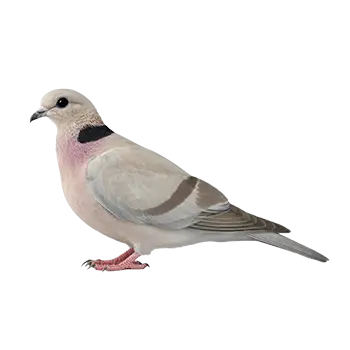

The Ring-necked Dove, also known as the Cape Turtle Dove or Half-collared Dove, is native to eastern and southern Africa. Its natural range stretches from Ethiopia and the Horn of Africa southward through Kenya, Tanzania, and into South Africa, where it thrives in open woodlands, savannas, and scrublands. The species belongs to the genus Streptopelia, a group of Old World doves that has produced several of the most familiar domesticated dove varieties in aviculture.
European naturalists first documented the Ring-necked Dove during the colonial exploration of the African continent in the eighteenth and nineteenth centuries. Early specimens were brought back to European aviaries, where the bird's calm demeanor and soft, melodic cooing made it an immediate favorite among collectors. By the mid-1800s, captive-bred populations were well established across much of Europe, and breeding programs had begun to produce color mutations that would later become staples of the domestic dove hobby.
The domestic Ring-necked Dove kept in homes today is largely descended from these early captive populations, selectively bred over many generations for tameness and variety. While it shares a close lineage with the Eurasian Collared Dove and the African Collared Dove, the Ring-necked Dove is generally considered its own distinct species. Its long history of captive breeding has made it one of the most genetically well-understood doves in aviculture, and it remains one of the most widely kept dove species worldwide.