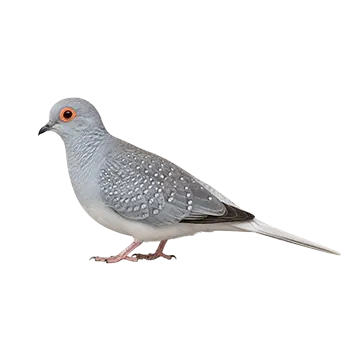

The Diamond Dove (Geopelia cuneata) is one of Australia's smallest dove species and among the most widely kept doves in aviculture worldwide. Native to the arid and semi-arid interior of the Australian continent, Diamond Doves have adapted over millennia to thrive in dry grasslands, open woodlands, and scrubby terrain where water sources are sparse. Their diminutive size, soft plumage, and delicate red-orange eye rings have made them instantly recognizable among bird enthusiasts and ornithologists alike.
European naturalists first encountered Diamond Doves during early expeditions into Australia's interior during the late eighteenth and early nineteenth centuries. The species was formally described by the English ornithologist John Latham in 1801, who noted its remarkably small stature compared to other members of the dove family. Specimens were collected and sent to European museums, where their beauty generated immediate interest among both scientists and the emerging community of aviculturists.
In their native range, Diamond Doves are nomadic birds that follow seasonal rainfall patterns across vast stretches of the Australian outback. They are ground feeders, foraging for grass seeds and small invertebrates on the dusty plains. Their ability to survive on minimal water intake and their preference for open terrain distinguish them from many of their forest-dwelling relatives. This ecological adaptability would eventually prove advantageous in captive settings, contributing to the species' popularity as a companion bird.
Aboriginal Australians have long been familiar with the Diamond Dove, and the bird appears in various regional oral traditions and ecological knowledge systems. Indigenous Australians recognized the dove's movements as indicators of seasonal changes and water availability, integrating this understanding into broader land management practices that sustained communities across the continent for tens of thousands of years.