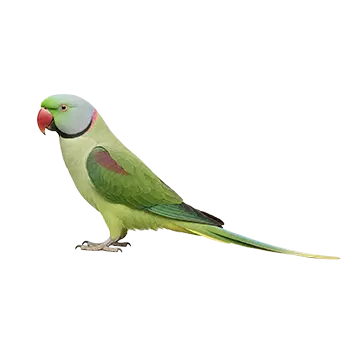

Selecting an appropriate travel carrier is the single most important preparation step when transporting a Derbyan Parakeet. As the largest member of the Psittacula genus, the Derbyan requires a carrier that accommodates its body length of 18 to 20 inches, including its long graduated tail, without forcing the bird to crouch or bend its tail feathers against the enclosure walls. A carrier that is too small will cause physical discomfort and increase stress, while one that is excessively large allows the bird to be thrown around during sudden stops or turbulence.
Hard-sided carriers designed for medium to large parrots are generally the best option for Derbyan Parakeet transport. These carriers offer structural protection against impacts, resist chewing, and provide stable footing for the bird during movement. The carrier should have a secure door latch that the bird cannot open from inside, adequate ventilation on at least two sides, and a solid, non-slip floor. A removable grate above a pull-out tray simplifies cleaning during longer journeys without requiring the bird to be removed from the carrier.
Before any trip, the carrier should be introduced to the Derbyan Parakeet well in advance of the travel date. Placing the carrier in the bird's living area with the door open, adding familiar treats and a small perch inside, and allowing the bird to explore it voluntarily over a period of days or weeks can significantly reduce the stress associated with being confined. Birds that associate the carrier with positive experiences are far less likely to panic when placed inside it for actual transport, and this desensitization process is particularly important for Derbyan Parakeets, which can be initially wary of novel objects.
For air travel, carriers must meet the specific dimensional and construction requirements of the airline being used, and these specifications should be verified directly with the carrier before booking. Requirements for ventilation, latch security, labeling, and carrier material differ between airlines and may also vary depending on whether the bird will travel in the cabin or as cargo. Having a carrier that meets the most restrictive common standards avoids last-minute complications at the airport.