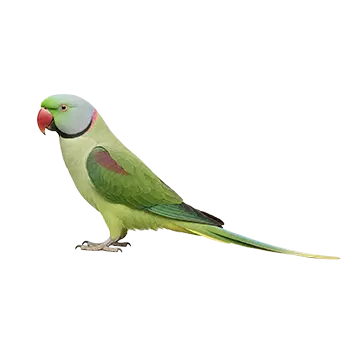

The Derbyan Parakeet's debut in Western visual culture came through one of the 19th century's most talented bird illustrators, Edward Lear. In 1831, Lear produced a detailed lithographic plate of Psittacula derbiana for his landmark work Illustrations of the Family of Psittacidae, or Parrots. The illustration depicted the species with remarkable fidelity, capturing the lavender-blue breast, the bold facial markings, and the large red upper mandible that distinguish the Derbyan from other Psittacula parakeets. This plate became the primary visual reference for the species across European ornithological literature for decades.
Lear's illustration was not created in isolation. It was part of a broader movement in 19th-century natural history publishing that sought to catalog and depict the world's bird species with scientific precision and artistic beauty. The Derbyan Parakeet appeared alongside dozens of other psittacine species in Lear's volume, but its size and distinctive plumage gave it a visual presence that set it apart. The Earl of Derby's living specimen, which served as Lear's model, provided the kind of direct observational detail that was rare for species from remote Asian habitats during this period.
Subsequent natural history illustrators revisited the Derbyan Parakeet throughout the 19th and early 20th centuries, though none achieved the iconic status of Lear's original plate. John Gould's multivolume works on Asian birds included depictions of Psittacula derbiana that emphasized the species' habitat and posture in a more naturalistic style. These illustrations, while less widely reproduced than Lear's, contributed to the growing visual documentation of the species and helped establish the Derbyan's identity as a bird of the high mountain forests.
Today, Lear's original Derbyan Parakeet plate is held in several major natural history collections and has been widely reproduced in books, prints, and digital archives. It remains one of the most recognizable images of the species, and its artistic quality has given the Derbyan a modest but enduring presence in the broader world of natural history art. For many people encountering the species for the first time, Lear's illustration is still the point of entry.