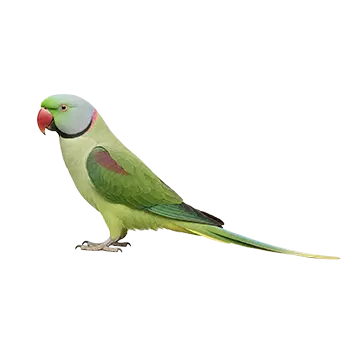

The Derbyan Parakeet (Psittacula derbiana) is native to a narrow band of high-altitude forest stretching across northeastern India, southeastern Tibet, and the mountainous provinces of southwestern China, principally Sichuan and Yunnan. It is the largest species in the Psittacula genus, distinguished by its robust build, broad lavender-blue breast, and bold black submoustachial stripe. The species occupies a remarkably specific ecological niche, favoring coniferous and mixed forests at elevations between 1,800 and 4,000 meters, a range that sets it apart from nearly all other parakeet species worldwide.
Within these montane forests, the Derbyan Parakeet feeds primarily on pine seeds, walnuts, barley, maize, and a variety of wild fruits and berries. Flocks typically range from small family groups to aggregations of several dozen birds, moving through the canopy and along forest edges in search of seasonal food sources. Their vocalizations, a series of loud, ringing calls, echo across the steep valleys they inhabit and serve as the primary means of maintaining contact within the flock during daily foraging flights.
The species' high-altitude lifestyle has shaped its physiology in notable ways. Derbyan Parakeets tolerate cooler temperatures far better than most psittacines, an adaptation to the frost-prone winters and cool summers of their mountain habitat. Their plumage, while vibrantly colored, is denser than that of many lowland relatives, providing insulation against cold nights at altitude. This resilience to cold has made the species surprisingly adaptable in certain captive settings, though it also means that the Derbyan's care requirements differ meaningfully from those of tropical parakeets.
Habitat loss driven by logging, agricultural expansion, and infrastructure development across the eastern Himalayas and southwestern China has reduced the Derbyan Parakeet's range over the past century. The species' dependence on mature, high-altitude forest makes it particularly vulnerable to deforestation, as these ecosystems regenerate slowly and are often targeted for timber extraction. This ecological fragility has become a defining feature of the species' modern conservation profile.