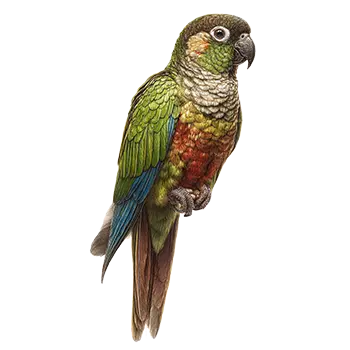

The Green-cheeked Conure, known scientifically as Pyrrhura molinae, is native to the forests and woodlands of South America. Its natural range stretches across a broad swath of the continent, encompassing parts of Brazil, Bolivia, Argentina, and Paraguay. Within these regions the species inhabits a variety of forested environments, from dense subtropical and tropical moist lowland forests to drier woodland edges and areas of secondary growth. Flocks are commonly observed at elevations ranging from lowland river valleys up to montane forests approaching 3,000 meters.
The species was first formally described by the Swiss-American naturalist John Cassin in 1854, though indigenous peoples of South America had long been familiar with the bird and its habits. Early European naturalists encountered the Green-cheeked Conure during collecting expeditions in the mid-nineteenth century, and museum specimens from that era helped establish its taxonomic classification within the Pyrrhura genus. The genus itself is one of the more species-rich groups among New World parrots, and ongoing field research continues to refine our understanding of the relationships between its many members.
In the wild, Green-cheeked Conures are highly social birds that travel in flocks of ten to twenty or more individuals. They forage together on fruits, seeds, flowers, and occasionally insects, moving through the forest canopy with characteristic agility. Their gregarious nature and relatively quiet demeanor compared to larger parrots made them appealing to early bird traders who recognized the species as a promising candidate for the companion bird market.
The bird's compact size, vibrant plumage, and endearing personality traits caught the attention of aviculturists during the latter half of the twentieth century. As captive breeding programs expanded in Europe and North America, the Green-cheeked Conure gradually transitioned from an obscure South American parrot to one of the most widely kept companion birds in the world.