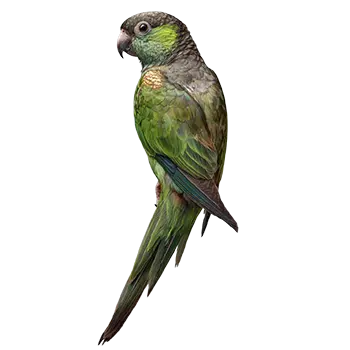

The Bronze Winged Parakeet (Brotogeris chrysoptera) inhabits a broad swath of northern South America, ranging from eastern Venezuela and the Guianas through the northern reaches of the Amazon Basin in Brazil. Within this range the species favors humid lowland forests, gallery forests that follow river corridors, and forest edges where canopy meets open terrain. It is most frequently observed below elevations of roughly 500 meters, though occasional sightings at moderate altitudes have been documented in the tepui foothills of southern Venezuela.
The bird derives its common name from the distinctive bronze-brown patch on the upper wing coverts, a marking that contrasts with the otherwise predominantly green plumage shared by most Brotogeris species. Adults typically measure between 18 and 20 centimeters, placing them among the smaller members of the Psittacidae family. Their compact build and rapid, direct flight allow them to navigate dense forest canopy with agility, a trait that has historically made them difficult to observe in the wild compared to larger, slower-flying parrots.
In their native habitat, Bronze Winged Parakeets are highly social. Flocks of 10 to 30 individuals are common, and larger aggregations may form at communal roosting sites or productive fruiting trees. Their diet in the wild centers on seeds, small fruits, blossoms, and nectar, supplemented by the occasional insect larva. This dietary flexibility has enabled the species to persist across a range of forest types, from primary terra firme forest to secondary growth and seasonally flooded varzea woodlands.
The ecology of the Bronze Winged Parakeet is closely tied to the seasonal rhythms of Amazonian and Guianan forests. Breeding activity intensifies during the early rainy season, when fruit availability peaks and natural tree cavities offer sheltered nesting sites. Pairs typically select hollows in dead or decaying branches, a nesting strategy common across the Brotogeris genus. This dependence on mature trees with suitable cavities links the species' reproductive success directly to the health and continuity of old-growth forest, a factor that has become increasingly relevant as land-use patterns shift across its range.