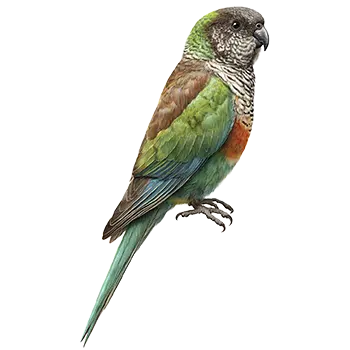

Origins & Discovery

Bourke's Parakeet (Neopsephotus bourkii) is native to the arid and semi-arid interior of Australia, where it inhabits dry scrublands, mulga woodlands, and spinifex grasslands. The species was first described by English ornithologist John Gould in 1841, who encountered specimens during his extensive survey of Australian birdlife. Gould named the bird in honor of Sir Richard Bourke, who served as Governor of New South Wales from 1831 to 1837 and was a prominent figure in early colonial administration.

The parakeet's natural range extends across much of inland Australia, from western New South Wales through South Australia and into Western Australia. It favors regions with sparse vegetation and access to water sources, often gathering at waterholes during the crepuscular hours of dawn and dusk. Aboriginal Australians were familiar with the species long before European documentation, observing its habits and seasonal movements as part of their deep ecological knowledge of the landscape.

For decades after its formal description, Bourke's Parakeet remained relatively obscure compared to more colorful Australian parrots such as budgerigars and cockatiels. Its soft, muted plumage of pinks, browns, and blues did not attract the same immediate attention from collectors and aviculturists. However, those who did encounter the species in the wild were struck by its calm demeanor and its beautiful, understated coloring, particularly the rosy flush across the breast that becomes more vivid in evening light.

Historical Roles

Unlike many parrot species that were prized for their ability to mimic speech or perform tricks, Bourke's Parakeet historically attracted attention for different reasons. Early naturalists and explorers in the Australian interior noted the species as an indicator of nearby water sources. Flocks of Bourke's Parakeets flying at dusk reliably pointed travelers toward waterholes, a practical observation that made the bird useful to those navigating the harsh outback terrain.

In the early days of European aviculture in Australia, Bourke's Parakeets were occasionally trapped and kept as cage birds, though they were far less commonly traded than budgerigars or cockatoos. Their quiet nature made them well-suited to domestic settings, and small numbers were shipped to Europe beginning in the late 19th century. By the early 20th century, aviculturists in England and continental Europe had begun breeding them in captivity, appreciating their docile temperament and relatively undemanding care requirements.

The species also played a minor but notable role in ornithological science. Its taxonomic classification was debated for many years, with some authorities placing it in the genus Neophema alongside other grass parakeets, while others argued its distinctive features warranted a separate genus. The eventual establishment of the monotypic genus Neopsephotus reflected the bird's unique evolutionary position among Australian parrots, a classification that continues to interest avian taxonomists today.

Cultural Symbolism

In Australian culture, Bourke's Parakeet occupies a quieter symbolic space than more iconic species like the kookaburra or galah. Nevertheless, the bird holds a special place in the hearts of those familiar with the outback. Its crepuscular habits, appearing most active in the soft light of dawn and dusk, have lent it an association with tranquility and the meditative stillness of the desert landscape. Birdwatchers who travel to the interior often describe the experience of watching a flock of Bourke's Parakeets at a waterhole as one of the most peaceful encounters in Australian birding.

The rosy plumage of the Bourke's Parakeet has also carried aesthetic significance. In avicultural circles, the bird is sometimes referred to as the "pink parakeet" or "sunset bird," names that reflect the warm tones of its feathering. The development of the rosy or rosa color mutation in captive breeding further emphasized this quality, producing birds with intensified pink coloring that became highly sought after by hobbyists and breeders worldwide.

Among Indigenous Australian communities in the bird's range, local ecological knowledge includes observations of the Bourke's Parakeet's behavior in relation to seasonal patterns, water availability, and weather changes. While detailed published records of specific cultural narratives involving the species are limited, the bird is part of the broader tapestry of relationships between Aboriginal peoples and the wildlife of the arid interior.

Avicultural Societies & Standards

Bourke's Parakeet has become a well-established species in organized aviculture, recognized by bird societies and clubs around the world. In Australia, the species is registered and exhibited through state-level bird clubs affiliated with national organizations. Standards for exhibition birds typically emphasize the clarity of the plumage pattern, the evenness of the rosy breast coloring, and overall body condition and deportment.

Internationally, Bourke's Parakeets are featured in the standards of avicultural organizations across Europe, North America, and Asia. European bird clubs, particularly in the Netherlands, Belgium, and Germany, have been influential in developing and refining color mutation standards. The World Ornithological Confederation (COM) and its affiliated national organizations maintain detailed standards for judging Bourke's Parakeets in competition, including categories for the wild-type coloring as well as established mutations such as rosy, yellow, and fallow.

In the United States, organizations such as the American Federation of Aviculture and various regional bird clubs include Bourke's Parakeets in their exhibition and educational programs. The species is particularly popular among hobbyist breeders who appreciate its gentle nature and manageable size. Bird shows and exhibitions provide a venue for breeders to display their stock, exchange knowledge, and promote responsible aviculture practices for the species.

The establishment of formal breed standards has contributed to the long-term health of captive populations by encouraging breeders to maintain genetic diversity and prioritize the well-being of their birds alongside aesthetic goals.

The Species Today

In the wild, Bourke's Parakeet is currently classified as a species of least concern by the International Union for Conservation of Nature (IUCN). Its population appears stable across much of its natural range in inland Australia, though localized pressures from habitat degradation, altered water regimes, and competition with introduced species are ongoing concerns. Conservation efforts in Australia focus on maintaining the health of arid and semi-arid ecosystems that support the species and many other native wildlife.

In captivity, Bourke's Parakeet enjoys widespread popularity as a companion bird and aviary species. Its reputation as one of the quietest and most easygoing parakeets makes it especially appealing to bird keepers in apartments or shared living spaces. The species breeds readily in captivity, and a thriving community of hobbyist and professional breeders ensures a steady supply of well-socialized, captive-bred birds for the pet trade.

The development of color mutations has added another dimension to the species' appeal. Beyond the wild-type coloring, mutations such as rosy, cream, yellow, fallow, and combinations thereof have expanded the palette available to breeders and buyers. While purists value the natural plumage, the mutation varieties have drawn new enthusiasts to the species and fueled interest in avian genetics among hobbyists.

Online communities and social media groups dedicated to Bourke's Parakeets have grown significantly in recent years, connecting keepers and breeders across continents. These digital communities serve as hubs for sharing husbandry advice, breeding results, veterinary information, and photographs, fostering a sense of global fellowship among those who appreciate this understated and charming species.

Notable Individuals & Milestones

John Gould's original description and illustration of Bourke's Parakeet in his monumental work "The Birds of Australia" (1840–1848) remains a landmark in the species' recorded history. Gould's detailed lithographic plates, prepared with the assistance of his wife Elizabeth, brought the bird to the attention of the European scientific community and laid the groundwork for its eventual popularity in aviculture.

In the 20th century, several aviculturists played key roles in establishing the species in captivity outside Australia. European breeders, particularly in the Netherlands and Germany, were instrumental in building sustainable captive populations during the mid-1900s, a period when Australia increasingly restricted the export of native wildlife. Their efforts ensured that the species remained available to aviculturists worldwide even after export bans took effect.

The emergence of the rosy mutation is widely regarded as a turning point in the species' popularity. First established in the latter half of the 20th century, the rosy Bourke's Parakeet captivated breeders and pet owners with its intensified pink coloring. This mutation, along with subsequent color varieties, sparked renewed interest in the species and contributed to its current status as one of the most popular small parakeets in aviculture.

More recently, individual Bourke's Parakeets have gained followings on social media platforms, where their gentle personalities and attractive plumage photograph well. While no single bird has achieved the viral fame of some larger parrot species, the collective presence of Bourke's Parakeets in online bird-keeping communities has significantly raised the species' profile among prospective bird owners.

Always consult a qualified professional before making any health-related decisions. This content is provided for informational reference only and should not replace professional guidance specific to your animal.