
In Literature & Naturalist Writing

The Bobwhite Quail has been a fixture of American nature writing since the earliest European accounts of the continent's wildlife. Colonial naturalists such as Mark Catesby and John Lawson described the bird's habits, plumage, and distinctive call in texts that circulated widely among educated European audiences. Catesby's illustration of the species in his Natural History of Carolina, published in the 1730s, was among the first color depictions of a North American quail and helped establish the bird as a recognizable symbol of the New World's avian diversity.

John James Audubon devoted considerable attention to the Bobwhite in his monumental Birds of America, producing a dramatic plate that depicted a covey under attack by a hawk. Audubon's accompanying text combined precise field observation with narrative storytelling, describing the quail's nesting behavior, seasonal movements, and response to predators in a style that blended science with literary ambition. His account contributed to a growing American literary tradition in which the Bobwhite served as both a subject of natural history and a touchstone for the beauty and fragility of the rural landscape.

In the 20th century, the Bobwhite became a recurring presence in southern regional literature. Writers such as Flannery O'Connor, who kept peafowl and other birds on her Georgia farm, inhabited a landscape in which quail were part of the everyday fabric of rural life. The bird's call appears as an atmospheric detail in novels and short stories set in the rural South, functioning as a sonic marker of place and season. Hunting narratives, a distinct literary subgenre with deep roots in the region, frequently centered on the Bobwhite and the rituals surrounding its pursuit, producing a body of writing that ranged from straightforward sporting accounts to meditative essays on landscape, memory, and loss.

Herbert Stoddard's scientific monograph on the Bobwhite, published in 1931, crossed the boundary between technical literature and popular readership. Written with clarity and passion, the book influenced not only wildlife management professionals but also lay readers who encountered in its pages a compelling portrait of a species intimately connected to the southern landscape. Stoddard's work helped elevate the Bobwhite from a common gamebird to a species of cultural and scientific significance worthy of sustained public attention.

In Visual Art & Illustration

The Bobwhite Quail has been a favored subject of American wildlife artists for nearly three centuries. Its compact form, richly patterned plumage, and association with appealing rural landscapes have made it a natural choice for painters, printmakers, and illustrators working in the sporting and natural history traditions. From Audubon's dramatic compositions to the refined decoy carvings of the Chesapeake Bay region, the Bobwhite has been rendered in virtually every visual medium available to American artists.

The golden age of American sporting art in the late 19th and early 20th centuries produced some of the most iconic Bobwhite imagery. Artists such as A. B. Frost, whose illustrations appeared in Scribner's Magazine and in popular sporting books, captured the drama of a covey rise with a kinetic energy that resonated with hunters and non-hunters alike. Frost's depictions of pointing dogs locked on coveys in autumn fields became definitive images of the American sporting landscape and helped establish a visual vocabulary for quail hunting that persists to this day.

The Federal Duck Stamp program, while primarily associated with waterfowl, inspired a broader tradition of wildlife stamp art in which upland gamebirds including the Bobwhite have featured prominently. Many states have issued their own upland game stamps depicting Bobwhites, and the competitive stamp art contests that surround these programs have produced a body of high-quality Bobwhite imagery that circulates among collectors and conservation organizations. These stamps serve a dual function, generating revenue for habitat conservation while reinforcing the Bobwhite's status as a cultural icon.

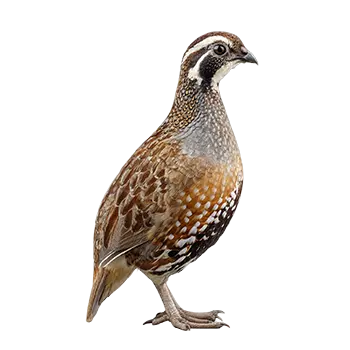
Contemporary wildlife artists continue to find the Bobwhite a compelling subject, often using the species to explore themes of habitat loss, ecological memory, and the tension between nostalgia and environmental reality. Gallery exhibitions and juried competitions dedicated to bird art regularly feature Bobwhite paintings, and the species appears frequently in the fine art prints and limited-edition reproductions marketed to hunters and conservationists. The bird's visual appeal, grounded in the subtle interplay of browns, whites, and blacks across its plumage, rewards close observation and has sustained artistic interest across generations.

In Music & Oral Tradition

The Bobwhite's clear, whistled call is one of the most frequently referenced bird vocalizations in American folk music and oral tradition. The two-note bob-WHITE, often rendered as a three-syllable bob-bob-WHITE, has been transcribed by musicians and incorporated into songs, fiddle tunes, and children's rhymes for generations. The call's melodic simplicity and its association with warm-weather evenings made it a natural element of the pastoral soundscape celebrated in American roots music.

Folk songs from the rural South and Midwest occasionally reference the Bobwhite by name or imitate its call as a lyrical motif. Shape-note singing traditions and early country music drew on the natural sounds of the agrarian landscape, and the quail's whistle fit comfortably alongside references to mockingbirds, whippoorwills, and other vocal species that defined the auditory character of the American countryside. While the Bobwhite never achieved the singular lyrical prominence of the mockingbird or the nightingale, its presence in this musical tradition reflects the depth of its integration into rural American life.

Beyond formal music, the Bobwhite's call has served as a mnemonic and conversational touchstone across the bird's range. Farmers, hunters, and rural residents routinely referred to the call as a seasonal indicator, noting its onset in spring as a sign that planting weather had arrived. Parents taught children to recognize the whistle and to repeat it, a practice that functioned as both nature education and a form of intergenerational cultural transmission. The decline of Bobwhite populations in many areas has disrupted this oral tradition, as younger generations in regions where the bird has disappeared may never hear the call that their grandparents regarded as one of the defining sounds of home.

In the world of competitive bird calling, Bobwhite whistles are among the standard calls that contestants are expected to master. Regional and national calling contests, often held in conjunction with hunting expos and conservation events, showcase the skill of callers who can reproduce the Bobwhite's whistle with remarkable fidelity. These competitions preserve a practical skill rooted in hunting and birding while also functioning as a form of cultural performance that celebrates the species and the traditions associated with it.

In Film, Television & Documentary

The Bobwhite Quail has appeared in film and television primarily through the lens of wildlife documentary and outdoor sporting programming. Nature documentaries focused on North American grassland ecosystems frequently feature the species as a representative of the open-country bird community, using footage of covey behavior, nesting activity, and dramatic covey rises to illustrate broader ecological themes. Programs produced by state wildlife agencies and conservation organizations have devoted entire episodes to the Bobwhite's life history and the management challenges it faces.

Outdoor sporting television, a genre with a dedicated and loyal audience across the American South and Midwest, has long featured Bobwhite hunting as a staple subject. Shows depicting traditional quail hunts over pointing dogs on southern plantations or Midwestern grasslands have introduced millions of viewers to the rituals and aesthetics of the sport, reinforcing the Bobwhite's cultural significance within the hunting community. These programs range from lavishly produced series on major outdoor networks to grassroots YouTube channels run by individual hunters and dog trainers, reflecting the democratization of media and the enduring appeal of the Bobwhite as a subject.

In narrative film, the Bobwhite appears less frequently but occasionally surfaces as an atmospheric detail in productions set in the rural South. The bird's call has been used on soundtracks to establish a sense of place and season, functioning as an auditory cue that signals open country, summer heat, and a slower pace of life. This use of the Bobwhite's vocalization in sound design reflects the call's deep association with a specific American landscape and the emotional resonances it carries for audiences familiar with the bird.

Conservation-focused documentaries have increasingly turned their attention to the Bobwhite's decline, using the species as a case study in grassland habitat loss and the broader ecological crisis facing ground-nesting birds in North America. These films, distributed through public television, streaming platforms, and conservation film festivals, have helped raise awareness of the Bobwhite's plight among audiences who may not have a direct connection to hunting or rural land management. The species' story, marked by abundance, decline, and the struggle for recovery, provides a compelling narrative arc that filmmakers have found effective in communicating complex ecological messages to general audiences.

In Hunting Culture & Sporting Heritage

No discussion of the Bobwhite Quail's media presence is complete without addressing the vast body of sporting literature, photography, and multimedia content that the species has inspired. Quail hunting occupies a singular position in American outdoor culture, and the Bobwhite is the species most closely identified with the tradition. Magazines such as Sporting Classics, Pointing Dog Journal, and Quail Forever's publication have devoted decades of editorial content to the Bobwhite, covering topics from dog training and habitat management to personal essays on the meaning of the hunt.

The visual culture of Bobwhite hunting extends well beyond fine art and into the commercial and vernacular realms. Calendar prints, greeting cards, merchandise, and lodge decor featuring Bobwhite imagery are ubiquitous in the rural South, and the bird appears on the logos of hunting preserves, dog breeding operations, and conservation organizations across the species' range. Quail Forever, one of the largest upland habitat conservation groups in North America, uses the Bobwhite as a central element of its branding and outreach, leveraging the species' cultural cachet to build membership and political support for habitat programs.

The rise of social media and digital content creation has expanded the Bobwhite's media footprint considerably. Instagram accounts, podcasts, and blogs dedicated to upland hunting frequently feature Bobwhite content, and the species generates substantial engagement within the online hunting community. Dog training videos set against the backdrop of Bobwhite coverts attract hundreds of thousands of views, and hashtags related to quail hunting trend seasonally as the autumn hunting season opens. This digital ecosystem has introduced the Bobwhite to younger audiences and has created new platforms for discussing both the sporting tradition and the conservation challenges that surround it.

The Bobwhite's prominence in sporting culture has had tangible economic consequences as well. Quail hunting tourism generates significant revenue in states such as Georgia, Texas, and Kansas, where outfitters and hunting lodges market Bobwhite hunts to clients from across the country and around the world. This economic dimension has given the species a constituency that extends beyond ecological concern and into the realm of rural economic development, adding another layer to the Bobwhite's complex cultural profile.

Legacy & Cultural Outlook

The Bobwhite Quail's cultural legacy is shaped by a tension between enduring affection and mounting ecological anxiety. For many Americans, particularly those with roots in the rural South and Midwest, the bird remains a powerful symbol of a landscape and a way of life that feel increasingly distant. The Bobwhite's call, once a taken-for-granted element of the everyday soundscape, has acquired a new resonance as its absence from former strongholds underscores the scale of habitat change across the continent.

This sense of loss has fueled a cultural movement that blends conservation advocacy with nostalgia and regional identity. Books, essays, and oral histories documenting the Bobwhite's place in American life have proliferated in recent decades, driven by a recognition that the living traditions associated with the species may not survive the bird's continued decline. Organizations such as the National Bobwhite Technical Committee and Tall Timbers Research Station have worked to translate cultural concern into actionable science and policy, positioning the Bobwhite as a flagship species for grassland and early-successional habitat conservation.

The species' cultural significance has also proven to be a powerful tool for engaging private landowners in habitat restoration. In many parts of the South, the desire to hear Bobwhites calling again motivates landowners to adopt management practices, such as prescribed burning and native grass restoration, that benefit not only quail but entire communities of grassland-dependent wildlife. This cultural motivation supplements and sometimes exceeds the financial incentives offered by government conservation programs, demonstrating the practical value of the deep emotional connection that many Americans feel toward the Bobwhite.

Looking forward, the Bobwhite Quail's place in American culture will depend in large part on the success of efforts to restore the habitats on which it depends. If wild populations stabilize and recover in meaningful numbers, the species may continue to serve as a living link between past and present, connecting new generations to the landscapes and traditions that shaped their predecessors. If the decline continues, the Bobwhite risks becoming a purely nostalgic figure, remembered in art, literature, and family stories but absent from the fields and fence rows where its call once defined the character of the American countryside.

Always consult a qualified professional before making any health-related decisions. This content is provided for informational reference only and should not replace professional guidance specific to your animal.