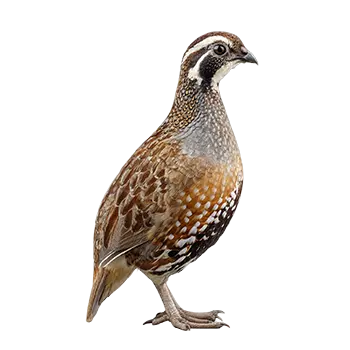

The Bobwhite Quail (Colinus virginianus) is a ground-dwelling bird native to the eastern and central regions of North America. Its historical range extended from southern Ontario and the Great Lakes states southward through the Atlantic seaboard, the Gulf Coast, and into eastern Mexico and parts of Central America. Within this vast territory, the species occupied a mosaic of grasslands, brushy fence rows, open pine savannas, and agricultural margins that provided the interspersion of cover and foraging habitat essential to its survival.
As a member of the New World quail family Odontophoridae, the Bobwhite diverged from Old World quail lineages millions of years ago. The genus Colinus is exclusively American, and over twenty subspecies of Colinus virginianus have been described, reflecting the considerable geographic variation across its range. Eastern populations tend to be slightly larger and darker than those found in the arid grasslands of Texas and Oklahoma, while the masked subspecies of the southwestern borderlands display striking facial plumage patterns distinct from the familiar white-throated males of the Southeast.
The species evolved alongside a landscape shaped by periodic fire, grazing by large herbivores, and the shifting agriculture of indigenous peoples. Longleaf pine savannas, tallgrass prairies, and early-successional shrublands all provided the low, dense ground cover that Bobwhites require for nesting and brood-rearing, as well as the open spaces they need for foraging on seeds and invertebrates. This dependence on disturbance-maintained habitats would prove critical to the bird's trajectory once European settlement began to transform the North American landscape.
Fossil evidence places quail in North America well before the Pleistocene, and pollen and charcoal records suggest that fire-maintained grasslands expanded and contracted with climatic shifts over millennia. The Bobwhite's reproductive strategy, characterized by large clutch sizes and the ability to re-nest multiple times in a single season, reflects an evolutionary adaptation to high predation pressure and the unpredictable availability of suitable habitat in a dynamic environment.