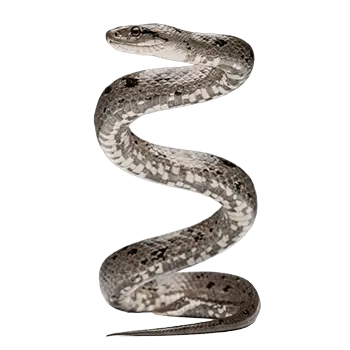

The Gray Rat Snake is an active, semi-arboreal species that demands more vertical space than many keepers initially expect. While hatchlings can be started in modestly sized enclosures to reduce stress and make prey location easier, the long-term housing plan must account for an adult animal that commonly reaches five to six feet in length and spends a significant portion of its active hours climbing. An adult Gray Rat Snake should be housed in an enclosure that provides a floor area of at least forty-eight inches long by twenty-four inches deep, with a height of at least twenty-four inches to accommodate climbing structures. Larger enclosures are always preferable when space and budget allow.
Hatchling and juvenile Gray Rat Snakes do well in smaller starter enclosures that offer security without overwhelming the animal with open space. A ten-to-twenty-gallon equivalent enclosure works for hatchlings up to about eighteen inches in length, and a mid-sized enclosure of roughly thirty-six by eighteen inches suits juveniles up to about two and a half feet. The key at every stage is that the enclosure must be fully escape-proof — Gray Rat Snakes are notorious escape artists with a remarkable ability to exploit gaps, loose-fitting lids, and unsecured ventilation panels. Every opening should be tested by attempting to slide a pencil through; if a pencil fits, a determined young rat snake can likely follow.
The transition from juvenile to adult enclosure should occur before the snake visibly outgrows its current housing rather than after. A snake that is cramped in an undersized enclosure exhibits stress behaviors such as persistent nose-rubbing against the walls, refusal to eat, and excessive hiding. Conversely, moving a small juvenile directly into a large adult-sized enclosure can cause a different form of stress — the animal may feel exposed and insecure, leading to the same appetite suppression and defensive behavior. The ideal approach is a staged transition: hatchling enclosure, intermediate juvenile enclosure, and final adult enclosure, each upgrade timed to coincide with the snake reaching roughly two-thirds of the enclosure's length.
Vertical space deserves special emphasis in Gray Rat Snake housing because this species is a far more active climber than many of its Pantherophis relatives. In the wild, Gray Rat Snakes ascend trees, rock faces, and building structures with impressive agility, hunting birds and raiding nests at considerable heights. An enclosure that provides only floor space and a single hide denies the animal access to a behavioral repertoire that is central to its biology. Tall enclosures with sturdy branches, shelves, or climbing platforms positioned at multiple levels allow the snake to thermoregulate vertically, choose its preferred elevation, and engage in the climbing behavior that keeps its musculature conditioned.