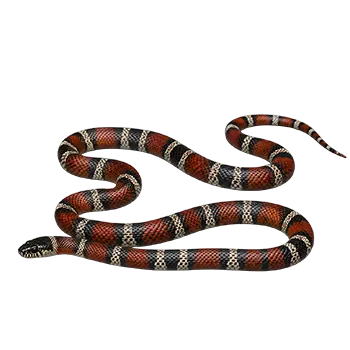

Enrichment in reptile husbandry has undergone a significant conceptual shift in the past two decades. Where once the prevailing philosophy held that snakes required only the basic necessities of heat, water, hides, and prey, contemporary research and keeper experience have demonstrated that environmental complexity has a measurable positive impact on snake behavior, stress levels, and overall welfare. The Eastern Milk Snake, as a naturally curious and exploratory colubrid that occupies diverse microhabitats in the wild, is particularly well-suited to benefit from a thoughtful enrichment program.
In the wild, Lampropeltis triangulum triangulum navigates a complex environment of leaf litter, rock outcrops, fallen logs, root systems, abandoned rodent burrows, and human structures such as old stone foundations and barn walls. Every movement involves sensory engagement — chemical cues detected by the tongue, thermal gradients sensed through labial pits, tactile feedback from varying substrate textures, and visual processing of light and shadow patterns. Captive enclosures that reduce this environmental complexity to a flat substrate, two hides, and a water dish strip away the vast majority of the stimuli the snake's nervous system evolved to process.
The behavioral indicators of under-enriched captive snakes include repetitive pacing along enclosure walls, excessive time spent hidden with minimal exploratory movement, nose-rubbing against glass or screen as the animal attempts to escape a barren environment, and feeding inconsistency. While some of these behaviors can have medical or husbandry causes unrelated to enrichment, their persistence in a snake whose temperature, humidity, and feeding are otherwise correctly managed points toward an environmental deficiency. Adding complexity to the enclosure often produces a visible shift in behavior within days — more time spent exploring, more varied use of the available space, and calmer demeanor during handling.
It is important to distinguish enrichment from clutter. The goal is not to fill every square inch of the enclosure with objects but to create a varied, navigable environment that invites exploration without restricting movement or complicating maintenance. Each enrichment item should serve a functional purpose — providing a climbing surface, a textural contrast, a visual barrier, or a novel scent — and should be positioned to allow the snake unrestricted access to its thermal gradient, water, and hides. Enrichment that forces the snake to navigate an obstacle course to reach its warm hide defeats the purpose entirely.