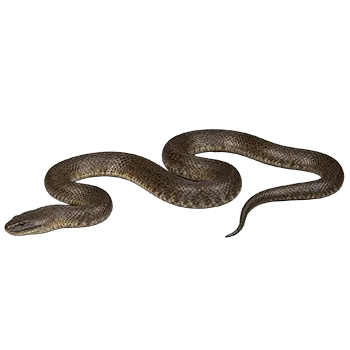

The word toys sits awkwardly on a snake, and it sits especially awkwardly on Cerberus rynchops. Snakes do not play in any sense a mammal keeper would recognize, and no manufactured plaything holds a snake's interest. What snakes unambiguously do have is a behavioral repertoire, and enrichment in this context means constructing an environment that permits the full expression of that repertoire rather than a truncated fraction of it. For a Dog-Faced Water Snake, the relevant behaviors are swimming, submerging, ambush hunting at the water margin, wedging into root tangles, nosing through soft substrate, and climbing into low emergent branches. Enrichment products are the furnishings that make those behaviors possible.
The research literature on reptile welfare has moved decisively in this direction over the last two decades. Studies across multiple squamate taxa have associated barren housing with elevated stress hormone concentrations, stereotypic behaviors such as persistent glass interaction and rail-riding, suppressed feeding response, and reduced immune competence. Conversely, structurally complex enclosures with abundant cover and choice have been associated with more settled behavior, better feeding consistency, and greater use of the total enclosure volume. The mechanism is straightforward: an animal that can control its own exposure and can perform the behaviors it is motivated to perform experiences less chronic stress.
For this species specifically, choice is the organizing principle worth designing around. A well-enriched Cerberus enclosure offers multiple water depths, several distinct thermal zones, more than one usable retreat at each temperature, both submerged and emergent cover, and both open water and dense structure. The snake then selects. The value of that arrangement is not that any single option is optimal but that the animal is never trapped in a suboptimal one, and that its selections over time give the keeper genuine information about whether the enclosure is meeting its needs.
It is also worth being clear about what enrichment is not. It is not a substitute for correct temperature, salinity, humidity, and security, and adding complexity to an enclosure whose base parameters are wrong will not rescue the animal. Enrichment is also not handling. Many keepers of more tractable species treat out-of-enclosure time as enrichment, and for a defensive, rear-fanged, moisture-dependent estuarine snake this reasoning does not transfer. Handling this species is a stressor to be minimized and conducted only when husbandry or health requires it, never as a form of stimulation.